What Is a Stock, Really?
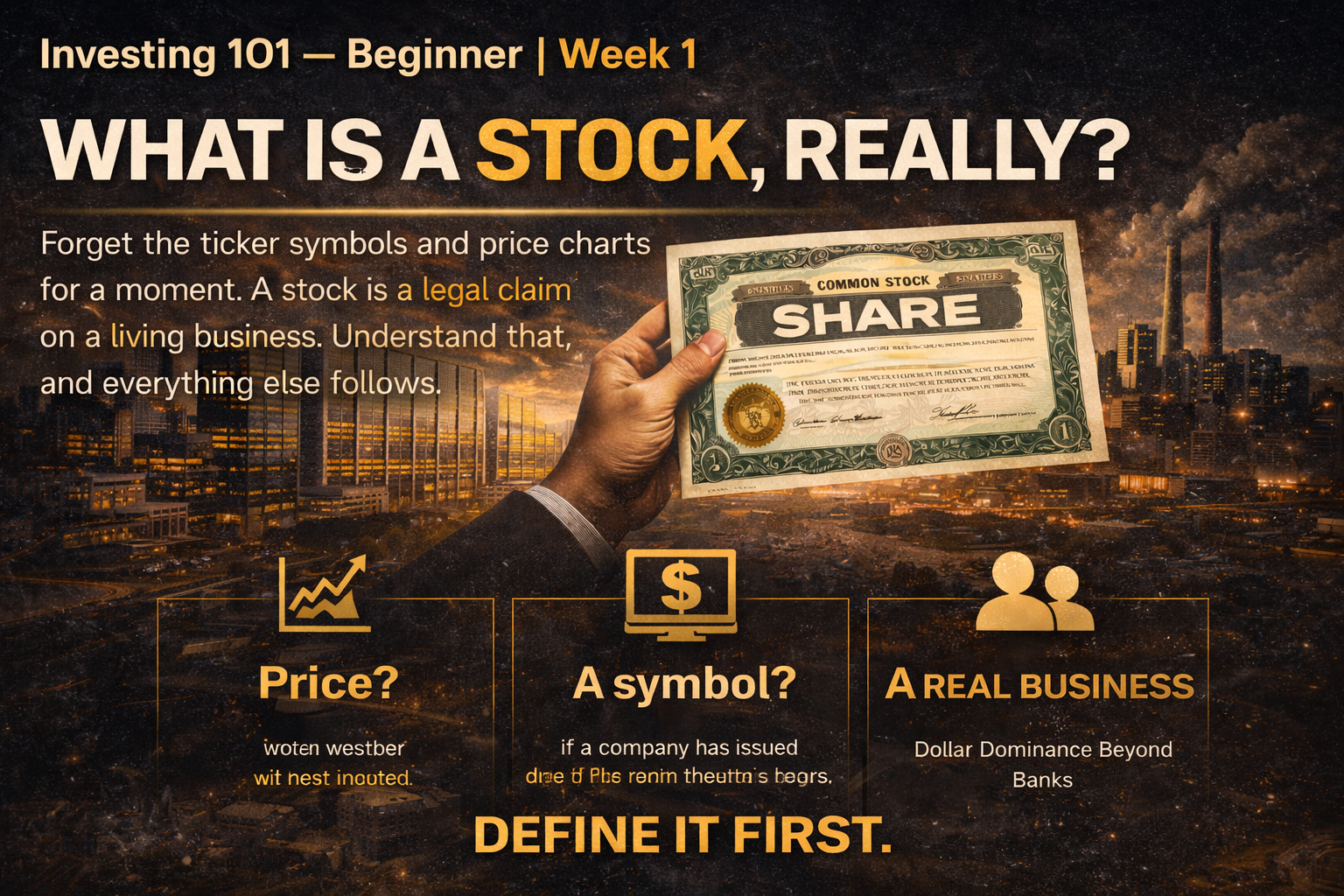
Forget the ticker symbols and price charts for a moment. A stock is a legal claim on a living business. Understand that, and everything else follows.
What Is a Stock, Really?
Most people who "own stocks" cannot actually tell you what a stock is.
They can tell you a price. They can tell you whether it went up or down today. They might even tell you a ticker symbol. But ask them what they actually own when they buy a share of Apple, and the answer usually dissolves into vague gestures about "the company."
This is not a criticism. It is the starting problem. You cannot think clearly about something you have not defined. And if you cannot think clearly about what a stock is, every decision you make about buying, holding, or selling one will be built on air.
So before you open a brokerage account, before you read another headline about the market, before you let anyone tell you what to buy — stop. Define the thing.
A Stock Is a Piece of a Business
Here is the definition stripped to the bone:
A stock is a legal claim on a fractional ownership of a real, operating business.
Every word in that sentence matters.
Legal claim. When you buy a share, you are not buying a number on a screen. You are buying a legally enforceable right — registered with a transfer agent, backed by corporate law, protected by regulators. That right entitles you to a share of everything the business owns and everything it earns, in proportion to how many shares you hold out of the total outstanding.
Fractional ownership. If a company has issued one billion shares and you own one hundred of them, you own one ten-millionth of that company. That sounds trivial, and in one sense it is. But it is also real. You are, by any meaningful definition of the word, one of the owners. Not a lender. Not a customer. An owner.
Real, operating business. This is the part most new investors lose sight of fastest. Behind every ticker symbol is a physical thing — factories, offices, warehouses, code repositories, supply chains, employees showing up to work on Monday. Coca-Cola is not a stock. Coca-Cola is a global beverage operation that happens to have stock issued against it. The stock is the paperwork. The business is the thing.
What Ownership Actually Gets You
If you own a share of a company, you have three specific rights that flow from that ownership.
The right to a share of the profits. When a company earns money, that money belongs to the owners. The board of directors — which the shareholders elect — decides what to do with it. Sometimes they pay it out directly as dividends. Sometimes they reinvest it into the business to grow future profits. Sometimes they buy back shares, which increases the ownership percentage of everyone who still holds stock. All three of these are ways that profits flow to you as an owner.
The right to vote on major decisions. One share usually equals one vote. You vote on who sits on the board. You vote on major mergers and acquisitions. You vote on executive compensation plans. In practice, a hundred shares will not swing a Fortune 500 election. But the right exists, and in aggregate, shareholder votes shape how the company is run.
The right to a share of the assets if the business is sold or liquidated. If the company is acquired, you get paid out at the agreed price. If the company is wound down, you get your proportional slice of whatever is left after creditors are paid. This is usually the last line of defense, and for a failing company it is often worth nothing — but the right is real.
That is it. Three rights. Profits, voting, residual claim. Everything else you hear about stocks is either a consequence of these three, or a distraction from them.
The Market Price Is Not the Business
Here is where almost every new investor gets their first serious concussion.
You buy a share of a company for $100. Two weeks later, the share is trading at $85. You panic. You assume the business has gotten worse by 15 percent.
But in those two weeks, nothing fundamental may have changed about the business at all. The stores are still open. The products are still selling. The employees are still working. The factories are still producing. What changed is not the business — what changed is the market's mood about the business.
The market price of a stock on any given day is the result of millions of people making buy and sell decisions for millions of different reasons. Some are buying because they did careful analysis. Some are selling because they need cash for a medical bill. Some are reacting to a headline they half-read. Some are algorithms trading on patterns that have nothing to do with the underlying company.
The business and the stock price are two different things that travel together over long periods and separate constantly over short ones. A great investor's edge comes from knowing the difference.
Benjamin Graham — Warren Buffett's teacher — put it this way: in the short run, the market is a voting machine, recording popularity. In the long run, it is a weighing machine, measuring actual business value. Both statements are true, and they explain almost everything about how stocks behave.
Why Businesses Issue Stock in the First Place
To understand what you are buying, it helps to understand why the company is selling.
A business needs capital to grow. It can get that capital in two ways. It can borrow it — take out a loan, issue bonds, promise to pay back a fixed amount with interest. Or it can sell ownership — give up a piece of the future profits in exchange for money now.
When a company issues stock, it is choosing the second path. It is saying to the public: give us capital today, and in exchange we will make you a part-owner of everything we build from here forward. We will not promise to pay you back a fixed amount. Instead, we will share whatever we earn, forever, in proportion to your ownership.
That trade is the foundation of the entire stock market. Every listed company on every exchange in the world exists there because at some point it made that trade — usually at its initial public offering, or IPO — and then continued to exist as a publicly owned entity afterward.
You, as a buyer on the secondary market, are not giving money to the company itself (except in rare cases like new share issuances). You are buying shares from a previous owner who wants to sell. But the rights you acquire are identical to the ones the original IPO buyer received. You become a co-owner from the moment the trade settles.
The Two Ways You Make Money as an Owner
Once you own a share, there are exactly two ways that ownership can generate returns for you.
The business distributes profits to you. This happens through dividends, which are direct cash payments, and through share buybacks, which raise the value of each remaining share by shrinking the total supply. Both are the company returning capital to its owners.
The business grows in value, and someone later pays more than you did. If a company earns $1 per share today and grows to earn $5 per share ten years from now, the share price almost always rises to reflect that growth. When you sell to the next buyer, you capture that appreciation as a capital gain.
Most of the famous long-term returns in the stock market come from the second path — compounding growth in underlying business value — with dividends layered on top. That is why stocks historically outperform bonds and savings accounts over long horizons: you are not just lending money, you are participating in the growth of real productive enterprises.
What a Stock Is Not
It is worth naming the misconceptions directly, because each one leads to a specific category of investor mistake.
A stock is not a lottery ticket. Lottery tickets are random-outcome gambles with a negative expected return. Stocks are claims on businesses that produce real economic output and compound that output over decades. The game is completely different.
A stock is not a bet against another trader. When you buy a share at $100, you are not betting that some specific person will be "wrong" and you will be "right." You are acquiring a productive asset. Whether the price goes up or down next week is largely irrelevant to the value you have acquired. What matters is what the underlying business does over the years you hold it.
A stock is not a chart. Chart patterns are visual representations of past price movements. They are sometimes useful as context, but they are not the asset. The asset is the business. A person who trades based purely on charts, with no understanding of what the underlying companies actually do, is playing a different game than an investor — and usually losing at it.
A stock is not safer than a savings account because it is "diversified." A stock is ownership in a real business, which can fail. Individual stocks go to zero. Diversification across many stocks reduces that risk. But a single stock, even a famous one, is not a risk-free instrument. Anyone who tells you otherwise is either confused or selling something.
The Mental Shift That Changes Everything
The most important thing you can do this week — before you open an account, before you pick a single company, before you decide on anything — is to change how the word "stock" feels in your head.
Stop picturing a ticker symbol flashing green and red. Start picturing the thing itself.
A share of Walmart is a slice of every store, every warehouse, every truck, every supply contract, every employee relationship, every customer habit, every piece of real estate that Walmart owns or operates. When you buy that share, you become a small co-owner of that entire physical and commercial apparatus. The share certificate is paperwork. The business is the thing.
A share of Microsoft is a slice of every server farm, every line of code in Windows and Office and Azure, every enterprise contract, every patent, every engineer's ongoing work. You are not buying a symbol. You are buying a fraction of a global software operation.
Once you see stocks this way — as living business ownership rather than abstract market instruments — almost every downstream question becomes easier to answer. How long should you hold? As long as the business continues to be excellent. When should you sell? When the business deteriorates or you need the capital for something more important. How do you pick stocks? By understanding businesses.
This is not a trick. It is not a motivational reframe. It is literally what a stock is. Most of the bad decisions retail investors make trace back to the moment they forgot — or never learned — this basic fact.
What You Should Do This Week
You do not need to buy anything yet. You do not need to open an account yet. You need to do something smaller and more important: you need to internalize the definition.
Pick three companies whose products you use every week. Not companies you have heard are "good stocks." Companies whose products are physically present in your life. Your phone. Your coffee. Your streaming service. Your grocery store.
For each one, write down, in one sentence, what the business actually does. How it makes money. What you are buying when you buy a share. Not the ticker. Not the price. The business.
This exercise sounds too simple to matter. It is not. It is the foundation on which every other skill in this course will be built. If you cannot describe what a company does in a sentence, you have no business owning its stock. And if you can describe it clearly, you have already done more analytical work than most retail investors ever do.
Looking Ahead
Next week, we look at the mechanism that turns these ownership claims into a functioning market. How does a share of Apple get from a seller in Tokyo to a buyer in Ohio in milliseconds? What is actually happening when you click "buy"? What makes a market a market?
Before you can invest, you need to understand the arena you are stepping into. Week 2 covers how the market actually works — not the theory, the plumbing.
For now, sit with the definition.
A stock is a legal claim on a fractional ownership of a real, operating business.
Everything else is detail.
Investing 101 — Beginner Series. Week 1 of 12.
Next week: How the Market Actually Works.
Educational content only. Not investment advice. Always do your own research.