Intel's Great Repricing: Why the AI Inference Era Could Make Intel Matter Again
The easiest way to get Intel wrong in 2026 is to tell one of two oversimplified stories. The first says Intel is finished. The second says Intel is on the verge of a clean comeback. Both are too simple. The real Intel case is more interesting — and more difficult.
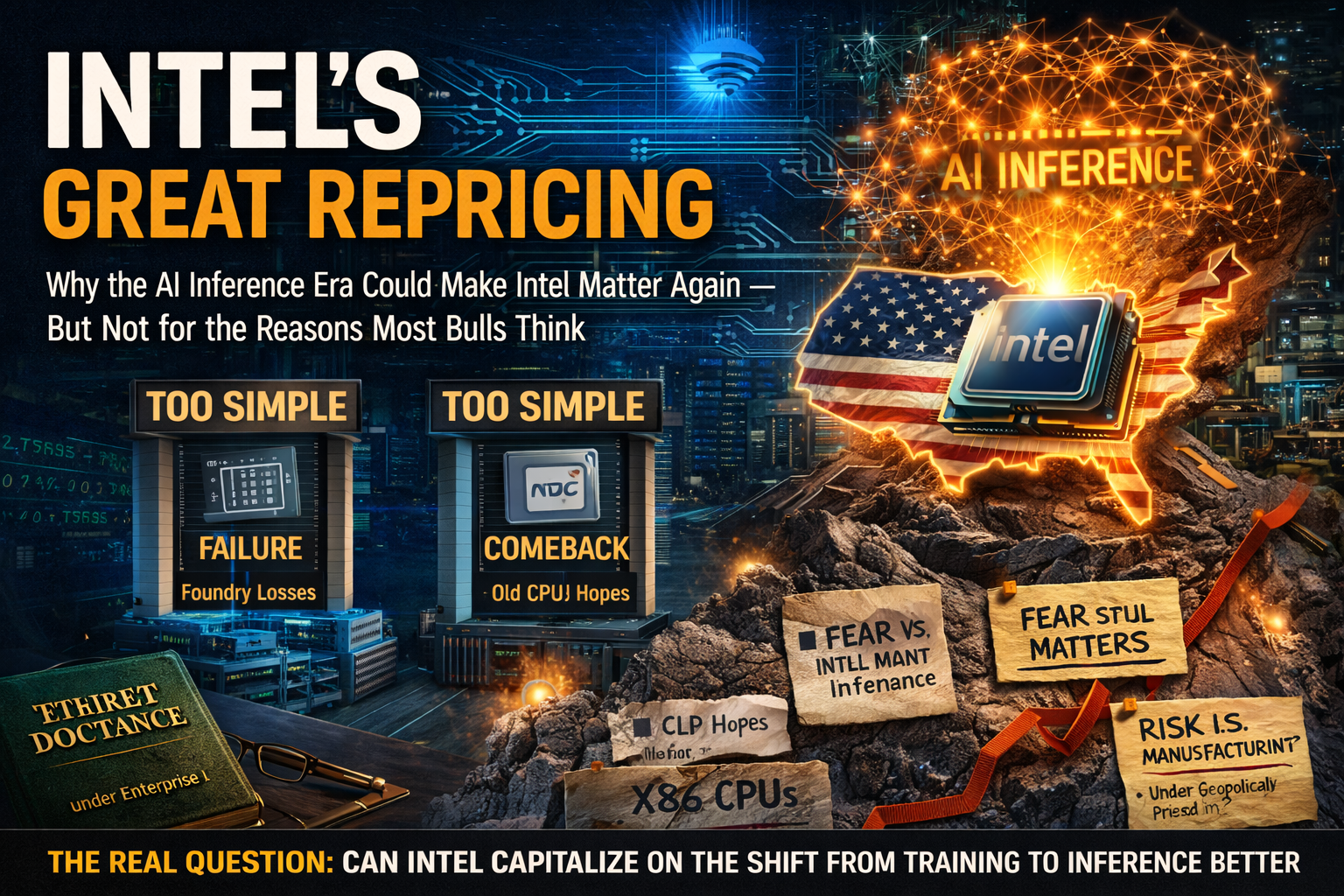
# Intel's Great Repricing
Why the AI Inference Era Could Make Intel Matter Again — But Not for the Reasons Most Bulls Think
The easiest way to get Intel wrong in 2026 is to tell one of two oversimplified stories.
The first is that Intel is finished: too late in AI, too far behind TSMC, too burdened by foundry losses, too structurally broken to matter.
The second is that Intel is on the verge of a clean "comeback" because AI inference will automatically restore the value of CPUs and make the old x86 franchise great again.
Both stories are too simple.
The real Intel case is more interesting, and more difficult.
Our view is straightforward: Intel is not yet a clean AI winner, but it may be one of the most misunderstood second-order beneficiaries of the next AI phase.
The bull case is not really that Intel will beat NVIDIA in accelerators.
It is that the market may be underestimating the value of Intel's CPU franchise, Ethernet/networking position, and U.S.-based manufacturing optionality in a world moving from pure model training toward large-scale inference, orchestration, and enterprise deployment.
The bear case is equally real: Intel Foundry is still deeply loss-making, execution risk remains high, and the company still has to prove that a strategic repositioning can translate into durable shareholder value.
1. Intel Is Not One Story — It's Three
Intel in 2026 is at least three stories happening at once:
The core products story, where client and server CPUs still generate substantial revenue and cash flow.
The AI and data center story, where Intel is trying to remain relevant in a world increasingly defined by accelerators, inference economics, and hyperscaler capex.
The foundry story, where Intel is attempting one of the most ambitious industrial turnarounds in modern semiconductor history by rebuilding itself as a major U.S.-based manufacturing platform.
Investors who reduce Intel to any one of those stories usually miss the valuation tension that makes the stock interesting.
That tension is visible in the company's own reporting. Intel's 2025 annual report says the company remains a global leader in CPU design and manufacturing and explicitly describes Intel Foundry as the segment that develops process technologies, manufacturing, and foundry services for both internal products and external customers.
It also says that, at present, nearly all of Intel Foundry's business still supports internal manufacturing, even though the company aims to build a more significant external foundry business over time.
That is a crucial point:
> Intel today is still primarily a product company funding a foundry ambition, not a mature third-party foundry business generating broad external demand.
2. Why the Inference Thesis Matters — If Framed Correctly
The next phase of AI may be less about giant training clusters alone and more about inference, orchestration, and real-world deployment.
That is directionally right, but it needs to be stated carefully.
It is too strong to say we are moving into a simple "CPU-GPU 1:1 era" as though that were already an industry rule. The better claim is that as AI workloads move from research toward production, the surrounding system architecture matters more:
- CPUs coordinate workloads
- Memory and networking matter more
- Enterprise deployments often value flexibility, latency, integration, and total system economics rather than pure accelerator bragging rights
This is exactly where Intel has a credible angle.
In Intel's Q4 2025 earnings presentation, management said AI is driving significant opportunity across the portfolio, and that demand is outpacing supply across both server and client. More importantly, in the DCAI section, Intel explicitly described demand as "strong [and] sustainable" and said it was "working with customers to support needs beyond 2026."
The numbers back that up.
In Q4 2025, Intel's DCAI segment generated $4.7 billion of revenue and $1.3 billion of operating income — implying a segment operating margin of 26.4%, up sharply from earlier in the year.
That is not a dying franchise.
That is a business that still throws off meaningful profit when demand conditions and product mix cooperate.
3. The Real Intel Bull Case: Not AI Glamour, But AI Plumbing
Most investors want Intel to be an exciting AI story.
That may be the wrong way to think about it.
The stronger Intel bull case is not that it becomes the most glamorous AI company. It is that it becomes one of the most necessary ones in an enterprise AI stack.
That means:
- CPUs
- System orchestration
- Memory bandwidth coordination
- Networking
- Cost-sensitive inference environments where total system efficiency matters more than peak benchmark theater
Intel's value in that world is not as the center of the AI narrative.
It is as part of the infrastructure that makes large-scale AI economically deployable.
This is where the American analogy should be industrial, not sentimental. Intel is not trying to be the Ferrari of AI. The more plausible investment case is that Intel could matter like a rail network or power substation matters — not always the flashy part of the story, but often indispensable to whether the system runs at all.
That is why the "hidden champion of inference" framing has some merit — as long as investors remember that "hidden champion" does not mean dominant winner.
It means a company whose importance may be underpriced relative to the attention it gets.
4. Gaudi Helps the Story — But It Is Not the Core of the Thesis
Intel's Gaudi business is real. The company has continued to push it into enterprise AI deployments.
Intel's May 2025 announcement said Dell's AI platform with Intel Gaudi 3 targets enterprise AI adoption, and Intel claimed Gaudi 3 delivered competitive generative AI price-performance and 70% better price-performance inference throughput of Llama 3 80B over NVIDIA H100 in that specific platform context.
That matters because it shows Intel still has a credible accelerator product for certain workloads and customer profiles.
But investors should not overstate it.
Gaudi is not currently the main reason to own Intel. In fact, past reporting has highlighted Intel's difficulty turning Gaudi into a large-scale AI revenue engine.
The cleaner investment argument is that Gaudi adds optionality and keeps Intel relevant in AI acceleration conversations, but the real near-term value driver remains the x86 server franchise and the company's ability to attach more system-level value to enterprise AI deployments.
5. The Biggest Risk Is Still the Foundry Hole in the Balance Sheet
No serious Intel report can avoid the central problem:
Intel Foundry is still consuming enormous capital and still losing a lot of money.
Intel's 2025 annual report shows Intel Foundry generated $17.8 billion of revenue but posted an operating loss of $10.3 billion for the year, after losing $13.3 billion in 2024.
That is an improvement.
But it is still a massive drag.
This is not a side issue. It is the defining reason why many investors remain skeptical that Intel's operational progress in products will translate into equity upside.
This is where the stock becomes difficult:
- The server CPU business may be healthier than bears admit
- The inference era may indeed raise the strategic value of CPUs and orchestration
- Intel may even have more AI relevance than the market gives it credit for
But if the foundry effort continues to burn capital at this scale without proving external customer traction and execution at advanced nodes, then the market can reasonably argue that Intel is funding an industrial moonshot with a franchise that, while still profitable, is not strong enough on its own to close the gap quickly.
That is the real Intel paradox:
> The company can simultaneously be more operationally relevant than the stock implies and still be less investable than the bullish narrative suggests — simply because the foundry losses remain so large.
6. Why U.S.-Based Manufacturing Still Matters More Than the Market Credits
Even so, one element of the story deserves more respect than it usually gets:
Strategic manufacturing relevance.
Intel's annual report says it remains the only company conducting both leading-edge logic R&D and high-volume manufacturing in the United States.
In a world where supply chain resilience, industrial policy, and sovereign semiconductor capacity matter more each year, that is not a minor detail.
It does not automatically create profits.
But it does create optionality — especially if geopolitical tension, government incentives, or customer diversification away from a single offshore dependency become more important.
This is one reason the Intel story cannot be reduced to a simple value trap or a simple turnaround.
The company still sits at the intersection of three very large themes:
- AI infrastructure
- U.S. industrial policy
- The strategic value of domestic semiconductor production
The market may be right to demand proof before assigning a premium.
But it may also be underpricing how important that combination could become if external foundry traction improves and node execution stabilizes.
7. What the Market Still Misunderstands
The market still tends to price Intel as if it must either return to old monopoly-style dominance or fail.
That is the wrong standard.
Intel does not need to recreate its historical peak position to be an interesting investment.
It only needs to do three things credibly enough:
1. Defend and monetize its still-important CPU franchise
2. Prove that the AI era makes that franchise more valuable than consensus assumes
3. Show that foundry losses can narrow along a believable path toward strategic relevance
If those things happen together, the stock can re-rate even without Intel becoming the undisputed king of AI hardware.
That is the deeper investment insight.
Intel's upside does not require fantasy. It requires a change in framing.
> If investors stop asking "Will Intel win the AI chip race?" and start asking "What role does Intel play in making enterprise AI systems actually work, and how much is that role worth?" — the answer may become much more constructive.
8. What U.S. Investors Should Watch
For American investors, there are four things that matter most now.
First, DCAI profitability and shipment strength. If the segment keeps delivering margins in the mid-20s and Intel continues signaling demand beyond 2026, the CPU franchise will remain much more valuable than the stock's dismissive narrative implies.
Second, actual foundry progress — not rhetoric. Investors should watch for narrowing operating losses, evidence of meaningful external customer wins, and confirmation that advanced-node execution is translating into manufacturable output rather than just roadmap slides.
Third, whether AI inference and enterprise deployments continue to pull on CPU, Ethernet, and system orchestration demand. Intel does not need to dominate accelerators if the broader AI stack increasingly values the categories it already serves well.
Fourth, capital discipline. Intel's challenge is not only technological. It is financial. The company has to prove it can pursue strategic manufacturing ambition without permanently exhausting shareholder patience.
9. Investment Conclusion
The strongest version of the Intel bull case is not that the company suddenly becomes NVIDIA.
That is the wrong comparison, and it leads to the wrong expectations.
The stronger version is this:
> Intel may be one of the most underappreciated infrastructure plays in the next phase of AI — especially if the market begins to value CPUs, orchestration, and U.S.-based manufacturing optionality more highly than it does today.
That does not make Intel low-risk.
It does not remove the foundry problem.
It does not guarantee that Gaudi becomes a major winner or that the company's advanced-node ambitions fully succeed.
But it does mean the simplistic "Intel is irrelevant in AI" narrative is too lazy for serious investors.
Final Line
Intel's comeback, if it comes, will not be powered by hype.
It will be powered by a quieter truth: in the inference era, the companies that keep AI systems running can become just as important as the companies that first made them exciting.
This Deep Dive is part of Brutal Edge's "American Infrastructure Revival" framework series. Related analysis: Velo3D and the New Arsenal (additive manufacturing for defense), JPMorgan and the American Fortress (financial infrastructure).
Share your analysis
Keep it data-driven. No investment advice.
- Keep it data-driven and respectful
- No investment advice (buy / sell / hold)
- No spam, promotion, or solicitation
- No profanity or offensive content
- Violations are automatically removed
Data: Financial Modeling Prep, Alpha Vantage, CoinGecko
NOT investment advice. Always do your own research.