Nike's Long Runway Back: A Premium Brand's Strategic Self-Inflicted Wound
Nike's problem is not that consumers suddenly stopped caring about sportswear. Its problem is that for several years the company behaved as though distribution, product innovation, and brand heat were all more replaceable than they really were. The result was not a normal cyclical slowdown. It was a strategic self-inflicted wound.
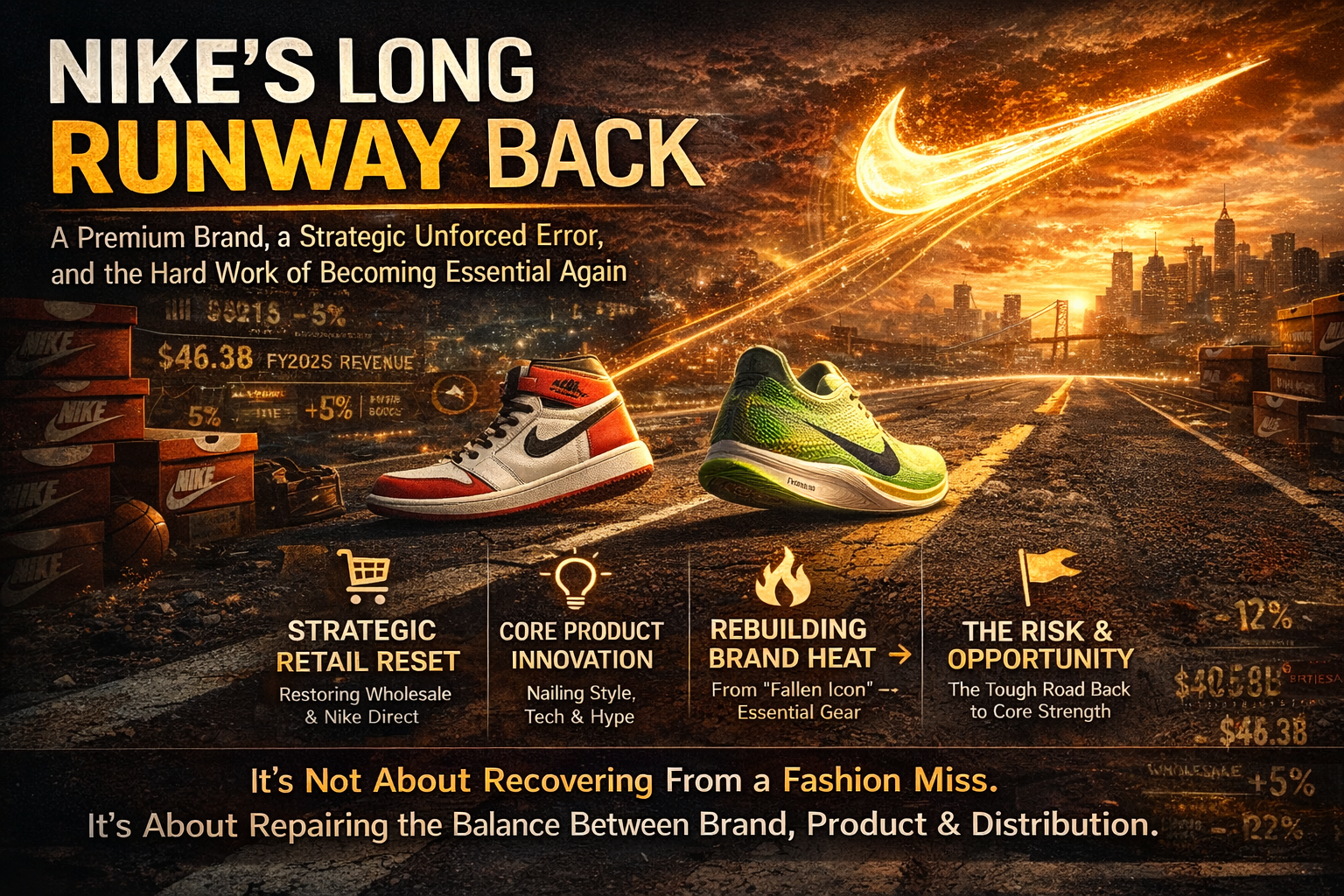
# Nike's Long Runway Back
A Premium Brand, a Strategic Unforced Error, and the Hard Work of Becoming Essential Again
Nike's problem is not that consumers suddenly stopped caring about sportswear.
Its problem is that for several years the company behaved as though distribution, product innovation, and brand heat were all more replaceable than they really were.
The result was not a normal cyclical slowdown.
It was a strategic self-inflicted wound.
Nike's fiscal 2025 full-year revenue fell to $46.3 billion, down 10% reported, while fiscal Q4 2025 revenue fell 12% and NIKE Direct revenue fell 14% in the quarter. In fiscal Q3 2026, wholesale revenue recovered to $6.5 billion, up 5% reported, while NIKE Direct remained weak, at $4.7 billion, down 12%.
That split tells the story: the turnaround is real, but it is incomplete and still being rebuilt through channels Nike previously undervalued.
The most important thing investors should understand is this:
> Nike is not trying to recover from a fashion miss. It is trying to repair a strategic imbalance between brand, product, and distribution.
That is why this stock is more interesting than a simple "fallen icon" narrative suggests.
If the company successfully restores those three pillars in the right order, today's valuation may eventually look more like a reset than a permanent downgrade.
If it fails, then the last decade's dominance may come to be seen as the peak of a model that management itself weakened.
1. The Valuation Collapse Was Real
The stock damage is severe, but it is important to state it accurately.
Nike shares recently traded around $46, versus a 52-week high around $80 and a one-year decline of roughly 22-29%.
That is a major compression, but it is not a total collapse from peak.
The better way to frame it is that Nike has fallen back toward price territory last seen roughly a decade ago — a striking loss of market confidence for what was once treated as one of the great durable consumer brands in America.
The real message of the stock chart is not that Nike has been obliterated like a broken small-cap.
It is that the market has aggressively repriced the company from a premium global growth compounder to a repair story that must prove its old strengths still exist.
That is a more useful interpretation for portfolio decisions.
2. The Core Failure: DTC Was Not the Problem. Treating DTC as a Substitute Was.
The most important strategic mistake Nike made was not choosing direct-to-consumer.
DTC, in itself, was rational:
- Higher margins
- Tighter data loops
- Cleaner consumer relationships
- Better inventory visibility
Those all sound like smart goals.
The mistake was assuming that direct channels could fully replace what wholesale relationships had been doing invisibly for the brand.
Nike's own numbers show the damage.
Fiscal 2025 NIKE Direct revenue fell 13% for the full year, while digital revenue fell 20%.
Meanwhile, the more recent recovery has come first through wholesale, not direct. In fiscal Q2 2026, wholesale revenue rose 8%, and in fiscal Q3 2026 it rose 5%, while NIKE Direct remained down.
That is the market telling Nike something management had to relearn the hard way:
> Wholesale was not just a lower-margin sales outlet. It was a distribution system, a discovery system, and a brand-amplification system.
That is why the company's return to Amazon matters symbolically as much as financially.
The Wall Street Journal reported in 2025 that Nike planned to sell products on Amazon's U.S. site for the first time in more than five years. Modern Retail also reported that Nike's return to Amazon was part of CEO Elliott Hill's broader wholesale rebuild.
Investors should read that not as surrender, but as an admission that omnipresence still matters in consumer brands.
A premium label can lose relevance surprisingly quickly when it makes itself harder to find in the places customers still naturally browse.
3. The Deeper Problem: Product Stagnation Disguised as Brand Strength
The distribution error was fixable.
The more serious problem was that Nike's product machine stopped producing enough urgency.
When a company with Nike's legacy loses momentum, management can be tempted to monetize the archive. That works for a while. Retro franchises, colorway refreshes, limited releases, and collaborations can extend the life of a brand.
But they are not a substitute for new performance-driven product energy.
Once consumers sense that a company is harvesting nostalgia more aggressively than inventing the future, the premium starts to slip.
Nike's reported turnaround under Elliott Hill is increasingly framed around getting back to sport and performance.
The company's Q3 FY26 commentary highlighted growth in North America and said that Nike is "moving through" its reset, while the current management team has repeatedly emphasized renewed focus on sport, wholesale partnerships, and product innovation.
Those talking points matter because they indicate the company itself now understands that the next phase of recovery will not be won by marketing language alone.
It has to be earned through product that athletes and consumers actually want to choose over Hoka, On, Brooks, Adidas, and emerging local champions.
The right way to put this for investors is simple:
> A brand as large as Nike can survive temporary fashion fatigue, but it cannot indefinitely survive innovation fatigue.
4. China Was Not Just a Macro Headwind
Many U.S. investors still treat China weakness as a temporary geographic drag.
For Nike, it is more revealing than that.
In fiscal Q3 2026, Nike Brand revenue declined in Greater China, and the company's earlier fiscal 2025 results showed declines across all geographies.
This is important because China used to function as both a growth market and a prestige validator for global consumer brands.
If Nike loses pricing power and cultural relevance there at the same time domestic brands grow stronger, that is not just a quarterly headwind.
It is a test of whether the brand still travels with the same force it once did.
I would not reduce the China problem to geopolitics alone, even though geopolitics matters.
The bigger issue is that local competitors are no longer weak, generic substitutes.
They are improving in design, product localization, and national resonance. A premium global brand can no longer assume that scale alone will protect its share.
For American investors, that means China should be watched not only as a revenue line but as a referendum on Nike's ability to remain aspirational in a market where local competition is smarter and more emotionally native than it was ten years ago.
5. Why Elliott Hill's Return Matters
One of the most positive changes in the story is leadership.
Modern Retail described Elliott Hill as a company veteran brought back to push the wholesale turnaround, and the company's recent earnings progression suggests that reset is beginning to show up in channel mix.
That matters because Nike's challenge is not conceptual anymore.
The company already knows what it did wrong.
The challenge is operational: re-earning floor space, rebuilding retailer trust, restoring product cadence, and repairing inventory discipline without permanently damaging the premium brand.
Turnarounds in premium consumer brands usually fail for one of two reasons:
1. Management tries to do too much at once and confuses the consumer
2. Management underestimates how long it takes to rebuild muscle memory inside a large organization
Hill's advantage is that he is not trying to reinvent Nike as a different type of company.
He appears to be trying to make Nike behave more like the best version of itself again.
That sounds obvious, but it is actually the hardest part of any recovery:
> Not chasing novelty, but restoring coherence.
6. What the Current Numbers Actually Say About the Comeback
The market should pay attention to one encouraging fact:
The early signs of recovery are showing up first where they should.
- Wholesale is improving
- North America is helping
- The company is rebalancing away from overdependence on direct channels
In Q2 FY26 wholesale revenue grew 8%, and in Q3 FY26 it grew 5%, primarily due to North America. By contrast, NIKE Direct remained down in both quarters.
That is not weakness disguised as recovery.
It is evidence that management is reopening the consumer funnel and accepting that channel health matters before direct economics fully recover.
That does not mean the turnaround is complete. It means it has begun in the right place.
Investors should remember that when brands break their distribution architecture, recovery usually looks messy at first. Margin repair can lag because the company has to re-earn demand, normalize inventory, and sometimes sacrifice near-term cleanliness to rebuild reach.
The current setup is therefore not a "clean beat-and-raise" story.
It is a sequencing story.
7. The Real Investment Question: Can Nike Become Culturally Necessary Again?
This is the deepest question in the report, and it matters more than quarterly EPS.
Nike does not need to be perfect to recover. But it does need to become more necessary again — on the shelf, in sport, and in culture.
That means three things:
1. Restore product authority in performance, not just lifestyle.
2. Keep repairing wholesale relationships without giving away too much margin power.
3. Prove that its brand can still generate desire in a market where newer brands feel fresher and more specific.
If Nike succeeds on those three fronts, then the market will likely stop valuing it as a broken premium brand and start valuing it as a repaired global franchise with unusually high operating leverage.
If it fails, then the stock can remain optically cheap for a long time without truly becoming attractive.
8. Final Verdict
Nike's fall was not caused by one bad quarter, one weak product cycle, or one noisy geopolitical environment.
It was caused by a strategic overreach: management tried to modernize the economics of the business faster than it protected the mechanisms that made the brand powerful in the first place.
That error showed up in:
- Weaker direct growth
- Damaged wholesale presence
- Inventory stress
- A product pipeline that no longer felt urgent enough to compensate
But this is not a hopeless story.
It is a demanding one.
Nike still has scale, global recognition, distribution relevance, and the financial resources to fix what it broke. The early recovery in wholesale suggests management is finally prioritizing reality over theory.
The next phase depends on whether it can pair that channel reset with enough product innovation and cultural energy to make consumers care again.
Our opinion is constructive, but conditional.
Nike is no longer a "set it and forget it" premium compounder.
It is a high-quality repair story.
Those can become great investments — but only when the repair is real.
Final Line
Nike's comeback will not be won by reminding the world what it used to be.
It will be won by proving that performance, distribution, and cultural relevance can still belong to the same company.
This Deep Dive is an independent analysis from Brutal Edge, focused on structural turnarounds in premium consumer brands.
Share your analysis
Keep it data-driven. No investment advice.
- Keep it data-driven and respectful
- No investment advice (buy / sell / hold)
- No spam, promotion, or solicitation
- No profanity or offensive content
- Violations are automatically removed
Data: Financial Modeling Prep, Alpha Vantage, CoinGecko
NOT investment advice. Always do your own research.