
Ethereum Special Report: Is ETH a Recovery Asset or a Re-Rating Asset in 2026?
ETH at $2,220 — 55% below ATH. Special report covering ETF flows, staking wrappers, macro environment, Pectra protocol upgrades, L2 value capture problem, and year-end scenarios. Is ETH repricing or re-rating?
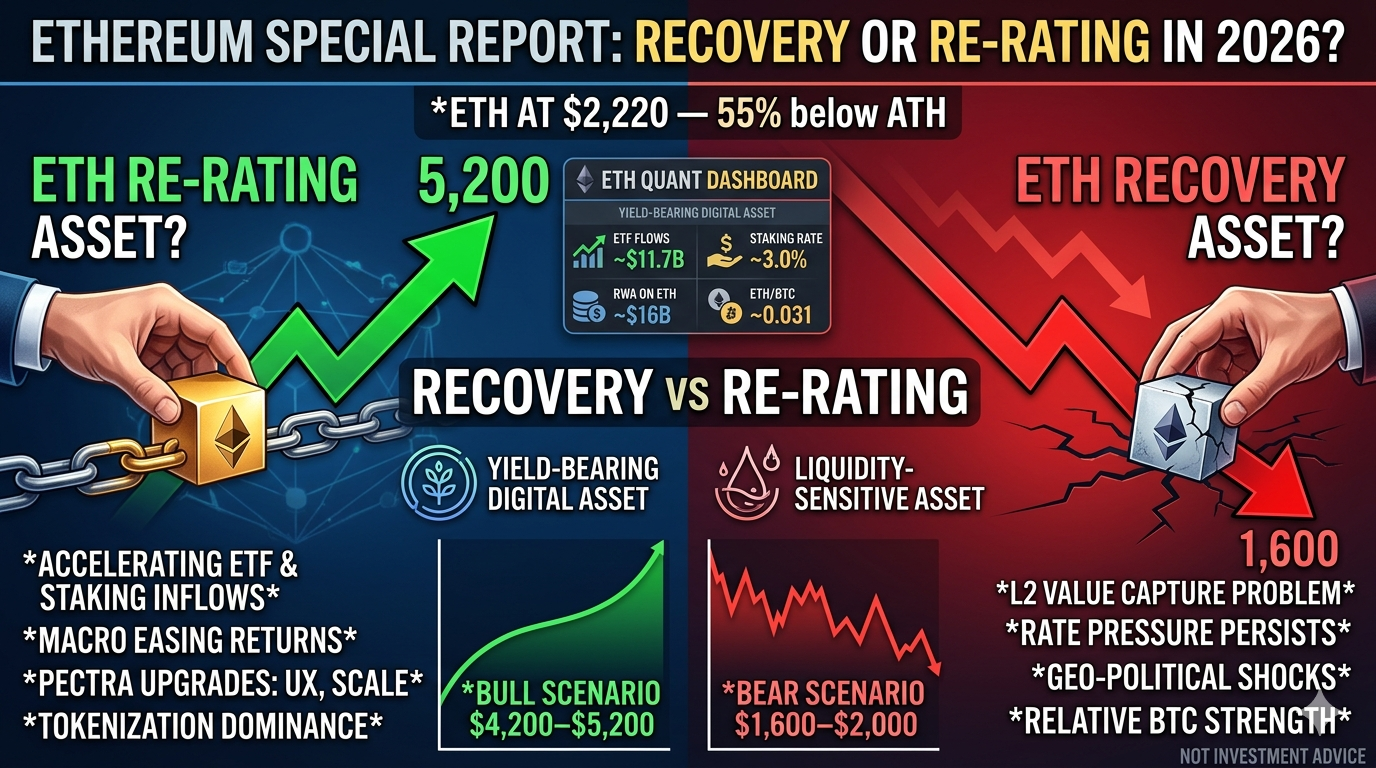
Ethereum is not simply a store of value. It simultaneously serves as network fuel, staking collateral, L2 settlement asset, and the base asset of tokenization infrastructure. This is why ETH is more sensitive to the macro environment than Bitcoin. When rates are high and liquidity is tight, ETH gets compressed. When rate pressure eases and institutional demand returns, ETH can re-rate more aggressively than BTC.
1. Executive Summary
If Bitcoin is being repositioned as a "digital reserve asset" in 2026, Ethereum is undergoing a more complex test. ETH is not simply a store of value — it simultaneously serves as network fuel, staking collateral, L2 settlement asset, and the base asset of tokenization infrastructure. This is why ETH is more sensitive to the macro environment than Bitcoin. When rates are high and liquidity is tight, ETH gets compressed. When rate pressure eases and institutional demand returns, ETH can re-rate more aggressively than BTC.
Coinbase and Glassnode noted in their Q1 2026 report that traditional cycle signals for ETH have lost much of their explanatory power, and that liquidity conditions and relative positioning will matter more going forward.
There are three reasons to pay attention to ETH right now. First, the US spot ETH ETF market has already reached meaningful scale. Second, staking-enabled ETFs are transforming ETH from "a coin with no yield" into a yield-bearing digital asset available inside brokerage accounts. Third, Ethereum remains the dominant network for stablecoins and tokenized real-world assets (RWA). The problem for ETH in 2026 is not a lack of technology — it is whether that technology and network dominance will translate into token price recovery.
2. Why ETH Matters Now
Cumulative net inflows into US spot ETH ETFs have reached approximately $11.698 billion. On April 10, 2026 alone, total net inflows were +$64.9 million (Farside data). BlackRock's ETHA has accumulated $11.731 billion in cumulative inflows, while Grayscale's ETHE has recorded -$5.18 billion in cumulative outflows. The message is clear: ETH is no longer an asset that circulates only within crypto exchanges — it is an asset where new capital is flowing in and legacy products are being replaced within traditional securities infrastructure.
The more important development is the emergence of staking wrappers. BlackRock's iShares Staked Ethereum Trust ETF (ETHB) launched on February 18, 2026, and had net assets of $503.6 million as of April 10. BlackRock describes ETHB as providing investors with exposure to ether's price movement as well as participation in monthly income based on staking rewards. For the first time, ETH is being marketed in the language of traditional finance as a yield-bearing crypto asset.
ETF infrastructure is also improving. According to SEC filings, as of February 2026, in-kind creation and redemption has been permitted for cryptocurrency ETPs listed on NYSE Arca. The Grayscale Ethereum Staking Mini ETF explicitly states in its filings that the "Staking Condition" has been satisfied. ETH ETFs are evolving from simple cash wrappers toward more efficient creation/redemption structures combined with staking components.
3. The Business Model: What ETH Actually Is in 2026
ETH in 2026 performs four roles simultaneously: gas asset, collateral asset, staking asset, and settlement asset. Ethereum's supply is not fixed — it moves through the interaction of Proof-of-Stake issuance and EIP-1559 fee burning. ETH is not just an asset with a "scarcity narrative" — it is a productive asset where increased usage leads to more burning and increased security demand leads to more staking lockups.
Ethereum's strength is simultaneously its weakness. The protocol's rollup-centric scaling strategy means rollups are currently 5–20x cheaper than mainnet. This is clearly advantageous for ecosystem growth — but for investors, it raises a question: if L2s succeed too well, will L1 fees and ETH burning be maintained at sufficient levels? This is precisely why Coinbase and Glassnode pointed out that "L2 fee compression and evolving network economics have weakened traditional cycle analysis for ETH."
The investment question for ETH today is not "does Ethereum matter?" The market already knows it matters. The real question is: how much of Ethereum's importance flows back into the ETH token's value?
4. Macro Environment: Interest Rates and Liquidity Determine ETH
At the March 2026 FOMC meeting, the Fed held its policy rate at 3.50%–3.75% and stated that inflation remains "somewhat elevated" and that the economic impact of the Middle East situation is "uncertain." The March CPI, released on April 10, came in at +0.9% month-over-month and +3.3% year-over-year. This combination is not a clean environment for risk assets, particularly high-beta assets like ETH.
This is also why ETH faces a harder path than Bitcoin. Bitcoin is increasingly gaining a "reserve asset" framing, while ETH is still evaluated as a growth-oriented network asset. When real interest rates are high or inflation re-accelerates, ETH can see its valuation compressed despite having "good technology." In 2026, Ethereum is essentially trading like a duration asset. Conversely, if CPI stabilizes and easing expectations revive, ETH can respond more elastically than Bitcoin, backed by ETF and staking demand.
5. Geopolitics: ETH Can No Longer Avoid Global Politics
One more characteristic ETH has shown this spring is that it no longer moves solely on "crypto-internal events." Immediately after the US-Iran two-week ceasefire announcement on April 8, international oil prices fell sharply below $95 per barrel and global equity markets rallied significantly. Markets remain cautious about the possibility of resumed conflict and Hormuz uncertainty.
ETH thrives in risk-on environments and gets compressed first when energy shocks and inflation fears intensify. Even if Ethereum's fundamentals are strong, if geopolitics pushes oil prices higher and reignites inflation expectations, ETH can respond more to macro forces than to technology in the short term. Conversely, if oil prices stabilize and tensions continue to ease, ETH is one of the first large digital assets to benefit from "rate fear relief." In 2026, ETH is trading like a policy-sensitive digital infrastructure asset.
6. Fundamental Engine: Pectra, Staking, Burning, and Tokenization
On the protocol side, Ethereum has not stopped building. The Pectra upgrade was activated on mainnet in May 2025 with three key changes:
- EIP-7702: EOA-based account abstraction — enables transaction batching, gas sponsorship, alternative authentication, and recovery mechanisms for existing wallets
- EIP-7251: Raises validator maximum effective balance from 32 ETH to 2,048 ETH — reduces validator count and improves network efficiency
- EIP-7691: Increased blob throughput for L2 scalability
Pectra bundled user experience improvement, staking efficiency improvement, and L2 scalability enhancement into a single release. The Ethereum Foundation's 2026 Protocol Priorities restructured its framework into three core tracks: Scale, Improve UX, and Harden the L1. Ethereum is no longer simply competing on performance — it is simultaneously pursuing scalability, usability, and core stability.
The staking structure remains strong. The ETH.STORE reference rate shows a recent Ethereum staking reference yield of approximately 3.003% p.a., with an effective balance total of roughly 36.8 million ETH. Ultrasound Money reports approximately 38.8 million ETH in staking, 9.1 million ETH in contracts, and 4.6 million ETH burned. A significant amount of ETH is locked outside the liquid market.
Ethereum's strongest long-term thesis: it currently hosts approximately $16.08 billion in tokenized real-world assets and approximately $168.52 billion in stablecoins (RWA.xyz). Ethereum is not just a DeFi chain — it remains the primary settlement layer where tokenized dollars, treasuries, and financial contracts are most heavily deployed. ETH's price may be struggling, but the network's institutional connectivity remains the deepest in crypto.
7. Quant Check: The Market Is Not Happy Yet
ETH is at approximately $2,220, ETH/BTC at roughly 0.031, and the price sits approximately 55% below its all-time high. This is not a simple pullback — it means the market is still applying a discount to ETH's structural value capture ability. BlackRock ETHA's total return was -29.32% YTD as of March 31. Despite the recent bounce, ETH in 2026 is not yet a "strong asset" — it is an asset recovering from weakness.
The derivatives market does not show full optimism either. CME Ether Futures open interest was 30,050 contracts with volume of 22,463 contracts on the April 8 trading day. Deribit Insights noted in mid-March that Ethereum's realized volatility had calmed to approximately 70 but remained higher than Bitcoin's, while the ETH/BTC ratio was compressing around 0.029. ETH is not a trendless asset — it is an asset waiting for direction.
Market structure itself, however, has improved. Coinbase and Glassnode assessed that the digital asset market entered 2026 with a "cleaner structure" following the 2025 leverage liquidations. But BTC dominance is holding around 59% and institutions continue to show large-cap preference amid geopolitical uncertainty. ETH's problem is not that it is a "bad asset" — it is that it has not yet earned higher conviction than Bitcoin.
ETH Quant Dashboard
| Metric | Latest Reading | Interpretation |
|---|---|---|
| ETH spot | ~$2,220 | Held $2K but no strong trend breakout yet |
| Market cap | ~$275.9B | Still the #2 digital asset by market cap |
| ETH/BTC | ~0.031 | Relative strength remains weak |
| Distance to ATH | ~-55% | Closer to recovery phase than overheating |
| US spot ETH ETF cumulative net flow | ~$11.7B | Institutional channel already at meaningful scale |
| BlackRock ETHA net assets | ~$6.86B | Core channel for traditional capital inflow |
| BlackRock ETHB net assets | ~$503.6M | Early confirmation of staking wrapper demand |
| Staking reference rate | ~3.0% p.a. | Strengthening ETH's "productive asset" character |
| Effective balance / staked ETH | ~36.8M–38.8M ETH | Liquid supply is smaller than it appears |
| CME Ether Futures OI | 30,050 contracts | Institutional price discovery continues expanding |
Data sources: CoinGecko, Farside, BlackRock, beaconcha.in, Ultrasound Money, CME
8. The Bull Case
The core of the ETH bull case is surprisingly simple: even if rates just stop getting worse, ETH can re-rate faster than expected. The Fed's March statement called the economic impact of the Middle East "uncertain," and if oil price stability continues, markets may begin reassessing the possibility of rate cuts resuming within 2026. If inflation cools again after April and oil normalizes, ETH has significant room to shed its "high-rate victim" label and trade again as a growth-oriented digital asset.
Structural demand is building piece by piece. ETHA has already become a large spot ETF. ETHB is transforming ETH into an asset capable of monthly income. At the protocol level, EIP-7702 and UX improvements, the Scale track, blob expansion, and validator efficiency upgrades are all progressing simultaneously. And in the real world, tokenized treasuries and stablecoins continue to settle most heavily on Ethereum.
If this combination works, ETH can shift from simply being the "altcoin leader" to being re-rated as a yield-bearing digital infrastructure asset with a new multiple.
My bull scenario sees ETH recovering to the $4,200–$5,200 range by year-end. The conditions are threefold: macro easing, accelerating ETF/staking inflows, and stabilization or recovery of the ETH/BTC ratio. For ETH to reclaim its all-time high, markets need to agree not just that "Ethereum is important" but that "the ETH token is also important."
9. The Bear Case
The bearish arguments are equally formidable. The greatest risk is persistently high interest rates. March CPI came in hot again and the Fed continues to describe inflation as "somewhat elevated." If geopolitics deteriorate further and oil prices resume their climb, ETH will get hit like a tech stock — and harder than Bitcoin. In 2026, ETH is not a "safe asset" — it remains substantially a liquidity-sensitive asset.
The second risk is the paradox of L2 success. Ethereum's scaling strategy may well be correct. But the more efficiently rollups operate at lower cost, the less mainnet fees and ETH burning may return to previous levels. This is precisely what Coinbase and Glassnode meant by "fee compression on L2s and evolving network economics." The network grows, but token value does not accrue through the old mechanisms.
My bear scenario for this year is the $1,600–$2,000 range. The conditions are: inflation re-acceleration, Fed holding or turning hawkish for an extended period, Middle East re-escalation, and further ETH/BTC weakness. In this scenario, ETH does not collapse — but the "looks cheap" state can persist for a long time. The most common mistake ETH investors make is believing that being cheap automatically means it will rise soon.
10. 2026 Year-End Outlook
Scenario analysis based on current price, ETF flows, macro environment, staking, and network economics. Think of these not as price targets but as a framework showing which ranges are reasonable under which conditions.
| Scenario | Probability | 2026 Year-End Range | What Needs to Happen |
|---|---|---|---|
| **Base case** | 50% | $2,800–$3,600 | Inflation cools gradually, rates stay high but don't worsen, ETF inflows maintained, ETH/BTC finds a floor |
| **Bull case** | 25% | $4,200–$5,200 | Oil stabilizes, easing expectations return, ETF/staking flows accelerate, account abstraction and tokenization demand connect to price narrative |
| **Bear case** | 25% | $1,600–$2,000 | Inflation re-accelerates, geopolitics deteriorate, ETH value capture debate intensifies, BTC dominance persists |
The takeaway is clear. The base path for ETH this year is recovery — but not an automatic new all-time high. For ETH to become a strong asset, markets need to agree not just that "Ethereum is important" but that "the ETH token is also important." 2026 is the year that proof must be delivered.
11. Brutal Edge Verdict
ETH is harder than Bitcoin. But that difficulty is also what makes it an opportunity. Bitcoin is simple — supply and demand, policy and reserve asset framing. ETH requires simultaneously evaluating macro conditions, policy, network usage, L2 structure, staking, and ETF wrappers. That is why ETH is always "the asset that takes longer to explain." And the market raises the discount rate as explanations get longer.
Ethereum remains the most important digital application layer. But ETH has not yet recaptured the full value of that importance in its token price.
To put it more bluntly:
ETH in 2026 is not an asset that looks good right now — it is an asset that could look very good if it proves its case.
My stance on ETH for this year comes down to one sentence:
Long-term constructive. Short-term macro-dependent. Year-end biased toward recovery — but without blind faith.
12. Sources & Methodology
This report was prepared as of April 12, 2026. Price and market cap data from CoinGecko. ETF fund flows from Farside. ETF structure and asset data from BlackRock. ETF infrastructure changes from SEC filings. Interest rates and CPI from the Federal Reserve and Bureau of Labor Statistics. Geopolitical variables from AP. Protocol roadmap and upgrades from the Ethereum Foundation and ethereum.org. Staking yields from beaconcha.in. Supply and burn data from Ultrasound Money. Derivatives data from CME and Deribit. Tokenization and stablecoin network dominance from RWA.xyz. Scenario price ranges are author estimates based on the above sources.
For informational and educational purposes only. NOT investment advice. Always do your own research before making investment decisions.
About ETH
Share your analysis
Keep it data-driven. No investment advice.
- Keep it data-driven and respectful
- No investment advice (buy / sell / hold)
- No spam, promotion, or solicitation
- No profanity or offensive content
- Violations are automatically removed
Data: Financial Modeling Prep, Alpha Vantage, CoinGecko
NOT investment advice. Always do your own research.