Navitas Semiconductor (NVTS): The Hidden AI Infrastructure Bet Nobody Priced
NVTS at $1.54B market cap on $7.3M quarterly revenue. NVIDIA-linked 800V HVDC architecture play. Everyone bought the GPU story. Nobody's pricing the power bottleneck. BEAF: Speculative — Not Rated.
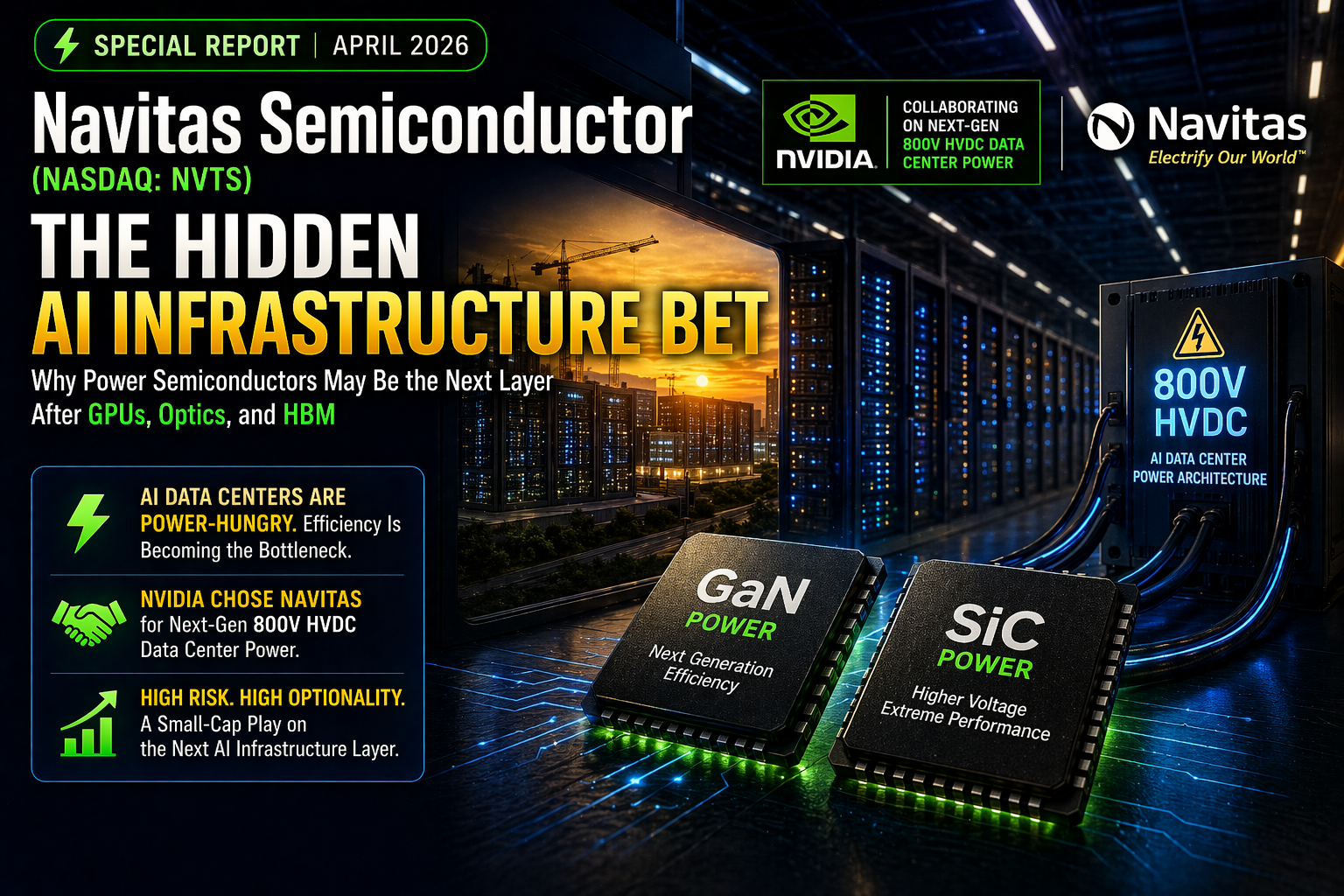
# Navitas Semiconductor (NVTS): The Hidden AI Infrastructure Bet Nobody Priced
The Number
$1.54 billion.
That's Navitas Semiconductor's market cap on $7.3 million in Q4 2025 revenue. A 211x trailing EV-to-revenue ratio on a company that just lost money. For context, NVIDIA trades at 28x. AVGO at 22x. MRVL at 17x.
Either NVTS is the most mispriced company in the AI supply chain, or it's a fever dream priced on one press release.
This report argues it's mostly the first. But just barely.
Executive Summary
The AI trade went through three phases. GPUs in 2023. HBM and networking in 2024. Optics and advanced packaging in 2025. Each phase minted a handful of winners: NVIDIA, AVGO, Micron, Coherent, ASML.
The market is now asking what's next. The consensus answer is "more of the same — scale up what worked."
The Brutal Edge take is different: the next bottleneck isn't compute. It's electricity delivery inside the rack. And the companies selling picks and shovels to solve that problem have not yet been repriced.
Navitas Semiconductor is the highest-beta expression of that thesis. Not the safest. Not the largest. But the most exposed to the single question that will decide whether AI data centers scale past 1 MW racks: who builds the power architecture that doesn't melt?
The NVIDIA partnership is real. The 800V HVDC architecture is real. The GTC 2026 demo board is real. But the revenue isn't — and won't be — until 2027 at the earliest.
Brutal Edge Verdict: This is a call option on a bottleneck that the market hasn't priced. High conviction on the thesis. Low conviction on the timing. Speculative by any honest definition.
1. What Actually Happened While You Were Watching NVDA
Between 2023 and 2026, NVIDIA went from $500B to $4.2T market cap. A 740% move. Broadcom quadrupled. Coherent tripled. Every semiconductor name with an AI angle repriced.
Navitas did not.
```
NVDA: +740% (2023 low to 2026 peak)
AVGO: +400%
MRVL: +280%
COHR: +220%
NVTS: -45% (versus 2021 IPO levels)
```
That divergence is the setup. The question is whether it reflects a real problem — or a market that hasn't figured out the power layer yet.
The honest answer is: both. NVTS underperformed because mobile fast-charging was a bad business and the pivot was painful. But the market also hasn't priced what happens when AI racks move to 800V HVDC and the entire power architecture inside the data center gets rebuilt.
That gap is the opportunity. It's also the risk.
2. The Bottleneck Nobody Talks About
Every AI narrative you've read focuses on compute. GPUs per rack. HBM per GPU. Bandwidth between racks. Transistor count.
None of it matters if you can't power the thing.
Here's what's actually happening inside a modern AI data center:
Power density per rack:
- 2020: 10-15 kW
- 2023: 40-60 kW (H100 era)
- 2025: 120-150 kW (Blackwell era)
- 2027 target: 1,000+ kW (Rubin-era AI factories)
A 100x increase in power density in seven years. Every watt has to be delivered, converted, and cooled. Every conversion step creates heat. Every meter of copper creates loss.
The industry response so far has been "more of everything" — more copper, more cooling, more substations. That approach breaks at about 1 MW per rack. Beyond that, you have to rearchitect the entire power distribution system.
Goldman Sachs: data center power demand up 165% by 2030.
McKinsey: 171–219 GW of new data center capacity needed by 2030, stretch case 298 GW.
IEA: electricity demand from data centers growing at the fastest rate since the industrial era.
These aren't bullish forecasts. They're physical constraints. Unless someone rebuilds power delivery, AI scaling hits a wall measured in amps, not flops.
3. 800V HVDC — The Architecture Change Nobody Bought Yet
In May 2025, NVIDIA did something that should have been front-page news in the semiconductor world.
They announced that future AI data centers would convert 13.8 kV AC from the grid directly to 800V HVDC at the perimeter, using solid-state transformers. No intermediate 480V conversion. No 48V DC bus at the rack level. Straight from high-voltage AC to high-voltage DC to the load.
Why?
Copper math. Power = voltage × current. Raising voltage lets you transmit the same wattage with less current. Less current means less copper. Navitas claims the 800V architecture reduces copper usage by 45%.
At hyperscaler scale, copper savings of 45% isn't a line item. It's a difference of tens of millions of pounds of copper per data center. And copper isn't cheap anymore.
Efficiency math. Every conversion step loses 2-5% to heat. The traditional architecture (AC → 480V → 48V → 12V → 0.8V) has four conversion steps. An 800V direct-to-load architecture can collapse this to two. Two steps saved × 3% loss each = 6% efficiency gain at rack level.
6% of 1 MW = 60 kW. 60 kW × 8,760 hours/year × $0.10/kWh = $52,560 saved per rack per year.
Multiply by thousands of racks per hyperscale facility. The economics compel the architecture change.
But nobody is shipping 800V-native power electronics at AI scale yet. That's the gap. And that's where Navitas lives.
4. Why GaN and SiC Aren't Commodities
The market treats "power semiconductors" as a commodity. Plot twist: the companies that will win the next decade aren't the ones making the most transistors. They're the ones whose devices work reliably at 800V, 1200V, and beyond.
Silicon (traditional):
- Max efficient voltage: ~650V
- Switching speed: slow
- Efficiency at high load: poor
- Market share in new data center designs: declining
GaN (Gallium Nitride):
- Sweet spot: 100V–900V
- Switching speed: 10–100x faster than silicon
- Efficiency: 97–99% in optimal designs
- Where it wins: high-frequency conversion, compact power supplies, rack-level distribution
SiC (Silicon Carbide):
- Sweet spot: 600V–10 kV
- Switching speed: fast
- Thermal handling: excellent
- Where it wins: industrial power, grid conversion, data center front-end (13.8 kV → 800V)
Navitas sells both. That's the unusual part. Most pure-plays are either GaN (like EPC Semiconductor) or SiC (like Wolfspeed). Navitas is building a full-stack capability.
If 800V HVDC architectures require BOTH high-voltage SiC at the front-end AND high-frequency GaN at the load side, then Navitas sits in a rare structural position. That's the bull case in one sentence.
Market projections:
- Power GaN market: 6x growth by 2030 (Yole Développement)
- SiC market: $3.83B (2025) → $12.03B (2030), 25.7% CAGR (MarketsandMarkets)
- Combined wide-bandgap semis: CAGR 23-27% through 2030
The demand is real. The question is capture rate.
5. The NVIDIA Partnership — What It Actually Means
Here's what the press release said:
> NVIDIA selected Navitas to collaborate on next-generation 800V HVDC data center power infrastructure.
Here's what investors need to understand:
This is not an exclusive contract. NVIDIA announced similar collaborations with Infineon, Vicor, and Delta Electronics. If you think NVTS alone owns this relationship, you're wrong.
This is also not nothing. Being in the reference architecture for Rubin-era AI factories is meaningful. NVIDIA doesn't name partners lightly for this kind of systems-level design work.
The right framing: NVTS is one of four to six companies with legitimate 800V HVDC design-in positions. Among them, NVTS is the smallest and most concentrated on the theme. That makes it the highest beta — both directions.
At GTC 2026, Navitas unveiled an 800V-to-6V direct conversion board with 96.5% efficiency. This bypasses the traditional 48V intermediate bus entirely. It's the kind of technical achievement that doesn't show up in this quarter's revenue but shapes who gets designed in for 2027-2028 rack architectures.
Design wins in semiconductors work on 2-3 year lead times. Today's architecture decisions determine 2028's revenue. Today's revenue reflects 2023-2024 architecture decisions.
That's why NVTS trades on 211x revenue. The market is guessing at 2028.
6. The Numbers — Brutally Honest
| Metric | Q4 2025 | Q1 2026 guidance |
|---|---|---|
| Revenue | $7.3M | $8.0–8.5M |
| YoY change | -59% | Still negative |
| Gross margin | ~36% | Trending up |
| Operating loss | Significant | Still loss-making |
| Cash | $236.9M | Healthy runway |
| Recent capital raise | $95.6M net (private placement) | — |
What this tells you:
1. The mobile charging business is dying — intentionally. Management pivoted out of low-margin consumer electronics. This is the right call strategically but painful in current numbers. Mobile revenue below 25% of Q4 2025 total.
2. The new business (AI data center, solar, EV, industrial) is ramping but small. Design wins exist. Revenue recognition does not, yet.
3. Cash position is strong. $236.9M + $95.6M raise means roughly 3-4 years of operating runway at current burn. That's the difference between "early-stage call option" and "company that might die before the thesis plays out."
4. $1.54B market cap on $30M run-rate revenue = 51x forward revenue. Only sensible if 2027-2028 revenue reaches $150M+.
The hurdle rate for this stock to work:
- 2027 revenue needs to be $80M+ (3x current)
- 2028 revenue needs to be $200M+ (7x current)
- Gross margins need to expand to 45%+
- Operating leverage kicks in, losses narrow, then profitable
None of this is impossible. All of this is uncertain. That's the entire thesis.
7. The Competitor Reality Check
Everyone loves a pure-play story. The reality is that Navitas faces established, well-capitalized competitors.
| Company | Market cap | Power semi exposure | NVIDIA relationship |
|---|---|---|---|
| **NVTS** | $1.54B | Pure-play GaN + SiC | 800V HVDC partner |
| **Infineon** | $54B | Full portfolio, #1 in SiC | Multiple AI data center programs |
| **Wolfspeed** | $3.2B | Pure-play SiC | Struggling execution |
| **onsemi** | $32B | Broad portfolio | Auto-heavy |
| **Monolithic Power** | $32B | Specialized DC-DC | AI-adjacent, NVDA supplier |
| **STMicro** | $26B | Broad portfolio | Limited AI visibility |
| **Vicor** | $2.1B | Pure-play DC-DC modules | Direct AI server power |
Brutal reading:
- Infineon is the safer version of this thesis. Diversified, profitable, larger NVDA footprint. If you want AI power exposure with less risk, buy Infineon.
- Monolithic Power (MPWR) is the "quiet winner" that already got rerated. Up ~300% over the past three years. Not a hidden bet anymore.
- Vicor (VICR) is the smallest direct comp. Similar market cap, similar AI exposure, similar volatility. Owns the 48V intermediate bus category — which NVTS is trying to disrupt.
- NVTS is not alone. It's not even the biggest. What makes it interesting is the concentration of the bet.
The question to ask yourself before buying NVTS: If I want 800V HVDC exposure, why am I buying the smallest, most speculative name instead of Infineon?
The honest answer: because you want 3x, not 30%. That's a real answer. But know you're saying it.
8. The Bear Case — Taken Seriously
Brutal Edge doesn't steelman bull cases and strawman bear cases. Here's the honest bear case:
Bear scenario 1: The timeline slips.
AI data center rollouts are capital-intensive and complex. Rubin-era 800V architectures could ship in 2027. Or 2028. Or 2029. Every year of delay is another year of operating losses and potential dilution. If revenue inflection pushes to 2029, this stock is a disaster.
Bear scenario 2: Infineon eats the lunch.
A $54B competitor with 10x the R&D budget can simply out-execute a $1.5B pure-play. When enterprise buyers choose suppliers, they prefer proven scale. Navitas wins the press release; Infineon wins the purchase order.
Bear scenario 3: Architecture change is slower than predicted.
The 800V HVDC thesis assumes the industry rearchitects data centers. What if they don't? What if they just add more 48V conversion stages and cooling? What if the transition takes 10 years instead of 3? The stock doesn't wait.
Bear scenario 4: AI capex cycle peaks.
This is the big one. If hyperscaler AI capex slows in 2027-2028 — because LLM economics compress, or because demand plateaus, or because Chinese models commoditize inference — every power semiconductor play gets derated together. NVTS has no protection from AI capex cycles.
Bear scenario 5: Dilution.
The $95.6M private placement in 2025 was dilutive. If revenue takes longer than expected and cash runs low by 2027, another raise follows. Small-cap AI stories live and die on dilution discipline.
The market cap is $1.54B today on $30M forward revenue. If any of the above plays out, this stock can easily be $500M market cap within 12 months. High-beta works both ways.
9. Why This Isn't Already Priced
Every Brutal Edge report asks the same question at the end: if this thesis is obvious, why isn't it already priced?
Three reasons:
1. Execution anxiety. Small-cap semi companies in transition are historically terrible investments. The market has been burned by pure-play pivots before (Wolfspeed, for one example). Investors wait for proof. Proof takes 12-24 months. That delay is the opportunity.
2. Theme fragmentation. Power semis span automotive, industrial, solar, grid, consumer, and data center. Most investors can't separate the threads. They see "Navitas = power semis" and lump it with Wolfspeed's automotive struggles. The data center thread alone is underpriced.
3. Too small to matter. At $1.54B, NVTS is below the minimum market cap for most institutional funds. It can't be held in large-cap portfolios. It gets flagged as "too volatile" for risk-averse managers. That institutional apathy is why retail-adjacent thesis stocks sometimes offer asymmetric setups.
The honest counter: reasons 1, 2, and 3 could all still be correct. "Underpriced" and "wrong" are not the same thing. A stock can trade at 211x revenue and still be overvalued if the thesis fails.
10. What Would Change the Thesis
Bull confirmation signals:
- Revenue back above $15M quarterly by Q3 2026 (true pivot inflection)
- Named design wins in hyperscaler 800V deployments (Microsoft, Google, Amazon)
- NVIDIA Rubin launch event mentions Navitas by name in architecture slides
- Gross margins expanding past 40% consistently
- First profitable quarter in 2027
Bear confirmation signals:
- 2026 revenue stays below $40M full-year
- Another dilutive capital raise before 2027
- Infineon announces competing 800V-to-6V reference design
- NVIDIA Rubin architecture de-emphasizes external power partners
- AI capex growth decelerates to single digits
Watch quarterly revenue trajectory more than anything else. If Q2 2026 isn't materially higher than $8.5M guidance, the thesis is in trouble.
11. Brutal Edge Verdict
Rating: Speculative — Not Rated
BEAF scores are reserved for companies with enough financial runway to be evaluated on execution. Navitas is currently a thematic bet, not an execution bet. It doesn't qualify for a BEAF score under our framework.
Thesis conviction: High. Power delivery is the next AI bottleneck. Someone will get rerated on this theme.
Execution conviction: Medium. NVIDIA partnership and GTC demo board are real. Revenue proof is 12-18 months out.
Valuation conviction: Low. $1.54B market cap on $30M forward revenue requires a lot to go right.
Position sizing recommendation (not advice): If you're going to own this, own it as a thematic satellite position, not a core holding. 1-3% of a diversified portfolio at most. Sized to survive a 50% drawdown without changing your life.
The core insight: NVTS is not a good stock. It's an exposed stock. It exists at the intersection of a real thesis (AI power bottleneck) and a high-risk vehicle (small-cap transition story). Those two things can produce very large returns or very large losses. They cannot produce boring outcomes.
If you want AI power exposure and can't handle that volatility, buy Infineon. If you want the highest-beta expression of the theme and can handle the downside, NVTS is the cleanest name.
Everyone bought the GPU story. Almost nobody is pricing the power story. That's what makes this interesting.
It's also what makes it dangerous.
12. Sources and Methodology
Report prepared April 17, 2026. Financial data from Navitas Semiconductor Q4 2025 earnings release and investor presentations. Market sizing projections from Yole Développement (GaN), MarketsandMarkets (SiC), Goldman Sachs Research (data center power demand), McKinsey Global Institute (AI infrastructure capacity), IEA (electricity demand). NVIDIA partnership details from public announcements May 2025 and GTC March 2026. Competitor financial data from SEC filings and public market data as of April 16, 2026 close. Scenario analysis and investment assessments are author estimates under Brutal Edge Analysis Framework. Nothing in this report constitutes investment advice.
This report is provided for informational and educational purposes only. It is not investment advice and should not be treated as such. Past performance does not guarantee future results. The author of this report does not hold any position in NVTS or any company mentioned at time of publication. Always conduct your own research before making investment decisions.
For the edge that cuts through the noise — Brutal Edge.
Share your analysis
Keep it data-driven. No investment advice.
- Keep it data-driven and respectful
- No investment advice (buy / sell / hold)
- No spam, promotion, or solicitation
- No profanity or offensive content
- Violations are automatically removed
Data: Financial Modeling Prep, Alpha Vantage, CoinGecko
NOT investment advice. Always do your own research.