JPMorgan and the American Fortress
Jamie Dimon's 2026 shareholder letter isn't really about bank earnings. It's a worldview — one that treats American financial strength as inseparable from national strength. Why JPMorgan is one of the clearest public-market expressions of the architecture of American power.
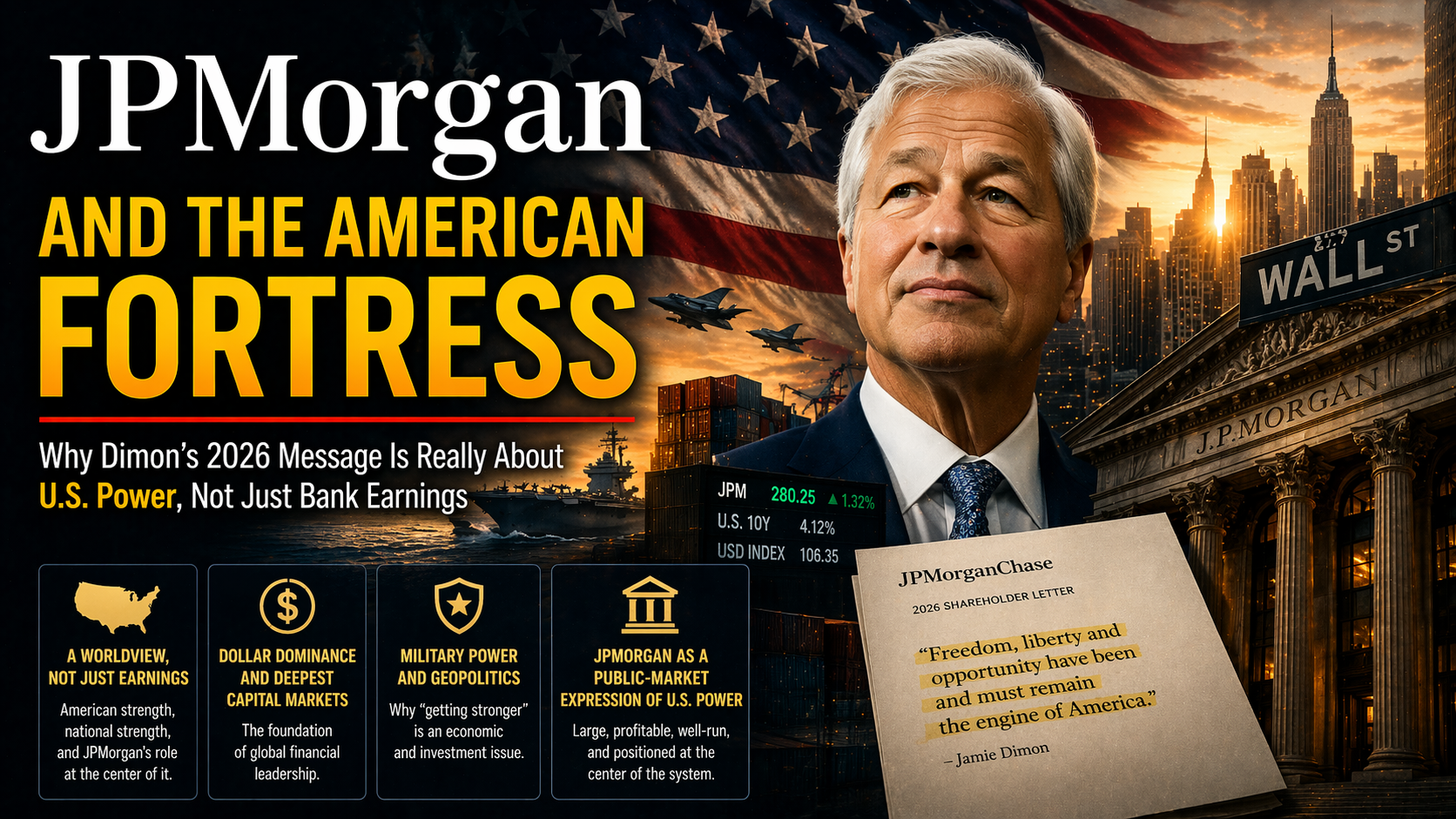
# JPMorgan and the American Fortress
Why Dimon's 2026 Message Is Really About U.S. Power, Not Just Bank Earnings
The most important thing in Jamie Dimon's 2026 shareholder letter is not a quarterly number, a net interest margin, or a capital ratio.
It is a worldview.
That worldview is simple: American financial strength is inseparable from American national strength. Dimon opened his letter by tying JPMorgan's future to the country's 250th anniversary and to the values of "freedom, liberty and opportunity," while warning that U.S. leadership cannot be taken for granted amid wars, geopolitical tension, debt, and elevated asset prices. Bloomberg's summary was even more direct: Dimon argued that the U.S. needs to "get stronger" to preserve its military and economic might.
That is why this report matters for investors. It is not really a report about one bank.
It is a report about the architecture of American power.
JPMorgan is valuable not only because it is large, profitable, and well-run. It is valuable because it sits at the center of the deepest capital markets, the most important reserve currency system, and the most credible crisis-response machinery in the world.
When Dimon writes, he is not speaking as a passive observer of the American system.
He is speaking as one of its principal operators.
Our view is clear: the strongest bullish case for America in 2026 is not blind patriotism and not a slogan about exceptionalism. It is the very practical observation that the United States still combines military reach, dollar dominance, institutional depth, and capital-markets scale better than any rival.
JPMorgan is one of the clearest public-market expressions of that reality.
1. Dimon's Real Message: National Power Is a Balance-Sheet Asset
Many investors read Dimon's annual letters as macro commentary with some bank detail attached. That understates what he is doing.
The 2026 letter is a defense of American resilience — but it is also a warning that resilience is not self-sustaining. Dimon wrote that the U.S. economy remained resilient, with consumers still earning and spending and businesses still healthy, even while facing war in Iran, broader Middle East instability, tensions with China, high fiscal deficits, and richly valued assets.
He did not present America as invincible.
He presented it as strong — but only if it continues to reinforce the foundations of that strength.
This is where the report becomes bigger than banking.
Dimon's argument is that financial value is downstream from national capability. The reason U.S. assets command a premium is not just that American companies innovate. It is that the entire American system still enjoys a level of legal credibility, military backing, and capital-market depth that no other system has matched.
The market may price that premium every day without naming it.
Dimon named it.
For American investors, there is a patriotic reading and a strategic reading. The patriotic reading is that the United States remains the indispensable economic republic of the modern world. The strategic reading is more useful: if national strength and financial strength are linked, then institutions embedded deepest in that strength deserve a premium.
JPMorgan is one of them.
2. Why JPMorgan Is More Than a Bank
JPMorgan is not just "big."
It is systemically central.
That distinction matters. Lots of firms are large. Far fewer are important enough that they effectively become part of the operating system of American capitalism.
JPMorgan is one of those firms.
In stress periods, it is not merely another market participant. It is often a coordinator of liquidity, a buyer of time, a validator of price, and a signal to the rest of the market that order still exists. That is why Dimon's views carry such weight even when they sound broader than banking. Investors understand that he sees the plumbing — not just the headlines.
The private-credit debate offers a vivid example.
Recent scrutiny has focused on liquidity strain, underwriting quality, and the risk that private markets may not behave as advertised in a true credit cycle. JPMorgan's response has not been defensive panic. Reuters reported that the bank filed to launch a JPMorgan Public and Private Credit Fund with expected quarterly repurchases of 7.5% — above the more common 5% cap used by many peers — and sought SEC relief to enable at least 2% monthly repurchases. Business Insider also reported that JPMorgan disclosed around $50 billion of exposure to private credit and said it was "broadly comfortable" with that exposure, with Dimon arguing that private-credit risks were not systemic, even if a broader credit cycle could still produce larger-than-expected losses.
That combination is revealing.
JPMorgan is not saying, "There is no risk." It is saying, "We understand the risk, we have the balance sheet, and we intend to play offense where others may be forced to retreat."
That is classic fortress behavior.
It is also one of the clearest expressions of American financial dominance: when stress appears, the strongest institutions do not only survive it. They often intermediate it, price it, and sometimes profit from it.
3. The Private-Credit Lesson: Panic Is Local, Scale Is National
A lot of commentary around private credit has been framed as if the system itself is on the verge of breaking.
That is too dramatic.
The better interpretation is that private credit is discovering the limits of illiquidity marketing in a world where end investors still want exits. What makes JPMorgan interesting is not that it can abolish those limits.
It cannot.
What makes JPMorgan interesting is that it can step into the gap between fear and functioning.
That is what the 7.5% redemption structure represents symbolically. It is not just a fund term. It is a statement of institutional confidence. At a moment when some managers have been forced to limit withdrawals, JPMorgan is effectively telling the market that it has the underwriting discipline, structural protections, and brand strength to offer a more accommodating product.
That does not eliminate risk.
It reinforces hierarchy.
And hierarchy is a core feature of American finance. In moments of stress, capital does not disappear equally. It clusters around the most trusted balance sheets.
For investors, this is one of the most important truths to remember:
> Crises do not just destroy value. They redistribute bargaining power.
The United States has repeatedly shown an unusual ability to turn market stress into institutional consolidation. JPMorgan's posture in private credit is best understood through that lens.
4. Dollar Power Is Not Mystical. It Is Backed by Institutions, Alliances, and Force.
There is a claim that makes some investors uncomfortable when stated too bluntly, and comfortable when stated too softly:
Trust in the dollar ultimately rests on American military power.
Stated rhetorically, that sounds like a talking point.
Stated properly, it is one of the least sentimental truths in global finance.
Reserve currencies do not endure because of spreadsheet elegance alone. They endure because the issuing state combines economic scale, military reach, legal reliability, and alliance credibility. Dimon's 2026 language about America needing to get stronger to preserve its military and economic might points in exactly that direction.
He did not literally write that "trust comes from aircraft carriers."
But the inference is not unreasonable: markets trust the dollar because they trust the American state's capacity to defend the order in which the dollar sits at the center.
This is one reason American investors should resist the recurring temptation to assume that U.S. primacy is about to vanish on schedule. The U.S. can make policy mistakes. It can run excessive deficits. It can misprice assets. Dimon explicitly warned about deficits and elevated asset prices.
But none of that automatically erases the structural advantages of having the world's deepest capital markets, the dominant reserve currency, and the military capability to underwrite a broad geopolitical system.
Those advantages are not abstract.
They show up in borrowing costs, liquidity conditions, crisis response, and valuation premiums.
5. The Real American Edge: Self-Correction at Scale
If there is one phrase worth emphasizing for U.S. investors, it is this:
> America's advantage is not perfection. It is recoverability.
That is what JPMorgan represents at its best.
Not flawless foresight.
Enormous capacity to absorb stress, reprice risk, raise capital, and keep the machine operating.
Dimon's 2026 tone was not triumphalist. It was vigilant. That is another reason the letter deserves respect. It did not say America is unbeatable. It said America must stay strong, disciplined, and realistic if it wants to remain preeminent.
That is also why the report should speak to American pride without becoming empty chest-thumping. The right kind of national confidence is not arrogance. It is recognition of real strengths:
- Unmatched financial-market depth
- A reserve currency system still central to global trade and savings
- Globally relevant corporate champions
- Institutions large enough to impose order when disorder appears
JPMorgan is not the whole of that system.
But it is one of its clearest mirrors.
6. What This Means for Investors
The straightforward portfolio takeaway is not that investors should buy every U.S. asset indiscriminately.
Dimon himself warned about "very high" asset prices and multiple macro risks. Patriotism is not a substitute for valuation discipline.
But the correct lesson is that investors should continue to assign serious weight to businesses that are deeply embedded in the American power stack — financially, institutionally, and strategically. JPMorgan is one of the strongest examples because its franchise quality compounds with national advantages rather than against them.
That makes JPMorgan interesting in three specific ways:
First, it remains one of the best public proxies for the resilience of U.S. finance itself. When Dimon says the economy is strong but exposed to complex risks, he is effectively saying that the U.S. still has the capacity to withstand shocks without losing the center. That is a constructive message — even if it is not complacent.
Second, it is positioned to benefit from dislocation. Private-credit stress, regulatory complexity, and broader market strain often enhance the relative value of scale, trust, and underwriting rigor. JPMorgan does not need the world to be calm to win. It often needs the world merely to remember who the strongest hands are.
Third, it offers exposure not just to American growth, but to American system quality. That sounds intangible, but it is not. It appears in funding costs, client trust, regulatory relevance, deal flow, and the ability to deploy enormous balance-sheet and franchise advantages when others are constrained.
7. The Risk Case Investors Should Not Ignore
A strong report has to respect the counterargument.
The biggest risk to this bullish American thesis is not that America suddenly disappears.
It is that the country becomes too comfortable monetizing its advantages instead of renewing them.
Dimon's warnings on fiscal deficits, elevated asset prices, geopolitical shocks, and policy fragility matter precisely because they threaten the very premium U.S. assets still enjoy. If America treats dominance as permanent, it may gradually cheapen the foundations of that dominance.
For JPMorgan specifically, the risk is not existential weakness.
It is that being systemically central can also mean carrying the burdens of policy, regulation, and broader credit cyclicality. Fortress institutions are still exposed to the systems they help stabilize.
That is why the right investor tone is not blind certainty.
It is confident realism.
8. Final Verdict
Jamie Dimon's 2026 message should not be read as routine CEO patriotism.
It should be read as a reminder that American finance is strongest when America itself is strong — economically, militarily, institutionally, and morally. JPMorgan matters because it sits where those forces meet. Its value is not only in earnings power.
Its value is in being one of the great public expressions of the American system's durability.
So yes, this report speaks to American pride.
But the deepest version of that pride is not sentiment.
It is structure.
The United States still has the deepest markets, the strongest reserve-currency platform, and institutions with enough scale to confront panic instead of becoming part of it. JPMorgan is not simply a bank benefiting from that system.
It is one of the reasons the system still works.
The Final Line
The American era does not persist because people say it will.
It persists because, when the world is tested, capital still runs toward American strength.
And JPMorgan is one of the clearest places that strength becomes visible.
This Special Report is part of Brutal Edge's framework series on structural advantages in American finance. Related analysis: Intel's Great Repricing (U.S. semiconductor resilience), Velo3D and the New Arsenal (American manufacturing revival).
Share your analysis
Keep it data-driven. No investment advice.
- Keep it data-driven and respectful
- No investment advice (buy / sell / hold)
- No spam, promotion, or solicitation
- No profanity or offensive content
- Violations are automatically removed
Data: Financial Modeling Prep, Alpha Vantage, CoinGecko
NOT investment advice. Always do your own research.