The Rise of Claude: Why the Next AI Investment Cycle May Be About Trust, Not Scale
The strongest way to understand Anthropic in 2026 is not as 'another frontier-model company.' It is as a company trying to own the trust layer of enterprise AI. The first phase of the AI boom rewarded model novelty. The next phase is increasingly about who can be trusted inside regulated workflows, codebases, and decision environments where being wrong is expensive.
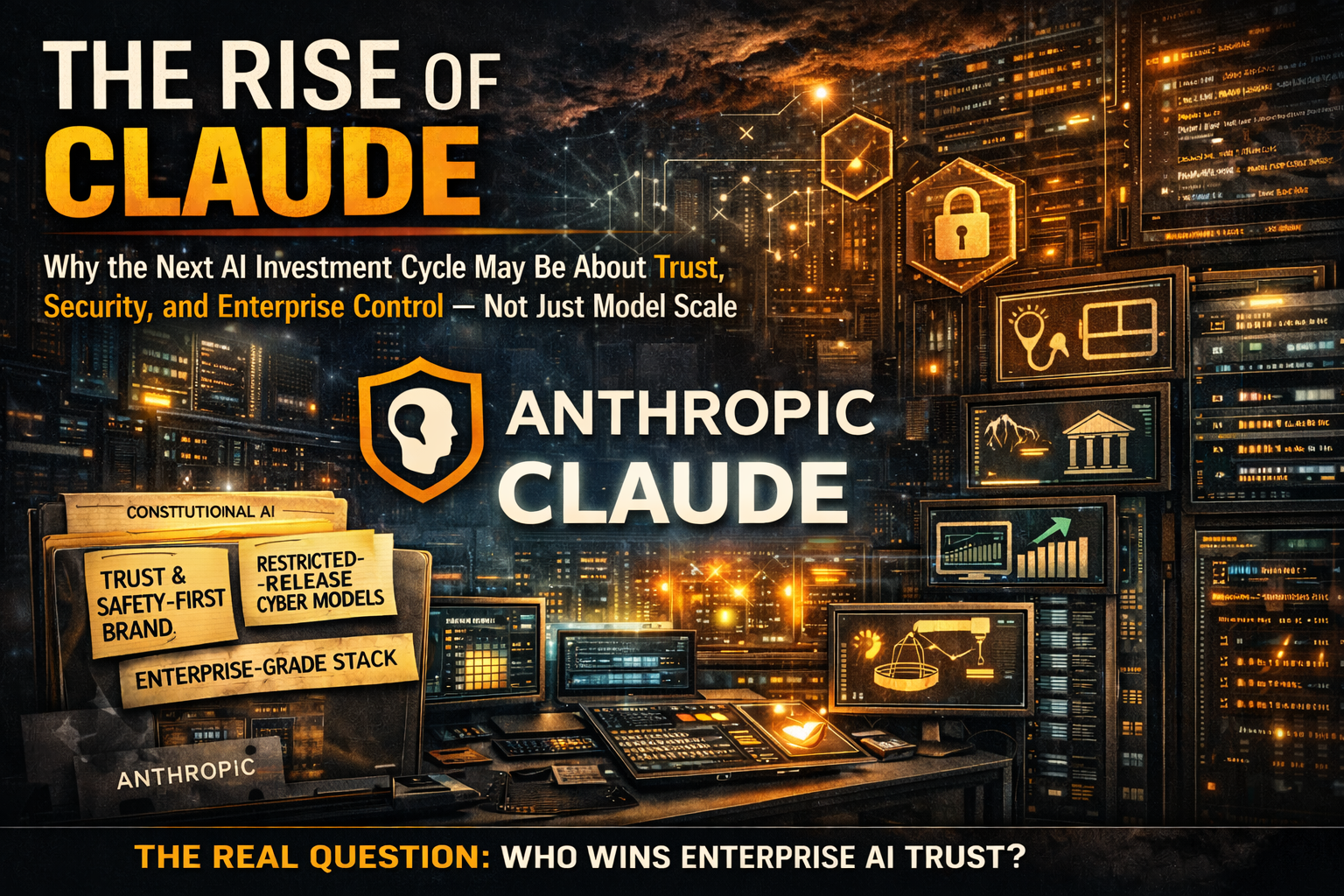
# The Rise of Claude
Why the Next AI Investment Cycle May Be About Trust, Security, and Enterprise Control — Not Just Model Scale
The strongest way to understand Anthropic in 2026 is not as "another frontier-model company."
It is as a company trying to own the trust layer of enterprise AI.
That distinction matters.
The first phase of the AI boom rewarded model novelty, consumer growth, and raw capability headlines.
The next phase is increasingly about who can be trusted inside regulated workflows, codebases, security operations, and decision environments where being wrong is expensive.
Anthropic's positioning around Constitutional AI, enterprise-grade deployment, and restricted-release cyber models suggests it is trying to win that second phase.
That framing is also a necessary correction to a lot of noisy AI discourse.
The market is not really splitting into "fun AI" versus "serious AI" in a clean binary sense. OpenAI, Anthropic, Google, and others are all pushing both broad and enterprise use cases.
But Anthropic has deliberately leaned into a differentiated brand: Claude is marketed as more reliable, more steerable, and more suitable for high-stakes work where disclosure quality, instruction-following, and defensibility matter.
Anthropic's own materials now emphasize enterprise products, financial-services workflows, healthcare/life sciences deployments, code security, and a Constitutional AI lineage that is directly tied to control and safety rather than just chatbot popularity.
Executive View
Our central view is straightforward.
The most important Anthropic story in 2026 is not that Claude is a better chatbot.
It is that Anthropic is trying to become the default AI vendor for environments where trust, compliance, and bounded autonomy matter more than raw virality.
That is a much more investable story than generic model hype because it points toward:
- Recurring enterprise budgets
- Deeper workflow lock-in
- Higher switching costs
It also changes what investors should watch: less "who won the consumer app week," and more "whose models are getting embedded into finance, software delivery, healthcare, and cyber operations."
1. Constitutional AI Is Not Just Branding — It Is Product Strategy
Anthropic's phrase "Constitutional AI" can sound like marketing if you only encounter it secondhand.
In practice, it is a meaningful strategic choice.
The company's research describes Constitutional AI as a training and governance approach in which the model critiques and revises its own outputs using explicit principles rather than relying only on conventional human feedback loops.
Over time, Anthropic has extended that into safety mechanisms such as Constitutional Classifiers and next-generation classifier systems intended to improve robustness against jailbreaks and harmful behaviors at lower compute cost.
For investors, the important point is not the technical elegance alone.
It is that Anthropic has built a company identity around steerability and bounded behavior — and that identity maps directly onto enterprise purchasing logic.
That matters especially in regulated sectors.
Anthropic's financial-services page now highlights production use cases and customer language from firms such as Citi and LSEG, emphasizing safety, reliability, and compatibility with enterprise workloads. Moody's recently launched credit and compliance workflows directly inside Claude, and PwC announced a collaboration with Anthropic around enterprise agents in finance and healthcare.
Claude is not being positioned as merely a brainstorming assistant.
It is being positioned as a workflow engine where defensibility matters.
That is a more durable commercial wedge than consumer novelty.
2. The Real Significance of Mythos
Mythos is not just a rumor or a vague internal code name.
Anthropic has publicly documented Claude Mythos Preview through its red-team site, a system card, and a redacted risk report. The company describes Mythos Preview as a new general-purpose language model that is especially capable at cybersecurity tasks, and says it launched Project Glasswing to use the model to help secure critical software while the industry prepares for a world in which models of this class exist.
This is the real break in the story.
Most AI investors still think in terms of incremental model improvement: better coding, better reasoning, better image handling, better enterprise summarization.
Mythos implies something more uncomfortable:
> Frontier models may now be crossing from "productivity tools" into "systemic cyber capability."
Anthropic's own documentation says Mythos Preview can identify and exploit zero-day vulnerabilities across major operating systems and browsers when directed to do so. External reporting adds that the company has restricted access and is working with a small set of partners rather than releasing the model broadly.
That is not a normal product-launch pattern.
It is closer to controlled strategic deployment.
Investors should take this seriously for two reasons.
First, it suggests that the next major frontier in AI monetization may be security augmentation and infrastructure hardening, not just office productivity.
Second, it reinforces Anthropic's broader claim that safety is not a side constraint but a core product feature. Anthropic is effectively arguing that a model this powerful cannot simply be released and let loose into the wild; it must be surrounded by governance, partner controls, and deployment discipline.
Whether one sees that as prudence or strategic theater, it is clearly part of the company's moat-building effort.
3. Claude's Enterprise Angle Is Getting Stronger, Not Weaker
One of the most useful investor mistakes to avoid is thinking of Claude primarily through the lens of public chatbot mindshare.
Anthropic's product footprint now spans:
- Claude for Enterprise
- Claude Code
- Claude Code Security
- Claude Cowork
- Financial-services solutions
- Healthcare/life sciences tooling
- Managed agents on the Claude Platform
Anthropic is also investing heavily in distribution, including a $100 million Claude Partner Network aimed at training, sales enablement, and partner-led deployments.
That is not how a company behaves when it is aiming only for consumer-chat relevance.
That is how a company behaves when it is building a channel-heavy enterprise stack.
The quality of the partners matters too:
- Accenture announced Cyber.AI powered by Claude for AI-driven cyber operations
- Infosys announced enterprise AI collaborations using Claude
- Anthropic's own enterprise materials emphasize deployment into complex, regulated workflows rather than lightweight experimentation
These are the kinds of partnerships that tend to matter in the second half of technology adoption cycles, when customers stop asking "Can this model do something impressive?" and start asking:
"Can we govern it, integrate it, and trust it enough to embed it into real operations?"
4. Trust Is Becoming an Investable AI Category
This is the deepest investment insight in the report.
The first AI wave rewarded model capability.
The next wave may reward institutional trust.
That means Anthropic's real competition is not just model-for-model benchmarking. It is a contest over who becomes the preferred vendor for tasks where error costs, privacy risks, and compliance burdens are structurally high.
That is why Anthropic's ad-free positioning also matters more than it first appears.
In February 2026, the company explicitly said Claude would remain ad-free and framed advertising incentives as incompatible with a genuinely helpful assistant. Investors should not over-romanticize that. But they also should not dismiss it.
In enterprise software, the absence of ad incentives is not just a philosophical statement.
It can strengthen the perception that the vendor's economics are aligned with the customer's trust needs rather than engagement extraction.
This is especially relevant in finance, law, security, and healthcare.
Anthropic's newer Opus materials highlight strong performance on legal and finance-oriented benchmarks, with emphasis on calibration, disclosure quality, and handling of ambiguity. That fits neatly with the company's enterprise story.
Whether or not Claude is "the best model overall" is almost the wrong question.
The more important one is whether Claude becomes the model that boards, CISOs, compliance officers, and CTOs feel most comfortable allowing into high-stakes systems.
If it does, that is worth far more than a temporary lead in generic chatbot engagement.
5. The Security Investment Implication Needs Tighter Framing
The idea that the AI era will broadly shift cybersecurity from software to "optical security" needs reframing to be investable and credible.
What is more supportable is this:
If models like Mythos materially increase the speed and scale of vulnerability discovery, then enterprises and governments will likely spend more on:
- Hardware-rooted trust
- Network segmentation
- Encryption modernization
- Secure communications
- Identity infrastructure
- High-assurance data transport
The World Economic Forum's Global Cybersecurity Outlook 2026 already points to AI adoption and geopolitical fragmentation as reshaping cyber risk, and broader market data point to rising enterprise cyber budgets.
Where "optical" or photonic security does fit is in the longer-duration theme of quantum-secure communications and quantum key distribution. Those are not immediate broad-market replacements for conventional security stacks, but they are increasingly relevant in critical infrastructure, finance, telecom, and government settings where tamper detection and high-assurance key distribution matter.
So the cleaner investment conclusion is not "buy optics because AI breaks software."
It is that the next security cycle may increasingly reward technologies that reduce dependence on purely software-layer trust and instead move toward more physically grounded or quantum-safe communications architectures.
That is a more defensible, longer-duration thesis.
6. The Larger Market Meaning: AI Is Splitting into Three Categories
For investors, one of the most useful ways to frame 2026 is that AI is beginning to separate into three economic categories.
Category 1: Consumer Engagement and Interface AI
The assistants, search-like surfaces, and broad productivity layers that live in public-facing applications.
Category 2: Workflow AI
Models embedded inside real work, where the value comes from integration, reliability, and domain-specific execution.
Category 3: Sovereign and Infrastructure AI
Models and systems that matter to national security, critical software, cyber defense, and financial resilience.
Anthropic increasingly appears to be leaning toward the second and third categories.
That shift is one reason Claude matters more than generic market-share chatter might suggest.
This also explains why Mythos matters beyond Anthropic.
If the model is even directionally as capable as Anthropic and outside reports suggest, then AI security is no longer a niche subtheme.
It becomes a central part of the frontier-model investment conversation.
Once you accept that, the obvious beneficiaries are not only model vendors. They also include:
- Cyber platform providers
- Identity and trust-layer companies
- Compliance automation vendors
- Secure deployment platforms
- Over time, quantum-safe communications and photonics-linked infrastructure
Anthropic may be one of the clearest signals, but the investable basket is broader.
7. What Could Go Wrong with the Anthropic Bull Case
A serious investor report has to include the failure modes.
The first is that Anthropic's trust premium may prove real but not sufficiently monetizable. Enterprises may praise Claude's safety posture while still multi-homing across OpenAI, Google, and open-source stacks. If so, Anthropic could end up with admiration without enough economic capture.
The second is that "safety" can become a double-edged brand. If Claude is perceived as too constrained, too cautious, or too slow to ship frontier capability, some customers may prefer more flexible alternatives. Anthropic is clearly trying to avoid that by continuing to release strong general models like Opus while restricting Mythos-class capabilities. But that balance is hard to maintain.
The third is governance and political risk. Recent reporting suggests Anthropic's stance on safeguards and government relationships has produced tension as well as credibility. That may strengthen its reputation with some customers while complicating defense or federal adoption with others.
Investors should understand that "trusted" does not mean politically frictionless.
8. Investment Conclusion
The most important thing U.S. investors should understand is this:
> Anthropic is not just trying to build a smarter model. It is trying to build the default AI vendor for environments where mistakes are expensive, security is strategic, and trust has to be engineered — not merely promised.
That makes Claude's rise significant far beyond chatbot competition.
If Anthropic succeeds, the company will help define a new AI category where the winners are not simply the most capable model labs, but the firms most trusted to deploy intelligence safely inside the core machinery of finance, code, medicine, and security.
Mythos adds urgency to that story by suggesting the frontier may already be moving from "AI as assistant" toward "AI as systemic cyber actor."
Our own view is constructive but selective.
The investable thesis is not "Claude will win consumer AI."
It is that the next durable AI multiple may accrue to the companies that own trusted deployment, regulated-workflow integration, and security infrastructure.
Anthropic is one of the clearest names in that shift.
The secondary winners may emerge across cyber platforms, quantum-safe communications, and photonics-linked secure network infrastructure.
Final Line
The next AI era may not belong to the loudest model.
It may belong to the one institutions trust when the cost of being wrong becomes unacceptable.
This Special Report is Part 1 of Brutal Edge's "Intelligence Economy" series. Related analysis: The Token Economy (Part 2), NVIDIA: The Industrial Architect (Part 3), The Final Frontier — M7 AGI Map (Part 4), and upcoming Trust Architecture synthesis.
Share your analysis
Keep it data-driven. No investment advice.
- Keep it data-driven and respectful
- No investment advice (buy / sell / hold)
- No spam, promotion, or solicitation
- No profanity or offensive content
- Violations are automatically removed
Data: Financial Modeling Prep, Alpha Vantage, CoinGecko
NOT investment advice. Always do your own research.