
The Warsh Doctrine
What a Warsh-led Fed means for the yield curve, bank repricing, and the end of easy-money assumptions in U.S. capital markets.
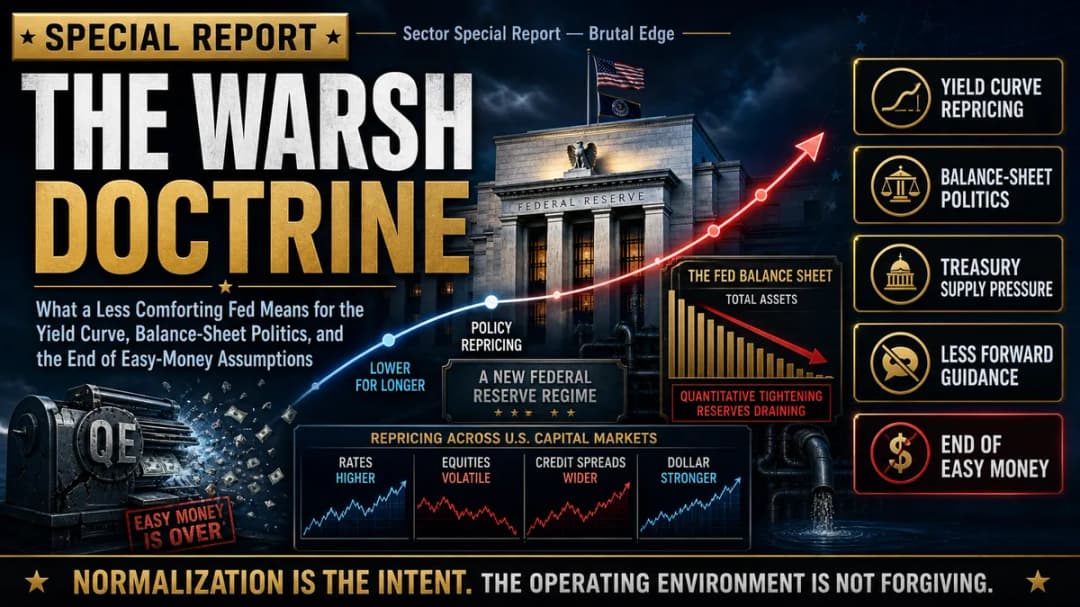
# The Warsh Doctrine
Sector Special Report — Brutal Edge
Framework-based analysis of the next Fed regime and what it means for U.S. capital markets
Executive Summary
Kevin Warsh is not yet Fed chair. He is the nominee. That distinction matters because markets are already trading on the possibility of a regime change at the top of the Federal Reserve — a regime that would put less weight on forward guidance, more weight on traditional rate policy, and more skepticism on prolonged QE and an oversized balance sheet.
Most analysts are framing this as "Warsh equals hawkish" or "Warsh equals rate cuts." Both readings are too small.
The Brutal Edge view: a Warsh-led Fed would attempt to restore policy signaling discipline and shrink the central bank's role in market pricing. But it would have to do so in a world of higher debt, larger Treasury supply, persistent energy shocks, and a banking system still architected around an ample-reserves framework.
The intent is normalization. The operating environment is far less forgiving than the 1990s.
This report breaks down what the Warsh framework actually changes, what it cannot change, and which parts of the U.S. capital structure get repriced if a less comforting Fed regime takes hold.
1. What Actually Changed
The April 29, 2026 FOMC meeting was the clearest signal yet that the easy-cut narrative is breaking down.
| Event | Date | Significance |
|---|---|---|
| Fed holds at 3.5%–3.75% | Apr 29, 2026 | Fourth straight pause |
| Four-way dissent | Apr 29, 2026 | First in years |
| Miran dissent | Apr 29, 2026 | Wanted immediate 25bp cut |
| Hammack / Kashkari / Logan dissent | Apr 29, 2026 | Objected to easing bias in statement |
| Energy reference in statement | Apr 29, 2026 | Hormuz disruption explicitly cited |
| Fed BTC purchase program | Through Apr 15, 2026 | $40B/month Treasury bills, ongoing |
| QT halt | October 2025 | Already paused |
These are not separate stories. They are one story about a Fed that has lost the easy consensus that defined 2020–2024.
The cartel-like discipline of "we are going to cut, the only question is when" is gone. Replaced by a four-way argument about whether the policy bias should even point toward easing in the first place.
This is the macro environment Warsh would inherit.
2. The Old Framework Is Broken. Markets Are Still Pricing It.
For the past five years, the operating mental model for Fed policy was:
> Forward guidance sets expectations. Balance sheet absorbs shocks. Rate path is communicated months in advance. Surprises are bugs, not features.
This model is no longer sufficient.
The Brutal Edge view: anyone still trading rates on the assumption that the Fed will smoothly telegraph cuts, support markets through balance-sheet expansion, and provide frictionless forward guidance is reading a map of a country that no longer exists.
The Warsh framework, as articulated through his nomination hearing and prior writings, replaces these four pillars with:
1. Less forward guidance — markets price uncertainty directly, not pre-commitments
2. Smaller balance sheet — central bank steps back from market pricing where possible
3. Disciplined rate policy — fed funds rate is the primary tool, not communications
4. Lower tolerance for inflation overshoots — institutional credibility above market accommodation
This is not "hawkish." It is a return to a more traditional operating model. The problem is that the structural environment around the Fed is anything but traditional.
3. The Central Contradiction — Intent vs. Operating Reality
Warsh's framework points toward a smaller Fed footprint. The operating reality of 2026 makes that hard.
| Dimension | Warsh Intent | Operating Reality |
|---|---|---|
| Forward guidance | Reduce | Markets are conditioned to expect it |
| Balance sheet | Shrink over time | Reserve scarcity risk in money markets |
| Rate communication | Less pre-commitment | Higher volatility cost during transition |
| Long-term rates | Let market price freely | Heavy Treasury supply anchors term premium |
| Asset purchases | Reserve for true emergencies | Banking system architected around ample reserves |
| Energy inflation | Treat as transitory if possible | Hormuz risk is structural, not transitory |
| Fiscal coordination | Operationally independent | $574B/quarter Treasury supply requires implicit coordination |
Goldman Sachs Asset Management's March analysis put it directly: notable balance-sheet shrinkage would take time, require committee buy-in, regulatory changes, and asset recomposition. The Fed had already stopped QT in October 2025 and resumed Treasury bill purchases through April 15, 2026 specifically to manage funding-market conditions.
The Brutal Edge read: Warsh would inherit a Fed that has stopped QT, is buying $40B in T-bills monthly, and has dissents in four directions. The path to a smaller, less-communicative Fed is intellectually clear and operationally constrained.
4. Why "Warsh = Lower Rates" Is the Wrong Frame
The intuitive read is that any new Fed chair eventually cuts. Warsh prefers traditional policy. Therefore Warsh equals lower rates.
This frame is too small.
Over a long horizon, policy rates respond to inflation, growth, and labor market conditions. A new chair cannot override that arithmetic. But over the next 4–8 quarters, three forces work against the easy-cut reading:
| Force | Effect | Why It Matters |
|---|---|---|
| Energy persistence | Adds 50–100bp to inflation floor | Hormuz risk reprices oil for years, not weeks |
| Treasury supply | Adds 50–75bp to term premium | $574B/quarter requires real demand |
| Reduced forward guidance | Adds volatility premium | Less pre-commitment = wider rate path uncertainty |
Even if the Fed eventually cuts, the long end may not follow the way it did in past cycles. CBO projects federal debt at 101% of GDP in 2026, rising to 120% by 2036, with deficits at 5.8% of GDP and climbing. That is not an environment where long rates respond mechanically to short-rate cuts.
The right framework: the Fed got less predictable, the curve got more independent, and U.S. duration risk became more about supply than about Fed policy.
In a bullish scenario for rate cuts, banks benefit from a steeper curve.
In a bearish scenario for inflation, duration assets get repriced lower.
Both paths reduce the central role of Fed forward guidance in pricing the curve.
5. The Four-Layer Repricing Map
Most rate commentary collapses the entire macro structure into one trade. That is the same mistake people made about cartel discipline in oil — treating a structurally diverse system as a single thematic bet.
The Brutal Edge framework breaks the U.S. capital structure into four layers, each repriced differently by a Warsh regime.
Layer 1 — Banks and Financial Intermediaries (Steepener Beneficiaries)
These are firms whose net interest margin expands when the curve steepens — exactly the structural condition a Warsh framework could produce.
| Category | Brutal Edge Read |
|---|---|
| Large-cap money center banks | NIM expansion, deposit franchise advantage, fee businesses stable |
| Regional banks | More leveraged to NIM moves, but also more exposed to credit cycle |
| Insurers | Long-duration liability matching benefits from higher long rates |
| Custody banks | Treasury custody volumes track issuance, structurally rising |
Layer thesis: A less-aggressive easing path with persistent term premium is the friendliest yield curve banks have seen in years. Multiples in financials have been compressed for over a decade. They deserve a structural re-rating in a steeper-curve regime.
Layer 2 — Quality Equities with Pricing Power (Inflation Defenders)
These are businesses that can raise prices alongside inflation without losing customers. In a regime where inflation is structurally higher, this is the layer that compounds.
| Characteristic | Brutal Edge Read |
|---|---|
| Subscription business models | Recurring revenue with annual price increases |
| Asset-light operators | Margin expansion in inflationary environments |
| Brand-led pricing power | Customer retention even with price increases |
| Toll-road economics | Volume growth + price growth simultaneously |
Layer thesis: Quality has been the consistent winner across regime changes. A Warsh framework that allows inflation to run modestly higher actually benefits this layer, not penalizes it. Multiples expand on real earnings power, not on rate-cut hopes.
Layer 3 — Long-Duration Assets (Repricing Risk)
This is where the Warsh framework matters most negatively. Anything that priced in low long-term rates as a structural condition gets repriced.
| Asset | Repricing Risk |
|---|---|
| Long-dated Treasuries | Term premium rebuild, supply pressure |
| Investment-grade corporate bonds | Spread compression has already happened |
| Long-duration tech equities | Discount rate sensitivity is highest |
| REITs | Cap rate adjustment needed if long rates stay elevated |
| Speculative growth stocks | Most vulnerable to higher discount rates |
Layer thesis: The market has been pricing the eventual return of low long rates as base case. A Warsh regime makes that scenario less likely. Long-duration assets that have rallied on rate-cut hopes are the most vulnerable to disappointment. This is the primary risk asymmetry of the next regime.
Layer 4 — Real Assets and Inflation-Sensitive Sectors (Persistent Demand)
If inflation stays structurally higher and term premium expands, real assets benefit.
| Category | Brutal Edge Read |
|---|---|
| Energy infrastructure | Already covered in The Great Energy Shift |
| Industrial commodities | Persistent demand in re-shoring environment |
| TIPS | Direct inflation protection without duration penalty of nominals |
| Gold | Hedge against both inflation and Fed credibility risk |
| Defense industrials | Capex cycle aligned with geopolitical regime |
Layer thesis: A Warsh framework that respects the inflation floor — rather than fighting it with aggressive cuts — keeps real assets structurally bid. This is the ballast layer for portfolios in a regime change.
6. The Bank Repricing Story Is the Most Underappreciated
Of the four layers, the bank repricing case deserves separate emphasis because it is the most underappreciated single thesis in the Warsh framework.
For most of the past decade, the consensus was simple: low rates hurt banks. Flat curves hurt banks. The Fed needs to cut to avoid recession, and banks need cuts to do well.
This frame is broken.
What banks actually need:
| Variable | Current State | Warsh Regime |
|---|---|---|
| Yield curve slope | Improving but flat by historical standards | Structurally steeper |
| Net interest margin | Compressed for years | Expanding |
| Deposit franchise value | Underappreciated in zero-rate world | Highly valuable |
| Credit cycle | Manageable | Stable to improving |
| Regulatory environment | Tighter post-2023 stress | Stabilizing |
| Capital return | Restrained by stress tests | Normalizing |
The Brutal Edge view: U.S. large-cap financials are trading at multiples that imply they need rate cuts to work. A Warsh framework changes that math entirely. A steeper curve, persistent term premium, and stable credit conditions are exactly the environment banks have been waiting for.
This is one of the strongest single re-rating stories in U.S. equities, and most generalist investors are still operating on the old assumption that the sector is rate-cut dependent.
7. The "Fed Put" Is Quietly Being Repriced
For two decades, the operating assumption among equity investors was that the Fed would step in to support markets during sustained drawdowns. Sometimes called the "Fed put," sometimes called "the Greenspan put," sometimes called "Bernanke," "Yellen," or "Powell put" — the idea was the same.
Warsh's framework directly challenges this assumption.
His pre-Fed writings argued repeatedly that the Fed had become too willing to substitute monetary support for market-clearing prices. His confirmation hearing comments suggest the same instinct — that the Fed should be the lender of last resort, not the buyer of last resort, and not the underwriter of asset prices.
The Brutal Edge view: investors should not assume the Fed put is dead — institutions usually preserve their option to act in real crises. But they should assume the strike price is lower and the activation threshold is higher than markets have been pricing.
That alone is enough to change risk-asset multiples on the margin. The ones most affected are the ones priced as if the Fed put is permanent and reliable. The ones least affected are the ones with real cash flows and real moats that do not depend on continued asset-price support.
8. The Bear Case (Honest Version)
Brutal Edge does not write one-sided reports. The bear case here is real and deserves equal weight.
Confirmation risk: Warsh is not yet confirmed. The thesis assumes a confirmation that may face Senate friction. If confirmation fails, the framework discussed here does not become operative.
Operating constraint: Even if confirmed, Warsh operates inside an FOMC. He cannot unilaterally restructure forward guidance, balance-sheet policy, or the Fed's communication framework. Persistent dissents may force compromises that dilute the doctrine.
Recession risk: If the U.S. enters recession in 2026–2027, even Warsh would face pressure to cut aggressively and expand the balance sheet. The doctrine survives in good times. In real economic stress, all Fed chairs become activists eventually.
Credit cycle deterioration: The bank thesis assumes stable credit conditions. If commercial real estate, regional bank exposures, or consumer credit deteriorate materially, the steeper-curve benefit is offset by credit losses.
Term premium expansion overshoot: If long rates rise too fast, the disorderly repricing damages risk assets across the board, including the layers that benefit from a regime change. A controlled steepening is bullish for banks and quality equities. A disorderly steepening is bearish for everything.
Energy resolution: The thesis assumes Hormuz risk persists. A diplomatic resolution that re-opens transit cleanly compresses the inflation premium and reduces the case for higher term premium.
These risks do not invalidate the thesis. They define the shape of position sizing, scenario planning, and which layer of the four-layer stack deserves more capital at each point in the regime change.
9. What to Watch Over the Next Four Quarters
The thesis develops or breaks based on observable signals. Brutal Edge tracks the following:
Q2 2026:
- Warsh confirmation timeline and Senate margin
- 10-year Treasury yield (above 4.5% = term premium expanding)
- 2y/10y spread (steepening = thesis intact)
- Bank earnings commentary on NIM trajectory
- FOMC composition and dissent patterns
Q3 2026:
- First Fed meeting under Warsh (if confirmed) — communication tone shift
- Balance-sheet runoff resumption or continued pause
- Treasury auction reception (especially long-duration auctions)
- Bank sector vs. broader market relative performance
- Inflation persistence (PCE trajectory, especially services)
Q4 2026:
- 2027 capex guidance from financials
- Long-duration tech sector relative performance
- TIPS breakeven movements
- Credit spreads (high-yield, especially)
- Real-asset sector performance (energy, industrials, TIPS)
Q1 2027:
- Annual confirmation of Fed framework changes (if any)
- Bank capital return announcements
- Treasury supply dynamics for the year
- Realized vs. expected term premium expansion
Any clean bullish signal in 3 of 5 metrics per quarter = thesis confirmed.
Any clean bearish signal in 4 of 5 metrics in Q2 = thesis re-evaluated.
10. Brutal Edge Coverage Integration
This Special Report connects to existing Brutal Edge coverage across multiple frames.
| Coverage | Connection |
|---|---|
| The Great Energy Shift (May 2026) | Energy as inflation floor — directly supports the persistent inflation thesis |
| The Token Economy (April 2026) | Same regime read — infrastructure repricing across sectors |
| Special: Rise of Claude (May 2026) | AI labor productivity offsets some inflation pressure |
| The Mental Game #003: Confirmation Loop | Investors holding 2020-era Fed assumptions face repricing risk |
| Alphabet / Fed Fracture Thesis (May 2026) | Less forgiving market environment, infrastructure wins, narrative loses |
| The Structural View Vol. 2: Distribution Layer Wars | Same frame applied to AI — who owns the rails matters more than who builds the train |
The unifying thread across all of these: the next phase of U.S. equity returns will be driven by who owns infrastructure that becomes more valuable as the easy-money regime ends. Banks, energy infrastructure, AI distribution layers, and quality cash flow generators are the same story told in different sectors.
11. Final Judgment
Kevin Warsh's policy instincts point toward a more restrained, less communicative, less balance-sheet-dependent Fed. That instinct is intellectually clear.
The macro environment he would inherit is anything but. Public debt at 101% of GDP, Treasury supply at $574B per quarter, energy inflation reignited by Hormuz disruption, and a banking system architected around ample reserves all push back against any clean return to a 1990s-style framework.
The strongest strategic conclusion for U.S. investors:
Stop assuming the next Fed regime will look like a simple replay of the last one. Start positioning for a less comforting Fed framework — and identify which layers of the capital structure benefit when the easy-money reflex finally ends.
That is the lens through which this story becomes most investable.
The winners will not be limited to obvious rate plays. They will include the large banks that benefit from a steeper curve, the quality equities with real pricing power, the real-asset categories that hedge inflation persistence, and the infrastructure operators across energy, financials, and AI that capture pricing power in a less liquidity-supported environment.
The market spent the last decade pricing every asset class as though the Fed put was permanent and the easy-cut path was inevitable. The next regime may price assets as though both assumptions are now optional.
That is a much wider distribution of outcomes than the consensus is currently embedded in.
12. Risk Disclosure
This Special Report has a 60-day shelf life. Monetary policy regimes are slow-moving, but confirmation outcomes and FOMC composition can shift quickly. Any of the underlying premises (Warsh confirmation, FOMC dissent patterns, Treasury supply trajectory, energy inflation persistence, banking sector credit conditions) can shift materially within the shelf life of this report.
Brutal Edge does not provide personalized investment advice. This content is for educational and informational purposes only. Specific layer categories mentioned are for analytical illustration of the four-layer repricing framework, not buy/sell recommendations. Investment decisions should be based on individual circumstances, risk tolerance, and consultation with qualified financial advisors. Past performance does not guarantee future results.
Brutal Edge. Frameworks over forecasts. Signal over noise.
Related Brutal Edge coverage:
- The Great Energy Shift (May 2026)
- The Token Economy (April 2026)
- The Structural View Vol. 2: Distribution Layer Wars
- The Mental Game #003: The Confirmation Loop
- Alphabet / Fed Fracture Thesis (May 2026)
This content is for educational and informational purposes only. It does not constitute financial advice, investment advice, or any recommendation to buy or sell securities. Investment decisions should be made based on your own research and consultation with qualified financial advisors. Past performance does not guarantee future results. Brutal Edge and DHLM Studio do not assume any liability for losses incurred from investment decisions made based on this content.
Read full Financial Disclaimer →Data: Financial Modeling Prep, Alpha Vantage, CoinGecko
NOT investment advice. Always do your own research.