The Token Economy: How Big Tech Is Turning AI Into a New Industrial Output
The most important mistake investors can make in 2026 is to think the AI race is still mainly about 'who has the smartest model.' That was the first round. The next round is about who can produce, distribute, and monetize intelligence at industrial scale — and the unit of that scale is the token.
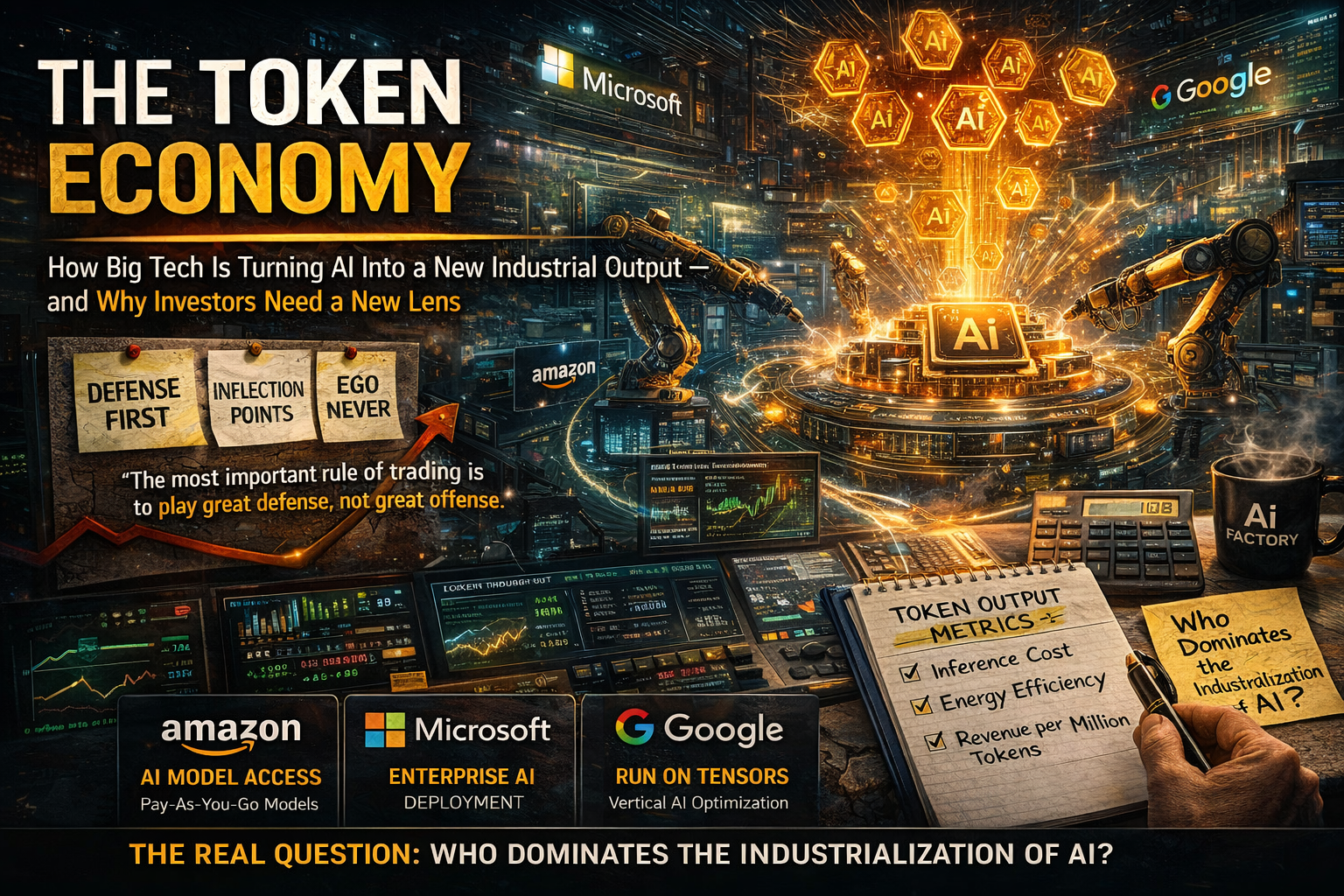
# The Token Economy
How Big Tech Is Turning AI Into a New Industrial Output — and Why Investors Need a New Lens
The most important mistake investors can make in 2026 is to think the AI race is still mainly about "who has the smartest model."
That was the first round.
The next round is about who can produce, distribute, and monetize intelligence at industrial scale.
In that sense, the relevant unit is no longer just a user, a seat, or a subscription.
It is increasingly the token — the atomic unit of AI work.
Satya Nadella has publicly described the coming world in terms of "token factories," arguing that token production will correlate with economic output and that energy and infrastructure will matter as much as model breakthroughs.
That is the right place to begin.
"Token economy" should not be read as a crypto phrase or a slogan. It is a way of describing the industrialization of machine intelligence.
Every prompt, completion, chain-of-thought step, agent task, code review, search augmentation, summarization pass, and inference cycle is ultimately processed as tokens. Once AI moves from demo to production, the strategic question changes from "Can the model do it?" to:
> "How cheaply, reliably, and at what scale can the system generate useful tokens?"
That is why inference cost, energy efficiency, chip architecture, and distribution control are becoming central to valuation.
Our core view is simple:
The next durable AI winners will not necessarily be the companies with the single best model on a benchmark. They will be the companies that build the strongest token loops — where infrastructure, model access, workflow integration, and monetization reinforce one another.
On that score, Amazon, Microsoft, and Google are not fighting the same war in the same way.
Each is building a different version of an AI factory.
Investors should stop treating them as one homogeneous "AI trade."
1. The New KPI: Cost, Energy, and Token Throughput
Nadella's "token factory" language is important because it reveals how at least one major CEO now wants investors to think about AI economics.
The implication is that intelligence is becoming an output that can be produced, measured, and optimized.
Once framed that way, one metric starts to matter more than investors appreciated a year ago: the cost and energy required to generate useful tokens at scale.
The exact phrase "dollar per watt per token" is not a standardized public metric, but the logic behind it is real. AI production has shifted from a world dominated by training headlines to one increasingly constrained by ongoing inference economics.
This is why the inference story matters so much.
Training is a capital event.
Inference is an operating system.
Once a model is deployed, costs recur every minute that users and agents call it. That is why sources focused on inference economics now describe a major inversion: inference is absorbing a larger share of spend, and falling cost-per-token is becoming strategically decisive.
NVIDIA itself is leaning into this framing, with Blackwell-era materials and ecosystem partners highlighting large cost-per-token reductions for production inference workloads.
In practical investing terms, this means the AI leaders will increasingly be judged not only by model quality, but by their ability to answer four questions:
- Who controls the cheapest compute?
- Who has the lowest-friction route to customer demand?
- Who owns the workflow where token consumption naturally expands?
- Who can keep more of the economics rather than passing them to outside chip vendors or cloud intermediaries?
Those are the right questions for this phase of the cycle.
2. Amazon: The Infrastructure Toll Collector
Amazon's AI position is often under-read because investors still describe it as "AWS plus some optionality."
That is too shallow.
The better way to understand Amazon is as the company trying to own the infrastructure layer of token production.
AWS remains one of the key places where enterprise AI workloads are trained, hosted, and increasingly served. Amazon is trying to deepen that advantage with a stack that includes Trainium, Inferentia, Bedrock, and partnerships that improve inference performance.
Anthropic remains deeply important here. Anthropic recently said Amazon remains its primary cloud provider and training partner, while also stating that Claude runs on a range of hardware including AWS Trainium, Google TPUs, and NVIDIA GPUs.
That correction actually makes the investment case more interesting, not weaker.
Amazon does not need absolute exclusivity to win.
It needs to remain the default place where enterprise token workloads are economically attractive.
The AWS-Cerebras partnership announced in March points in exactly that direction. AWS said it plans to bring Cerebras-powered inference to Amazon Bedrock, combining AWS Trainium servers, Cerebras CS-3 systems, and AWS networking to improve inference speed and performance.
This is the real Amazon story:
Not "Amazon picked one model winner."
But "Amazon is building the broadest and most flexible factory for token production."
If developers use Claude, Bedrock, Nova, or open-source models on AWS infrastructure, Amazon still monetizes the factory.
That makes Amazon the closest thing in big tech to an AI toll collector.
> It does not need to win the model brand war outright if it can keep winning the infrastructure economics war.
3. Microsoft: The Application Monopoly on Token Demand
If Amazon is trying to own token production infrastructure, Microsoft is trying to own token demand inside daily work.
This is a different and arguably more powerful position.
Microsoft already controls some of the most durable enterprise surfaces in the world:
- Office
- Teams
- Windows
- GitHub
- Dynamics
- Azure
- Copilot
That means it does not have to invent token demand from scratch. It can embed token consumption inside work people are already doing.
This distinction matters enormously for valuation.
The most attractive economics in AI may not come from producing the cheapest token in isolation. They may come from owning the context where token use becomes habitual, budgeted, and hard to displace.
Microsoft is exceptionally well placed there. If every meeting summary, document draft, code suggestion, enterprise search flow, and internal agent loop increases token consumption, then AI stops being a feature and starts becoming a new usage-based layer on top of already-captive workflows.
Nadella's token-factory framing makes the supply side visible.
But Microsoft's real edge may be the demand side.
There is another strategic advantage: Microsoft can route much of this through its own cloud and enterprise stack. Even where economics are shared with outside model partners, Microsoft still owns crucial monetization surfaces and customer relationships.
That is why the company's AI case is less about viral excitement and more about industrial conversion.
If AI spending inside enterprises evolves from experimentation to embedded operational behavior, Microsoft may capture a large portion of that through application-layer entrenchment.
4. Google: The Vertically Integrated Moonshot with the Highest Strategic Tension
Google may be the most misunderstood of the three.
It is tempting to say Google is "behind" because it monetized less aggressively at the start, or that it is "all in" because internal leadership has clearly pushed hard on Gemini.
Reporting around Sergey Brin's memo to Gemini-focused teams did indeed show an unusually intense internal tone, with Brin reportedly urging 60-hour workweeks as the company tried to accelerate AI execution. The better interpretation is that Google has elevated Gemini from a product priority to a firm-wide strategic imperative.
What makes Google so important in the token-economy framework is vertical integration.
It has:
- TPUs
- Gemini
- Chrome
- Workspace
- Search distribution
- Android reach
- One of the world's largest data and traffic graphs
In theory, that should make Google a monster.
In practice, it also creates a difficult balancing act.
Google must push token adoption and model usage without destroying the economics of its legacy search business or training the market to expect too much AI utility for free.
That makes Google's challenge less about technical capability and more about monetization sequencing.
This is why Google may have the highest strategic operating leverage of the group.
If it can successfully redirect large parts of Search, Workspace, and cloud demand into paid or economically productive token usage, the upside is enormous.
If it cannot, it risks becoming the company with the best integrated stack but the weakest incremental monetization discipline.
Investors should not underestimate either outcome.
> Google may be the most asymmetric token-economy bet in big tech precisely because its upside is so large and its self-disruption risk is so real.
5. The New Hardware Battlefield: Inference-First Silicon
The next hardware battlefield is increasingly about inference, not just training.
The exact label matters less than the economic function. Whether marketed as inference accelerators, domain-specific chips, or language-processing-optimized systems, the strategic goal is the same:
Reduce cost per token. Increase speed per watt.
Cerebras is one of the clearest examples of this shift. The company says its hardware is dramatically faster for decoding-heavy inference tasks, and recent reporting says AWS and Cerebras will deploy an inference stack in AWS data centers and through Bedrock.
This is where the market needs to think more clearly.
The old AI investment story was: training cluster, GPU scarcity, capex boom.
The new one is: inference economics, energy constraints, and sustained workload serving.
That does not make NVIDIA obsolete — far from it. It changes how NVIDIA wins. NVIDIA's current advantage is no longer just that it owns the hottest training chips. It is that its ecosystem is adapting to the inference era while keeping software, tooling, and developer lock-in strong.
The cleaner investor point is that the market is now shifting from a GPU scarcity narrative to an inference efficiency narrative — and that will re-rank both hardware winners and cloud/platform beneficiaries.
6. The Most Important Concept Investors Are Still Underestimating
Token demand is not the same as user demand.
This may be the deepest insight in the report.
In the software era, we often valued platforms by seats, subscribers, monthly active users, and ARPU. In the token era, those still matter, but a new question becomes decisive:
How many useful tokens can be induced, retained, and monetized per workflow?
That is a different lens.
An enterprise employee using AI casually is one thing.
An enterprise system where agents continuously generate, evaluate, revise, search, summarize, code, and act on behalf of users is another.
The second case produces what we might call token-intensive agentic workflows. These are likely to be the next big monetization unlock.
If agents become normal inside software development, internal knowledge systems, finance ops, customer support, and research environments, token consumption can scale nonlinearly.
That is where today's AI capex starts to look economically rational.
This is why investors should stop asking only, "Which model is best?" and start asking:
> "Which platform causes token consumption to expand in ways customers are willing to pay for?"
Microsoft has a strong answer in work software.
Amazon has a strong answer in infrastructure.
Google has a potentially massive answer if it can convert search, productivity, and cloud usage into economically disciplined AI behavior.
7. What to Watch Now
For Amazon, the key issue is whether Bedrock, Trainium, Inferentia, and the Cerebras collaboration produce a meaningful step-change in enterprise inference economics. If they do, AWS's role in the token economy strengthens substantially.
For Microsoft, the key issue is whether Copilot-style usage becomes routine budgeted enterprise behavior rather than an upsell novelty. If tokens become embedded inside the operating rhythms of Office, Teams, GitHub, and Azure, Microsoft's AI monetization may prove more durable than the market currently models.
For Google, the key issue is whether the company can turn vertical integration into paid token loops without giving away too much value in the process. It may have the strongest architectural position and still underperform if monetization discipline lags usage expansion.
Across all three, investors should watch:
- Inference cost curves
- Energy intensity
- Workload migration
- Agent usage
- The shift from training headlines to steady-state serving economics
Those are the real determinants of the next leg of AI profitability.
8. Investment Conclusion
The most important conclusion for U.S. investors is this:
Big Tech is no longer just building AI. It is building industrial systems for producing and monetizing machine intelligence. Tokens are becoming a useful way to think about that output because they connect model usage to infrastructure cost, energy consumption, workflow design, and recurring revenue potential.
- Amazon is building the infrastructure toll road
- Microsoft is building the application monopoly on token demand
- Google is attempting the highest-risk, highest-reward vertically integrated play
All three are credible winners, but for different reasons.
The right way to analyze them now is not as interchangeable AI beneficiaries.
It is to ask which company has built the strongest, most defensible token economy loop.
Final Line
The next AI bull market may not belong to the company with the smartest model.
It may belong to the company that can produce the most valuable tokens at the lowest real cost — and make those tokens impossible for customers to stop using.
This Special Report is Part 2 of Brutal Edge's "Intelligence Economy" series. Related analysis: The Rise of Claude (Part 1), NVIDIA: The Industrial Architect (Part 3), The Final Frontier — M7 AGI Map (Part 4).
Share your analysis
Keep it data-driven. No investment advice.
- Keep it data-driven and respectful
- No investment advice (buy / sell / hold)
- No spam, promotion, or solicitation
- No profanity or offensive content
- Violations are automatically removed
Data: Financial Modeling Prep, Alpha Vantage, CoinGecko
NOT investment advice. Always do your own research.