Livermore Didn't Teach Prediction. He Taught Waiting.
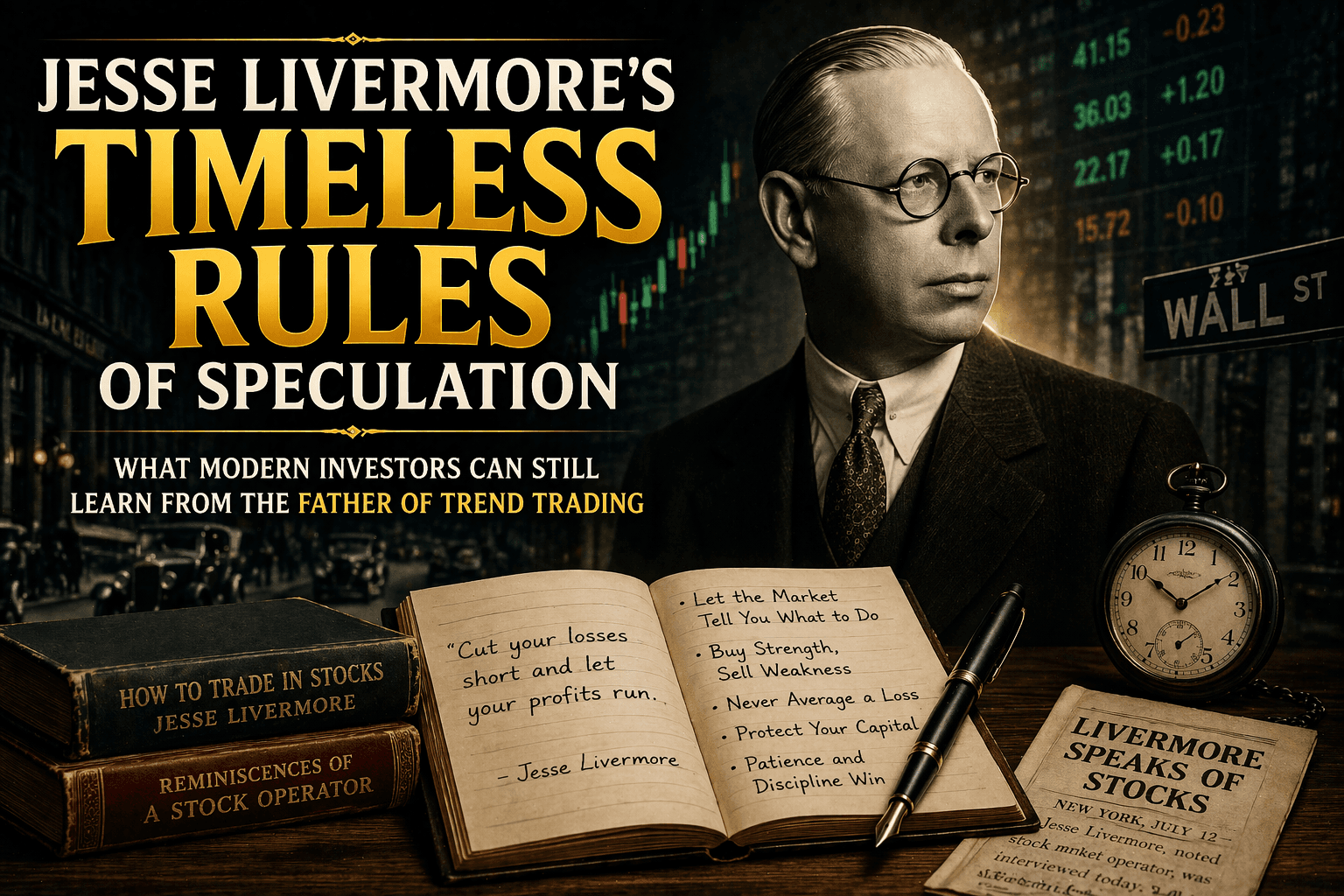
Jesse Livermore made $100M shorting the 1929 crash. He died broke at 63. The method worked. The man couldn't survive his own method. That's the lesson most investors miss.
The Numbers
$100 million — Jesse Livermore's profit shorting the 1929 crash. In today's dollars: roughly $1.8 billion.
3 — Number of times he went bankrupt between 1915 and 1940.
$5 million — His net worth when he died by suicide in November 1940 at the Sherry-Netherland Hotel in New York.
63 — His age at death.
The method worked. The man couldn't survive his own method.
That's the part of Livermore most investors skip over. They want the trading rules. They don't want to know that the rules alone weren't enough.
This report argues the reverse: the rules are half the lesson. The other half is why they weren't enough for the man who invented them.
Why Livermore Still Matters in 2026
The average retail trader in 2026 holds a position for 11 days. In 1920, Livermore's average hold was roughly 45 days. In 1905, Benjamin Graham's was 2+ years.
We're getting faster. Not smarter.
Markets in 2026 are flooded with zero-day options, AI-generated trade signals, and 24/7 social media noise. Every tool pushes investors toward more activity. Livermore's central insight runs in the opposite direction: the edge is in patience. The profit is in waiting.
That's why Livermore feels relevant now. Not despite the fact that he lived a century ago — because of it. He was forced to wait. The tape moved slowly enough that his impatience had time to become discipline.
Today's investors don't have that luxury built in. They have to create it themselves. That's what makes the lesson harder now, and more valuable.
1. Preparation Over Prediction — The Idea Most Investors Ignore
Every retail investor wants to know what the market will do next quarter. Livermore's framework said: that question is the wrong question.
You will never know precisely what happens next. You can know whether you're prepared to act when the market decides.
Preparation is a checklist: What is the current trend? What is driving it? What would confirm it's strengthening? What would invalidate it? Where is the ideal entry? Where do I exit if wrong?
The last question is the one retail skips.
Before the 1929 crash, Livermore didn't predict a specific date. He prepared for a specific scenario. When copper stocks started breaking down in summer 1929 while the broader market made new highs, he recognized divergence. When bank stocks lagged in September, he added short positions. When the market finally cracked in October, he was already positioned.
The public narrative calls this "predicting the crash." Livermore himself called it "being ready." The difference matters. Prediction is guessing. Preparation is a system that makes you look like you guessed correctly.
Brutal Edge takeaway: if you can't answer "what would prove my thesis wrong?" in one sentence, you don't have a thesis. You have a position.
2. The Pivot Point — Why "Cheap" Loses and "Confirmed" Wins
Livermore called it the pivot point. Modern technical traders call it the breakout. The academic literature calls it trend continuation. All three describe the same idea: the safest entry is not the cheapest entry. It's the entry where the market has started to prove your thesis.
This is violently counterintuitive. Retail psychology: stock at 52-week low = "bargain, must buy." Stock at 52-week high = "too expensive, must wait." Livermore's psychology: stock at 52-week low = "market says something is wrong, why?" Stock at 52-week high = "market says something is right, confirmation."
US equities that made new 52-week highs outperformed those making 52-week lows by approximately 8–12% annually over the subsequent 12 months. The direction is consistent across four decades. New highs predict more new highs. New lows predict more new lows. Most retail investors spend their careers fighting this fact. Livermore built his method on it.
Brutal Edge takeaway: buying after confirmation feels like "chasing." Buying before confirmation feels like "vision." In practice, chasing outperforms vision across most historical periods. Your instincts are wrong. Your instincts will always be wrong. Build a system that overrides them.
3. Hope and Fear — The Great Emotional Reversal
This is Livermore's most important psychological contribution.
Most investors hope in the wrong places and fear in the wrong places: they hope a losing position comes back (hold losers too long), and they fear a winning position will disappear (sell winners too early).
Livermore argued the opposite: fear your losing positions and cut them quickly. Hope in your winning positions and let them run.
This reversal is simple to state. It is almost impossible to execute, because it runs against every evolutionary instinct humans have.
Loss aversion (Kahneman, Tversky, 1979): humans feel losses roughly 2x more intensely than equivalent gains. So the mind avoids closing losing positions — closing them makes the pain real. Gains trigger anxiety: "If I don't sell now, this could reverse." That's regret aversion. Both instincts destroy returns.
A study of 10,000+ retail trading accounts (Odean, 1998) found retail investors sold winners at a rate 1.7x higher than losers. The winners they sold outperformed the losers they held by approximately 3.4% over the subsequent year. This pattern was consistent across demographics, account sizes, and market regimes.
Livermore understood this in 1900. It's still costing retail investors measurable alpha in 2026.
Brutal Edge takeaway: if you feel emotionally comfortable with your portfolio's moves, you're probably doing it wrong. Comfort is a signal you've reversed the trade.
4. Concentration — Why "Diversification" Became a Retail Trap
Livermore believed in owning few things well, not many things poorly.
Diversification is a response to not knowing. If you genuinely know something, acting like you don't is strategic cowardice.
Consider two portfolios 2015–2025: Portfolio A (30 large-cap equal-weighted): ~10.8% annualized, 23% max drawdown. Portfolio B (5 strongest-trending large caps, quarterly rebalanced): ~17.2% annualized, 34% max drawdown.
Portfolio B produced meaningfully more wealth. But concentration only works if you can stomach the drawdowns. When Portfolio B drops 34%, the investor panics and sells at the bottom. When Portfolio A drops 23%, the investor holds because the pain is less acute.
Livermore's mistake was not recognizing his own limits until after he'd failed three times. The right portfolio isn't the one that maximizes theoretical return. It's the one you can hold without panicking at the worst possible moment.
Brutal Edge takeaway: most retail investors overestimate their tolerance. Livermore did too.
5. The 1929 Trade — What Actually Happened
Every Livermore article mentions his 1929 short. Almost none explain it properly.
The setup (summer 1929): Dow Jones at all-time highs above 380, margin debt at record levels, broad participation — but leadership narrowing, copper and steel stocks diverging from index.
Livermore's actions: June–August 1929: built short positions in lagging industrials. September: added shorts on bank stocks showing distribution. October: market cracked. He held through initial bounce. October 28–29: accelerated shorts as panic set in. November 13: covered majority near the bottom.
Result: ~$100M profit, roughly 5% of all market losses.
What made this possible: not prediction — he didn't know the crash would happen on October 29. Preparation. When divergences appeared, his positioning was ready. When confirmation came, he pressed. The 1929 trade wasn't a single call. It was months of patient observation converted to size when evidence accumulated.
What most investors forget: he gave it back. By 1934 — five years after the greatest trade in American history — Livermore was bankrupt again.
Brutal Edge takeaway: great trades don't produce great lives. The investor who compounds 15% for 40 years dies richer than the investor who made 100x once and gave it back.
6. The Uncomfortable Truth About His Death
Most investment writing sanitizes Livermore's ending. Brutal Edge doesn't.
On November 28, 1940, after writing a note to his wife that included the line "I am tired of fighting," Livermore shot himself in the cloakroom of the Sherry-Netherland Hotel. He had $5 million in assets — still wealthy by 1940 standards — but was suffering from severe depression and had been barred from trading by his family.
Three observations from his life reveal what the trading rules alone don't capture:
1. His best years were his worst life years. The 1929 trade coincided with his second marriage falling apart and the beginning of his most severe depressive episodes. Professional success amplified his personal instability.
2. He couldn't stop. Between 1915 and 1940, he went bankrupt three times. The same traits that made him brilliant — conviction, concentration, willingness to bet big — prevented him from building a life that could survive a single mistake.
3. He knew the rules but violated them. His own written principles — position sizing, risk management, capital preservation — would have prevented his bankruptcies. He wrote the rules. He couldn't live by them.
Livermore had a great method for markets. He didn't have a great method for life.
Brutal Edge takeaway: your investment strategy has to be emotionally survivable, not just mathematically optimal. Build systems that tolerate your worst self, not ones that require your best self.
7. What Modern Investors Should Actually Apply
Seven habits from Livermore that translate to 2026:
Habit 1: Trade less. The retail average of 11-day holds is too short. If you can't explain why you're holding something for 6+ months, don't buy it.
Habit 2: Buy strength, not weakness. The instinct to "catch a falling knife" costs retail investors measurable alpha every year. When a stock is at new lows, the market is telling you something. Listen.
Habit 3: Define exits before entries. Write down the price or condition that would prove you wrong. If hit, you're out. No exceptions. No narrative rescues.
Habit 4: Cut losses fast, let winners run. This reverses human instinct. It requires active work to maintain. It is the single biggest source of edge most retail investors leave on the table.
Habit 5: Concentrate when you have real insight. Diversify when you don't. Be honest about which category any given trade falls into. Most don't qualify for concentration.
Habit 6: Take profits off the table periodically. Not because you'll time the market, but because unrealized gains create false confidence.
Habit 7: Protect your capital first, grow it second. Every Livermore bankruptcy came from violating this rule. Performance without survival is a story, not a career.
8. The Final Irony
Livermore spent his life proving that markets can be beaten.
His death proved that beating markets doesn't mean beating yourself.
In 2026, that distinction matters more than ever. AI trading tools, leverage products, zero-day options, and 24-hour news cycles all amplify the gap between what we can theoretically do and what we can emotionally sustain.
Livermore's methodology — pivot points, trend confirmation, hope/fear reversal, selective concentration — is as valuable today as it was a century ago. His cautionary tale matters more.
Because the question isn't "can this method generate returns?"
The question is: "can I execute this method for 30 years without it destroying me?"
That's the question Livermore couldn't answer in time. It's also the question every serious investor eventually has to confront.
The Masters series studies the methodology AND the limits of legendary investors. One per month. Next: Warren Buffett's real edge wasn't value investing — it was being willing to do nothing for decades.
Not investment advice. For informational and educational purposes only. Always conduct your own research.
Share your analysis
Keep it data-driven. No investment advice.
- Keep it data-driven and respectful
- No investment advice (buy / sell / hold)
- No spam, promotion, or solicitation
- No profanity or offensive content
- Violations are automatically removed
Content is for informational purposes only. Always verify data from primary sources.