Druckenmiller's Real Edge Wasn't Macro — It Was Knowing When He Was Wrong
30% annualized for 30 years with zero losing years. Everyone studies his NVDA trade. Almost nobody studies why he'd reverse it within weeks. The self-doubt is the strategy.
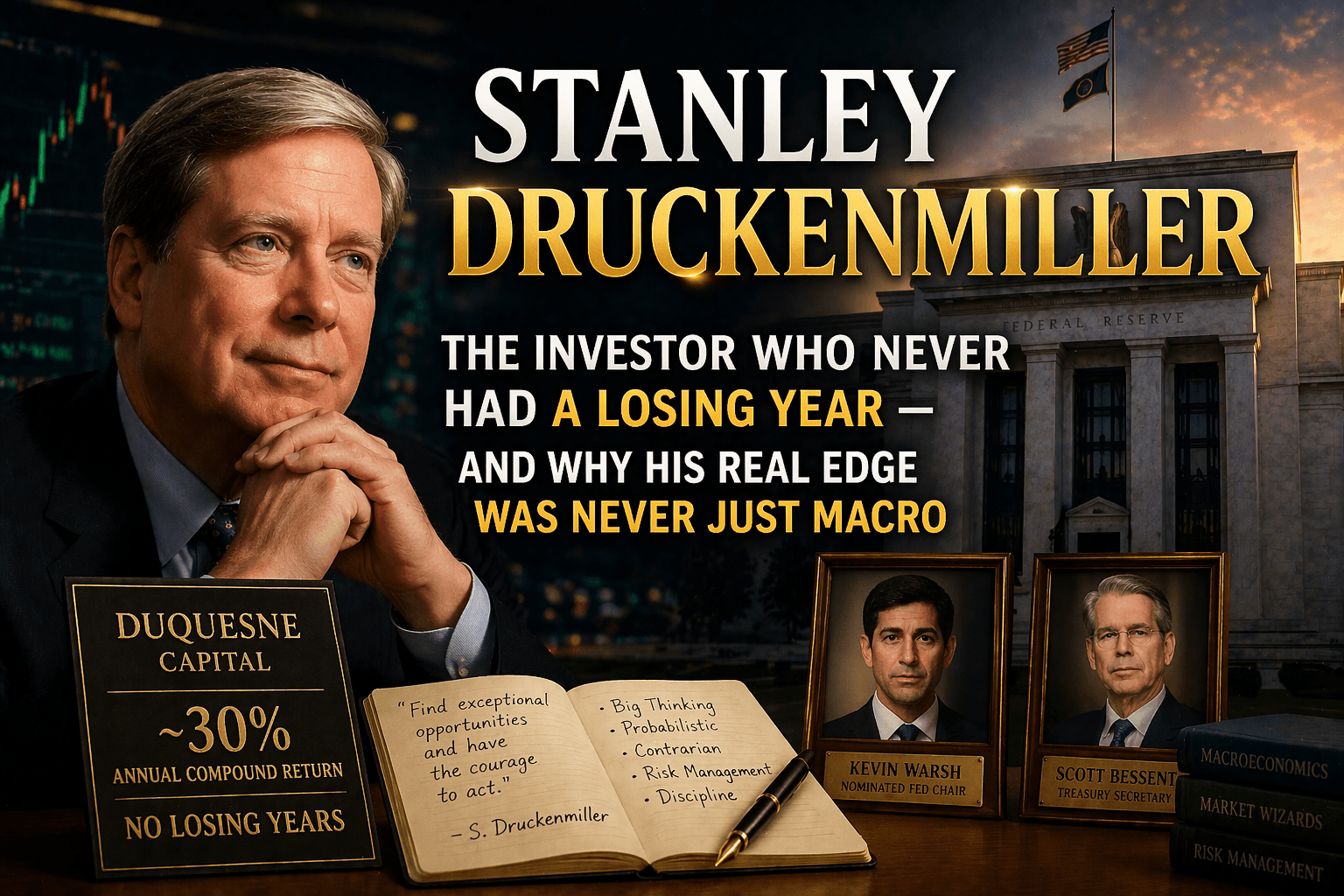
The Number
30 years. ~30% annualized. Zero losing years.
That's Stanley Druckenmiller at Duquesne Capital. Bloomberg's billionaire profile frames this record as one of the most replicated aspirations — and one of the least actually replicated performances — in modern finance.
Every retail investor has read about his philosophy. Almost nobody applies it.
The reason isn't that the philosophy is hidden. It's that most investors copy the wrong parts.
They copy "invest first, investigate later." They copy "look 18 months ahead." They copy "concentrate on conviction."
What they don't copy — because it's uncomfortable — is the part that actually made him rich: he was psychologically capable of reversing a thesis he believed 72 hours earlier.
That's the real edge. And it's the hardest thing in investing.
Why Druckenmiller Matters in 2026
Kevin Warsh was just nominated to chair the Federal Reserve. Scott Bessent is Treasury Secretary. Druckenmiller's intellectual network is now the core of U.S. economic policy, not a commentary track next to it.
Markets in 2026 are being driven by regime shifts, not quarterly earnings. AI is reshaping capex, labor, and energy demand simultaneously. The Fed leadership change reframes the monetary conversation. Fiscal credibility and the dollar are in play together for the first time in a decade.
In this environment, static valuation screens and backward-looking DCF models become less useful. What matters is the ability to detect which variable changes first and which assets are most sensitive to that change.
That is exactly the type of market Druckenmiller historically dominated. Which is why studying him now isn't nostalgia. It's tactical.
1. "Invest First, Investigate Later" — What He Actually Meant
The most misquoted line in his philosophy. Taken literally, it sounds reckless. Taken correctly, it's the opposite.
Druckenmiller wasn't saying "skip the work." He was saying: markets move before certainty arrives. By the time every channel check is done and every spreadsheet is clean, the opportunity is already in the price.
There's a massive difference between "I'll buy now and figure it out later" (reckless) and "I'll take a starter position on strong pattern recognition, then size up as conviction builds, and cut fast if it breaks" (disciplined asymmetry).
The second version requires two things most investors don't have: fast asymmetry recognition — the ability to see a major setup in minutes, not weeks — and instant exit willingness — selling before your ego catches up with the data.
His NVDA trade is the cleanest example. He once said he didn't even know how to spell Nvidia three months before building a large position early in the AI wave. Then he later reversed it. That full sequence — enter early, size up on confirmation, reverse when conviction broke — is the method.
Brutal Edge takeaway: you don't need perfect certainty to act. You need a clear exit plan the moment your thesis breaks. If you can't articulate what would make you wrong before you enter, you don't have a thesis. You have a hope.
2. The Variable That Actually Moves the Stock
Most investors look at what's easy to measure. Druckenmiller looked at what actually drives price. Those are rarely the same thing.
Retail investors stare at income statements when the market is pricing liquidity. They model earnings when the market is trading regulation. They obsess over P/E when the stock is being driven by capital cycle positioning.
Druckenmiller's core skill was isolating the single variable the market hadn't fully recognized yet.
For NVDA, the variable wasn't "AI is big." Every investor knew that by mid-2023. The variable was: hyperscaler capex acceleration (discoverable from AWS, Azure, GCP earnings calls), CUDA software lock-in (discoverable from developer adoption data), HBM supply constraints (discoverable from Micron/SK Hynix commentary), and data center power economics (discoverable from utility filings). Four variables. Most investors tracked zero.
This is why generic "AI exposure" ETFs underperformed concentrated NVDA/AVGO positions by 300+ percentage points through 2024-2025. The index couldn't distinguish between companies actually monetizing the variable and companies just tagged with the label.
Brutal Edge takeaway: stop asking "what does this company do?" Start asking "what will change about this business that the market hasn't priced yet?" If you can't name the specific variable, you're not investing. You're collecting tickers.
3. The 18-Month Rule — Where Price Actually Lives
The most uncomfortable truth in investing: price is not documentary. Price is anticipatory.
Markets don't tell you what is. They tell you what other investors believe will be — somewhere between 6 and 18 months from now.
This is why investors who wait for headlines feel permanently late. By the time CNBC runs a segment on a trend, the stock is up 80% and the easy money is gone.
Druckenmiller's edge was that he priced the economy as it would look 12-18 months out, not as it existed today.
Concrete example: when the Fed signals a pause before actually cutting rates, equity markets typically start repricing the cut within weeks. By the time the first cut actually happens, bond markets have already moved 100+ basis points. The investor who waits for confirmation buys the top.
The same sequence plays out in every cycle. Housing recovers before unemployment falls. Semiconductors bottom before factory orders turn. Crypto tops before retail flows peak.
The practical question becomes: what will be obvious 18 months from now that still feels arguable today? That question forces you to take a position before consensus, live with being called wrong for 6-12 months, and distinguish between being early and being wrong.
Brutal Edge takeaway: the only way to generate alpha is to be right before others are. That means you will feel wrong most of the time you're actually right. If your portfolio looks comfortable, you're probably already in the same trade everyone else has.
4. Technicals as Confirmation, Not Religion
This is where most retail investors misuse Druckenmiller's playbook.
They hear "he uses charts" and decide to become chartists. Then they spend weekends drawing trendlines on 5-minute candles and wonder why they're not making 30% annually.
Druckenmiller didn't use technicals to generate thesis. He used them to test whether the market was starting to agree with his thesis. The distinction is everything.
Chartist approach: "The chart says X, therefore X is happening." Druckenmiller approach: "My macro thesis says X. Is the chart starting to confirm X or reject X?" In the first framework, the chart is the argument. In the second, the chart is the judge of your argument.
If his macro view said the dollar should weaken on Fed dovishness, and price action started confirming it, that gave him confidence to press size. If price action diverged from thesis, that was his signal to question the thesis — not force the trade.
Crowded technical patterns in 2026 are less powerful than they were in the 1990s. Too many investors watch the same patterns. Too many quant funds trade against retail pattern-recognition. The edge has compressed.
Brutal Edge takeaway: if you use charts without a thesis, you're guessing. If you have a thesis but ignore charts, you'll over-size bad timing. The combination is where the skill lives.
5. The Self-Doubt That Made Him Rich
This is the part nobody wants to quote.
The public image of a great macro trader is someone thundering about currencies, crushing anyone who disagrees, radiating conviction. Druckenmiller's actual psychological profile seems to have been closer to: permanently suspicious of his own conclusions.
Forbes profiled him recently. What he chose to discuss publicly wasn't his triumphs. It was a recent mistake. That reflex matters more than people realize.
Great long-term performance isn't driven by being confident. It's driven by being psychologically incapable of defending a broken thesis.
The math of compounding is brutal. At +30% every year: 30-year outcome = 2,619x. With one -50% year: 1,310x — half. With two -50% years: 655x — a quarter of what full compounding would have produced.
Avoiding blow-ups matters more than hitting home runs. And avoiding blow-ups requires the psychological ability to sell something you publicly championed three weeks ago.
Most investors can't do this. Their identity is fused to their positions. They'd rather hold a -40% loser for two years than admit the thesis was wrong at -8%.
Druckenmiller's 30-year record isn't built on being right more often than others. It's built on being wrong more briefly.
Brutal Edge takeaway: if you can't separate your identity from your position, you will never compound at 30%. You will compound at whatever your ego allows — which is usually single digits, net of the blow-ups.
6. When Concentration Actually Makes Sense
Druckenmiller diversified when uncertain. That part gets copied. What gets ignored is: when he saw extraordinary asymmetry, he went concentrated, and didn't apologize for it.
This violates almost every retail investing rulebook. "Never put more than 5% in one stock." "Always maintain 20+ holdings." "Diversify across sectors."
Those rules exist because most investors can't tell the difference between high-conviction and high-hope. For the average investor, those rules are correct. For investors with genuine asymmetric insight, those rules are the reason their best ideas don't change their net worth.
The principle: portfolio construction should reflect the quality of the opportunity, not a generic rulebook.
When Druckenmiller believed he saw a 10x setup with manageable downside, he was willing to be concentrated. When he was uncertain, he diversified aggressively. His position sizing was a function of conviction × asymmetry × downside limit — not a static target.
Most retail investors do the exact opposite: small money in their best idea (because they're "uncertain"), large money in "safe" diversified ETFs (because it feels prudent). They end up owning everything the market owns, minus the cost of management.
Brutal Edge takeaway: diversification is a response to not knowing. If you actually know something, acting like you don't is strategic cowardice. The trick is being honest about which category you're in on any given trade.
7. The Five Habits That Actually Translate
Great investor studies usually become motivational posters. Here are the five habits from Druckenmiller's method that actually translate to retail execution.
Habit 1: Act before comfort. If everyone in your feed agrees with you, you're already late. The uncomfortable position is usually the profitable one.
Habit 2: Define your exit before you enter. Write down what would prove you wrong. If that price level, earnings miss, or macro data point is hit — you're out. No narrative rescue.
Habit 3: Find the driver variable. For every position, answer in one sentence: "This works if X changes, and it fails if X doesn't." If you can't answer that, you don't have a thesis.
Habit 4: Think 18 months out, not 3. Stop predicting next quarter's earnings. Start asking what the market will look like after the current cycle peaks or troughs.
Habit 5: Detach conviction from identity. Your positions are not your personality. The moment you refuse to consider selling, you've already lost.
8. Why This Framework Works in 2026 Specifically
The 2026 market environment plays directly to Druckenmiller's strengths.
Regime shift, not cyclical rotation. AI is rewriting sector leadership. Traditional "buy the dip" in last cycle's winners — consumer staples, healthcare, REITs — isn't working. The variable has changed.
Fed leadership transition. Warsh chairing changes the monetary policy conversation. Investors anchored to the Powell-era playbook are fighting the last war.
Fiscal credibility in play. The dollar, Treasuries, and gold are all being repriced against sovereign debt sustainability questions. This isn't a standard macro environment.
Concentration risk in indices. S&P 500 is more top-heavy than any prior decade. "Passive diversification" isn't what it was 10 years ago.
In this market, the investor who recognizes regime shifts early, identifies the specific variable driving each asset, thinks 18 months out, concentrates on highest-conviction asymmetries, and reverses positions without ego has structural advantages over the investor running 2015 playbooks. Druckenmiller's method wasn't designed for 2026. It happens to fit 2026 almost perfectly.
Final Thought — Why He's Hard to Imitate
Druckenmiller's legend is usually summarized with the number: 30 years, ~30% annualized, no losing years. The number is the result. It's not the lesson.
The lesson is that great investing requires holding contradictions: fast, but not reckless; convicted, but not attached; aggressive, but permanently capable of retreat; macro-thinking, but trader-reactive; self-confident enough to size, self-doubting enough to reverse.
Most investors naturally lean to one side of each pair. Druckenmiller lived in the middle. That's not an intellectual position. It's a psychological one.
Which is why studying his returns is easy, and replicating his method is almost impossible. But trying is the only path to better outcomes than your current returns.
For the investor who's honest about which habits they haven't adopted — that's where the edge starts.
The Masters series studies the methodology, not the mythology, of legendary investors. One investor per month. Next up: Warren Buffett's real edge wasn't value investing — it was being willing to do nothing for decades.
Not investment advice. For informational and educational purposes only. Always conduct your own research.
Share your analysis
Keep it data-driven. No investment advice.
- Keep it data-driven and respectful
- No investment advice (buy / sell / hold)
- No spam, promotion, or solicitation
- No profanity or offensive content
- Violations are automatically removed
Content is for informational purposes only. Always verify data from primary sources.