Your First 5 Years: A Realistic Roadmap
Eleven weeks of concepts now become one plan. Here is what a competent beginner actually does in month one, year one, and year five — a realistic path from where you are now to where durable investors live.
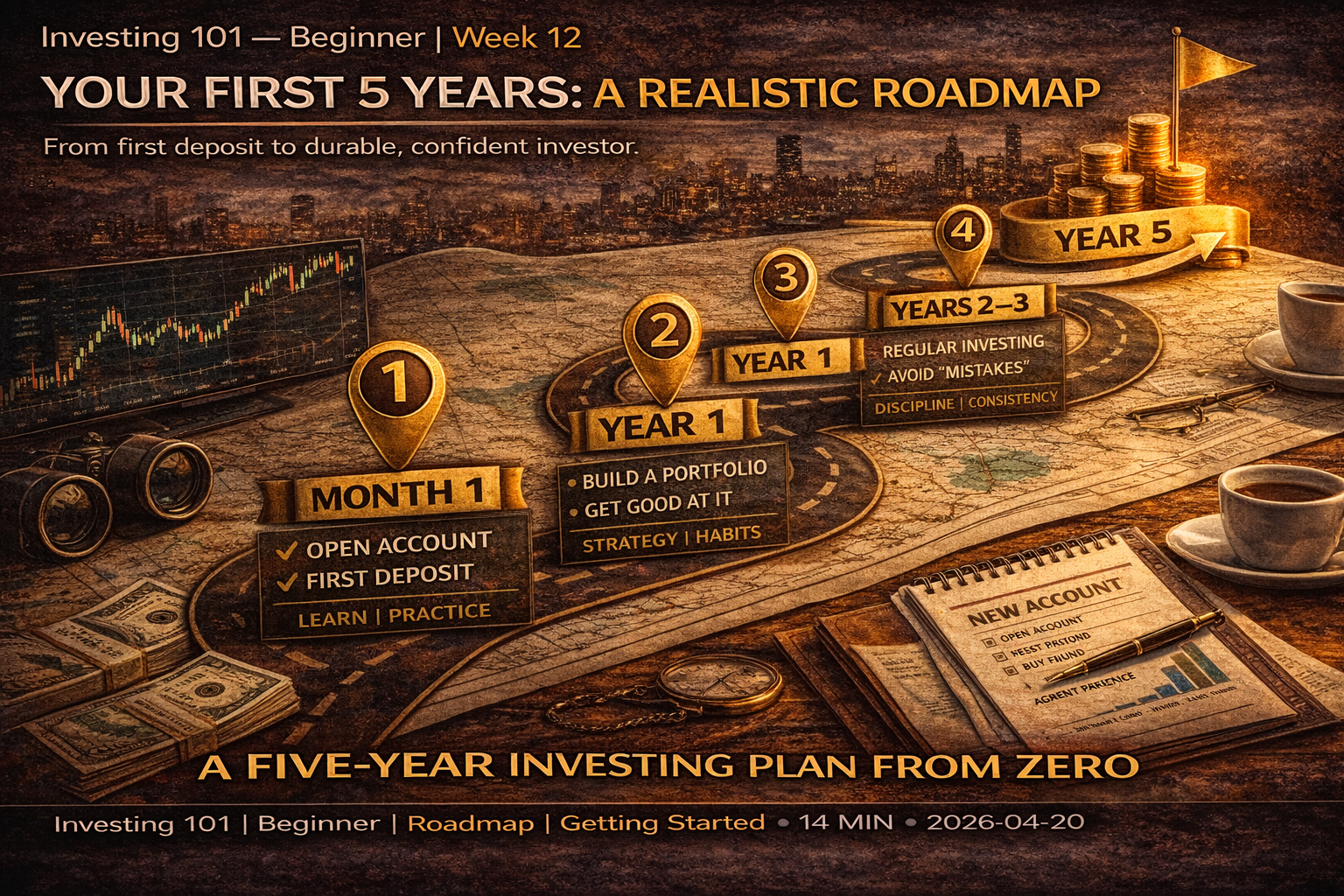
Your First 5 Years: A Realistic Roadmap
You have reached the end of the Beginner Series. Eleven weeks of concepts, from what a stock actually is to the psychological patterns that derail most retail investors. If you have worked through the material seriously, you have more investing literacy than the majority of people who trade stocks on any given day.
The question now is: what do you actually do with it?
This week we move from concepts to execution. What does a competent beginner's first month look like? First year? First five years? This is not a generic motivational roadmap. It is a specific, realistic sequence of actions, calibrated to what actually works for someone starting from zero — not someone with a large inheritance, not someone with twenty hours per week to devote to markets, just a person with a regular job, a reasonable income, and the intent to build wealth over decades.
The path is simpler than most people expect. The simplicity is precisely why it works.
The Core Principles That Govern Everything
Before we get to the timeline, five principles need to be stated explicitly. Everything in the roadmap follows from them, and any time you find yourself tempted to deviate, come back to these.
Start now, with small amounts, regularly. The single most important variable is time in the market. Not size of initial investment. Not skill in picking stocks. Time. A modest portfolio started at age 25 and contributed to regularly will beat a much larger portfolio started at age 45 in nearly every realistic scenario, because the former has an extra twenty years of compounding. The implication: start with whatever you can afford today, even if it seems trivially small. Get the clock running.
Emergency fund comes first. Before you invest any substantial amount in the stock market, you need a cash cushion sufficient to cover three to six months of essential expenses. This is not an investment. It is not supposed to grow aggressively. It is insurance against the scenarios — job loss, medical emergency, major unexpected expense — that would otherwise force you to sell investments at the worst possible time. Investors without emergency funds are investors on thin ice.
Low-cost index funds are your default. We covered this in Week 10. For most people, for most of their portfolio, for most of the time, broad-market index funds are the right answer. Not because they are exciting, but because they work. Individual stock picking is an optional layer on top, not the foundation.
Tax-advantaged accounts first, then taxable. If you have access to retirement accounts with tax advantages — a 401(k), IRA, or the equivalent in your country — fill them before contributing to taxable accounts. The compounded tax savings over decades are enormous.
Boring is the goal. The investors who build real wealth over decades are the ones whose investing lives are uneventful. They set things up correctly. They make small, regular contributions. They rebalance occasionally. They ignore the noise. They do this for thirty years. Anyone whose investing life feels exciting on a regular basis is probably doing something wrong.
These five principles cover maybe 90% of what matters. Everything below is about implementing them concretely.
Month 1: Foundation
The first month is not about investing. It is about putting the infrastructure in place so that investing can happen mechanically from here forward.
Week 1 — Assess your financial baseline. Before any investing, you need to know where you actually stand. Add up your assets (cash, savings, existing investments). Add up your liabilities (credit card debt, student loans, any other debt). Calculate your monthly income after tax and your monthly essential expenses. These four numbers — assets, liabilities, income, expenses — are your financial coordinates. You will be surprised how many people do not know them.
Week 2 — Build or confirm your emergency fund. If you do not have 3-6 months of essential expenses in a liquid savings account, your first priority is getting there. This takes as long as it takes. A high-yield savings account at a major bank is where this money lives. Not in the stock market. Not in bonds. Cash, accessible within a business day.
Week 3 — Handle high-interest debt. If you have credit card debt or any other debt at interest rates above about 8%, paying it down is mathematically superior to investing in the stock market. The stock market has historically returned about 10% per year on average, but with significant volatility. Credit card debt compounds at 20% or more with no volatility — you are guaranteed to pay it. Kill it first.
Week 4 — Open the accounts. As covered in Week 3 of this series: pick a broker (Fidelity, Schwab, Vanguard are the safe choices for US beginners), open a taxable brokerage account, and if you are eligible, open a Roth IRA at the same broker. If you have an employer 401(k), enroll at a minimum sufficient to capture any employer match — this is free money and passing it up is a mistake of hundreds of thousands of dollars over a career.
At the end of month one, you should have: clear numbers about your financial position, an emergency fund in place, high-interest debt being paid down or eliminated, accounts open and ready to receive money. You have not invested anything yet. That is fine. The foundation is more important than the rush.
Months 2-3: First Contributions
Now the investing begins.
Set up automatic contributions. Whatever amount per month you have decided you can consistently contribute, set up an automatic transfer from your checking account to your brokerage on a fixed date each month — ideally right after payday, so the money moves before you have a chance to spend it elsewhere. This is the single most important automation you will set up. It converts investing from a decision you have to make each month into a mechanical process that happens in the background.
Start with a broad-market index fund. In your Roth IRA (if you have one) and in your taxable account, your first purchase should be an S&P 500 or total US stock market index fund. Vanguard's VTI or the Schwab and Fidelity equivalents are standard choices. Expense ratios at all the major providers are now 0.03% to 0.10%, which is as close to free as investing gets.
You do not need to pick between index funds excessively. VTI, VOO, SPY, FXAIX, SCHB — they are all broadly similar. Picking any reasonable one is far more important than picking the "right" one.
Do not pick individual stocks yet. Resist the urge. The early months are about building the habit of regular contribution and getting comfortable with watching your portfolio move. Individual stock picking adds complexity that you do not need while you are still developing emotional familiarity with market volatility.
Watch one market drawdown without doing anything. This one is not scheduled — it happens when it happens. Early in your investing life, the market will drop somewhere between 5% and 15% at some point, probably multiple times. Your only job is to keep contributing on schedule and not panic-sell. If you successfully do nothing during your first meaningful drawdown, you have passed a test that many beginners fail, and you have proven something to yourself about your temperament.
By the end of month three, your portfolio is small but real. Automatic contributions are happening on schedule. You own a broad piece of the market through a single low-cost index fund. You have watched some market volatility without acting on it. This is a lot. Most people never get here.
Months 4-12: Building the Habit
The next nine months are about consistency.
Keep contributing. Every month, the automatic transfer moves money into the brokerage. Every month, you buy more of the index fund. You may or may not also add international exposure (an international index fund like VXUS) and perhaps a small allocation to bonds (though for someone young with a long horizon, this is optional). The simpler your portfolio stays in year one, the better.
Read one annual report. Sometime during this year, pick a company you know well — whose products you use, whose business you understand intuitively — and read their full annual report (10-K). This is a long document, perhaps 100-200 pages. Do not rush. Take it in pieces over a couple of weeks. You will not understand everything. That is expected. What you are building is familiarity with how public companies describe themselves, not an expert analysis.
Learn one concept you did not know before. Each month, pick one investing concept — a specific valuation metric, a specific type of business model, a specific historical market episode — and learn it properly. Depth beats breadth at this stage. You are building a slow accumulation of genuine understanding, not a shallow surface knowledge of everything.
Start tracking your portfolio in one simple spreadsheet. Date. Total value. Total contributions. That is all three columns. Update it monthly. Over time, this simple record will show you something important: how much of your portfolio's growth came from market returns versus from your own contributions. In the early years, contributions dominate. In the later years, market returns dominate. Seeing this transition happen is one of the more motivating things in a long-term investing life.
Do not check prices daily. This was covered in Week 11 but bears repeating. Daily price checking is one of the most corrosive habits a retail investor can develop. A monthly check is plenty in year one.
By the end of year one, the habit should be automatic. Contributions happen. The balance grows. You ignore the noise. You have owned the market through at least one moderate drawdown. You know roughly what you own and why. You have accumulated a small amount of genuine understanding through deliberate learning.
This is the base that everything builds on.
Year 2: Deepening
Year two is when things start to get interesting — and when most beginners get themselves into trouble by trying to do too much.
Maintain the core discipline. The automatic contributions continue. The index fund keeps being bought. Nothing that worked in year one stops working in year two. Whatever you add during year two, you are adding on top of the foundation, not instead of it.
Consider adding individual stocks, carefully. By year two, if you are still engaged with the process, you may want to start buying individual stocks. This is fine. The rule: no single individual stock position should exceed 5% of your total portfolio, and collectively, all your individual stock picks should not exceed 25-30% of the portfolio in this early phase. The other 70%+ stays in broad index funds. You are adding selective conviction on top of a broadly diversified base, not replacing the base.
Pick businesses you genuinely understand — whose products you use, whose customers make sense to you, whose economics you have examined using the tools from Weeks 4 through 9 of this series. Write a short investment thesis for each holding, as covered in Week 11. Keep the theses. Refer to them when prices move.
Start reading about investors you admire. The writings of Warren Buffett, Charlie Munger, Peter Lynch, Howard Marks, and similar long-term thinkers are freely available in letters, interviews, and books. Read slowly. One letter per week is plenty. These are compressed wisdom from people who have thought about markets for decades. The ideas will sink in over time in ways a quick skim cannot deliver.
Have your first tax experience. Depending on your jurisdiction and account types, your first full tax year of investing will generate some tax forms — dividend statements, interest, possibly capital gains if you sold anything. Handle them correctly. Understanding how investment income flows through your tax return is part of being a competent investor, and it is much easier to learn while the numbers are small.
By the end of year two, your portfolio is bigger, your habits are deeper, and you have probably started to develop genuine opinions about specific businesses and industries. You still own mostly index funds. The individual stock slice, if you have one, is modest and reasoned. You have not done anything dramatic. That is the point.
Years 3-5: Compounding Takes Over
Years three through five are where the math of compounding starts to make itself visible, and where some of the psychological tests described in Week 11 will show up for real.
The contributions become a smaller portion of growth. In year one, most of your portfolio's growth came from the money you put in. By year three, a meaningful portion comes from returns on what is already invested. By year five, investment returns may rival or exceed annual contributions for some people, depending on income and contribution amounts. This shift is one of the genuinely motivating experiences of long-term investing. Your money is starting to work harder than you are.
You will probably see a major market event. In any five-year period, there is typically at least one episode of market stress — a correction of 15-25%, sometimes a bear market of 30%+. Year three or four is a reasonable estimate for when your first significant drawdown as an invested person might occur. This is not pessimism; it is statistical realism.
Your job, when it happens, is to do nothing. Continue the automatic contributions (on a regular schedule, they now buy more shares at lower prices — exactly what dollar-cost averaging is supposed to do). Do not watch prices obsessively. Do not read the news compulsively. Do not sell. If you have written investment theses for your individual holdings, read them and ask whether anything has fundamentally changed about the businesses, or whether it is just the prices that moved. In the vast majority of cases, it is just the prices.
Surviving your first real bear market as an invested person, without selling, without abandoning the plan, without making panicked decisions, is the single most important skill development of the early years. The people who do this join the small group of investors who will actually harvest long-term compound returns. The people who fail this test tend to exit the market, lick their wounds, and return years later when prices are high again — which is precisely the opposite of what works.
Your portfolio evolves naturally. By year five, if you added individual stock positions in years two or three, some will have done well and some will have not. The ones that did well have become larger portions of the portfolio; the ones that underperformed have become smaller. This is normal and generally desirable. You may want to rebalance — trim outsized winners, reassess persistent laggards, confirm that the overall structure still makes sense. Annual rebalancing, as discussed in Week 10, is plenty.
Your understanding is deeper. If you have been reading annual reports, studying investors you admire, and paying attention to your own decisions, year five you is meaningfully more competent than year one you. You have seen real market volatility. You have watched specific businesses evolve over multiple years. You have made some decisions that worked and some that did not, and learned from both. This is the compounding of knowledge that parallels the compounding of capital.
What Not to Do in the First Five Years
Equally important as the roadmap itself is the list of things to avoid. These are the failure modes that derail most beginners.
Do not day trade. There is no clearer research finding in finance: day traders, as a group, lose money. The percentage who beat a simple index fund strategy is in the single digits, and that small group often cannot sustain their edge. Day trading feels like skill; it is almost always something closer to a random expensive hobby.
Do not use margin. Borrowing against your portfolio to buy more investments turns volatility from a temporary discomfort into a permanent risk. A margin call during a drawdown can force you to sell at the worst possible time, crystallizing losses. Beginners should operate entirely in cash.
Do not trade options. Options are sophisticated instruments that require real expertise to use without destroying capital. The retail options trader losing 80%+ of their capital within a year is a documented statistical pattern. None of this belongs in a beginner's portfolio.
Do not try to time the market. Attempts to jump out before crashes and jump back in before rallies fail far more often than they work, and the cost of missing just a few of the market's best days over a decade dramatically reduces long-term returns. Staying invested through the volatility is, historically, a better strategy than trying to be smart about it.
Do not chase the hot sector or theme. Every year there is a "this is the future" narrative that gets retail investors excited. AI today. Crypto a few years ago. Cannabis before that. Biotech, 3D printing, cloud computing, internet stocks — the list goes back decades. Some of these turn out to be real. Most deliver disappointment to the people who crowded in at the top. As a beginner, you have no edge in identifying which is which. Stay broad.
Do not take advice from strangers on social media. The financial corners of Twitter, Reddit, YouTube, and TikTok are filled with people who appear to be making fortunes. Some are lying. Some got lucky and will eventually lose. Some are promoting specific positions they already own and benefit from you buying. Almost none are structured incentives aligned with yours. Read books and letters by people with multi-decade track records who explain their reasoning. Ignore anonymous accounts making bold calls.
Do not conflate being busy with being productive. The urge to "do something" with your portfolio is constant. Most of the time, doing nothing is the correct action. An investor who reviews the portfolio once a quarter and makes changes only when there is a real reason is almost always outperforming the investor who fiddles weekly.
Where You Are After Five Years
If you follow this roadmap reasonably well, here is what your situation looks like at year five:
You have five years of continuous contributions in the market, giving the compounding engine a meaningful runway. You have lived through at least one significant drawdown and did not sell. You have a portfolio dominated by low-cost index funds, possibly with a modest slice of individual stocks you understand well. You have the habit of automatic contributions. You have a growing library of quarterly and annual reports you have read, and a deepening understanding of how businesses work. You know your own emotional tendencies and have built defenses against them.
You are not rich. Five years is not long enough for compounding to produce dramatic absolute wealth unless your contributions were very large. But you are now on a trajectory. You are positioned for what happens in years 10, 20, and 30 — which is where compounding produces the outcomes people describe when they talk about "wealth building." The first five years are the setup. The next twenty-five are the payoff.
Most people who intend to become long-term investors never make it through the first five years. They get discouraged by early returns that feel modest. They panic during a drawdown. They chase a hot trend. They lose interest. If you get through year five intact, on a reasonable path, still contributing on schedule — you have already separated yourself from the majority.
Closing the Series
Twelve weeks ago, we started with the most basic question: what is a stock, really? The goal of this series was to give you everything a beginner needs — genuinely needs — to start investing competently, without the noise, sales pitches, and hype that usually surround the subject.
You now know:
- What you actually own when you own a share
- How the market moves shares between people
- How to open an account and connect to the system
- How to read the three financial statements that describe any business
- How to think about a business model and its durability
- How to use valuation ratios honestly
- How dividends and total return work
- How portfolio construction and diversification shape risk
- How your own mind will try to sabotage you and how to resist
- And now — what to actually do, in what order, over what timeframe
This is real knowledge. It is not a complete education in investing — that takes decades — but it is a substantial foundation. What you do with it from here is your work.
The Intermediate Series, when it is released, will build from this foundation into deeper valuation (discounted cash flow, economic moat analysis at depth, return on invested capital), sector-specific thinking, macroeconomic context, and portfolio construction at more advanced levels. You will be ready for it if you want to go there.
For now, the most important thing is simpler: start. Apply what you have learned. Open the account. Make the first contribution. Build the habit. Let the compounding begin.
The market will be there. The businesses will be there. The opportunity will be there. The only variable is whether you are in the game, patiently, consistently, for long enough to let the math work.
You have the tools. Go use them.
Investing 101 — Beginner Series. Week 12 of 12. End of series.
The Intermediate Series builds on this foundation with deeper valuation, advanced portfolio construction, and sector analysis.
Educational content only. Not investment advice. Always do your own research.