Dividends and Total Return
Dividends are one of two ways you actually capture value as an owner. Understand them well — and understand what total return really means — and you see the investing game clearly for the first time.
Dividends and Total Return
Back in Week 1 we established something that most beginners still forget as soon as they see a price chart: there are exactly two ways you make money as a stock owner. The business distributes cash to you directly, or the business grows in value and someone later pays more for your share.
Everything you have learned since then — financial statements, business models, valuation — has been about understanding which businesses are likely to do one or both of those things well over time. Now we look at the first mechanism directly.
Dividends are cash payments from a company to its shareholders. They are the clearest, most tangible form of return on investment you can receive. You own a share. Quarter after quarter, year after year, money arrives in your account. No need to sell. No need to time anything. The business earns money, and a portion of that money becomes yours because you are an owner.
This sounds straightforward, and at the basic level it is. But there are important nuances — about what dividends actually signal, how to think about "dividend yield," what the tax implications are, and why the concept of total return is more useful than either dividends or price gains alone. Understanding these properly is the final piece of the valuation foundation.
What Dividends Actually Are
A dividend is a cash payment made by a company to its shareholders, usually on a regular schedule. In the United States, most dividend-paying companies pay quarterly — four times per year. In other markets, semi-annual or annual payments are more common.
The mechanics are simple. The company's board of directors declares a dividend of, say, $0.50 per share. The company sets a "record date" — if you own the stock on that date, you are entitled to the dividend. A few days after the record date, the cash shows up in your brokerage account. If you own 100 shares, $50 arrives. If you own 1,000 shares, $500 arrives. That is it.
Behind this mechanical simplicity is a meaningful economic event. The company earned profits. The board decided that some portion of those profits should go back to the owners as cash, rather than being reinvested in the business or used for some other purpose. The dividend is the board saying: we have more cash than we can productively use internally, so we are returning it to you.
This is why dividends are, in the long run, one of the most powerful signals a company can send. A business that consistently pays and raises dividends is a business generating real cash — and a business whose management has the discipline to return that cash to owners rather than spending it on empire-building acquisitions or executive perks.
Dividend Yield
The most common dividend metric is dividend yield, which expresses the annual dividend payment as a percentage of the current share price.
Dividend Yield = Annual Dividend Per Share / Current Share Price
If a company pays $2 per year in dividends and its stock trades at $50, the yield is 4%. If the stock price rises to $100 with the same dividend, the yield falls to 2%. If the price falls to $25, the yield rises to 8%.
This inverse relationship is important to understand. A rising dividend yield on a stock can mean one of two things: either the company raised its dividend, which is generally good, or the stock price fell, which may be bad. You cannot tell which by looking at the yield alone. You have to look at what is driving it.
For context, the broad US stock market has historically yielded somewhere around 1.5% to 2.5% in dividends on average. Stable, mature dividend-paying sectors — utilities, consumer staples, real estate — often yield 3% to 5%. Growth-oriented sectors like technology often yield below 1% or pay no dividend at all, preferring to reinvest cash into expansion. Anything much above 5% should prompt careful examination — yields that high often reflect market skepticism about whether the dividend is sustainable.
The yield is useful, but like P/E, it is an incomplete number. It tells you what you would earn in the next year if the dividend stayed the same and the price did not change. Both of those assumptions are wrong. Dividends change. Prices change. The real return from owning a dividend stock is shaped by both.
Why Companies Pay (or Don't Pay) Dividends
Not every company pays a dividend. Understanding the logic behind the decision helps you evaluate businesses correctly.
Mature, profitable businesses usually pay dividends. When a company generates more cash than it can productively reinvest, returning that cash to owners is the economically rational choice. Large consumer products companies, established utilities, big banks, and many industrial companies fall into this category. They have stable businesses, known returns on invested capital, and few opportunities to deploy more capital at attractive rates. Paying dividends acknowledges this reality.
Growth companies usually do not pay dividends. When a company has attractive reinvestment opportunities — new markets to enter, products to build, infrastructure to expand — retaining cash to fund that growth often creates more value for shareholders than paying it out. Amazon famously did not pay a dividend for its first three decades as a public company, even as it became one of the world's most valuable companies. The argument was that every dollar of profit was better invested in growing the business than returned to shareholders. For most of that period, the argument was correct — and shareholders did extraordinarily well through price appreciation alone.
Some companies do both. Microsoft, Apple, and many mature tech companies today pay meaningful dividends while still reinvesting heavily in their businesses. This hybrid approach reflects mature cash generation combined with continued growth opportunities. It is often a sign of a well-capitalized business with strong cash flow discipline.
Some companies should not pay dividends and do anyway. This is the warning sign. If a company's business is struggling, cash flow is weak, and debt is rising — but the dividend is maintained anyway, often because management fears the stock price reaction of cutting it — you are looking at a dividend that is effectively being funded by borrowing. These dividends eventually get cut, often dramatically, and the stocks tend to fall sharply when the cut happens. The yield before the cut looks attractive. After the cut, the investment thesis is typically destroyed.
The quality of a dividend matters much more than the headline yield. A modest dividend from a strong, cash-generating business is far more valuable than a high dividend from a weakening one.
Dividend Growth
Perhaps the most important concept in dividend investing is that growing dividends, over long periods, often compound into far larger returns than high initial yields do.
Consider two stocks. Stock A yields 5% today but the dividend never grows. Stock B yields 2% today but the dividend grows 10% per year. After twenty years, which has paid more?
Stock A pays a steady 5% every year — a total of 100% of the original investment in dividends over 20 years.
Stock B starts at 2% but compounds. After 20 years of 10% annual growth, the dividend is roughly seven times its original level. The yield on the original cost basis is approximately 14%. The cumulative payments over those 20 years add up to more than 115% of the original investment — and the annual stream is now paying seven times what Stock A's still-static dividend is paying.
This is why the "dividend growth" style of investing — focusing on companies with modest current yields but strong histories of raising their payouts — has outperformed high-yield strategies over very long periods. High current yield is usually a sign of limited growth ahead. Growing dividends compound exponentially.
The Dividend Aristocrats, an index of S&P 500 companies that have raised their dividends for at least 25 consecutive years, represent this philosophy in practice. These are companies with business models durable enough, and management disciplined enough, to increase shareholder returns every single year for a quarter century or more — through recessions, crises, and changes in fashion. It is an exclusive list, and the members tend to be exactly the kind of durable compounders we discussed in Week 7.
Dividends Are Taxed
In the United States, dividends are taxable. The specific treatment matters for how much of the reported yield you actually keep.
Qualified dividends — paid by US corporations and certain foreign companies, held for a minimum period — are taxed at the same preferential rates as long-term capital gains: 0%, 15%, or 20% depending on your income. This is significantly lower than ordinary income tax rates.
Ordinary dividends — those that do not meet the qualified requirements — are taxed at your regular income tax rates, which can be significantly higher.
Most dividends from established US stocks are qualified. Dividends from real estate investment trusts (REITs) and some foreign companies are typically not qualified and are taxed at ordinary rates.
This distinction matters for two reasons. First, the after-tax yield of a dividend stock is lower than the headline yield — a 4% yield in a taxable account might become 3% or less after taxes. Second, it explains why sophisticated investors often hold dividend-heavy investments in tax-advantaged accounts (IRAs, 401(k)s) where the dividends can compound without annual tax drag, while holding growth stocks — which pay little or no dividends — in taxable accounts.
For beginners, the practical takeaway is simple: if you intend to build a dividend-focused portfolio, doing it inside a Roth IRA, if you are eligible and able, is tax-efficient. Decades of compounding dividends without taxation is a significant advantage over identical investments in a taxable account.
Dividend Reinvestment
Most brokers offer a feature called dividend reinvestment, or DRIP (Dividend Reinvestment Plan). When you enable it, any dividends you receive are automatically used to buy additional shares of the same stock, at the market price on the dividend payment date. You can often buy fractional shares this way, so every dollar gets deployed.
For long-term investors, DRIP is powerful. It automates the compounding process. Instead of dividends piling up as cash — where they are likely to be spent, or left to erode to inflation — they immediately turn into more shares, which then earn their own dividends in the next period, and so on. Over decades, DRIP can dramatically increase the final value of a dividend-paying holding compared to simply taking the cash.
The mechanism is not magic. It is simple arithmetic applied consistently over long periods. But the emotional and practical advantage is real: automation removes the friction of manually deciding whether to reinvest each quarter, and reduces the temptation to use dividend cash for unrelated spending.
Most brokers let you enable DRIP per holding or globally for your account. For anyone building a long-term dividend portfolio, turning it on is usually the right call.
The Concept of Total Return
Here is the concept that brings this week together and connects it back to everything we have covered.
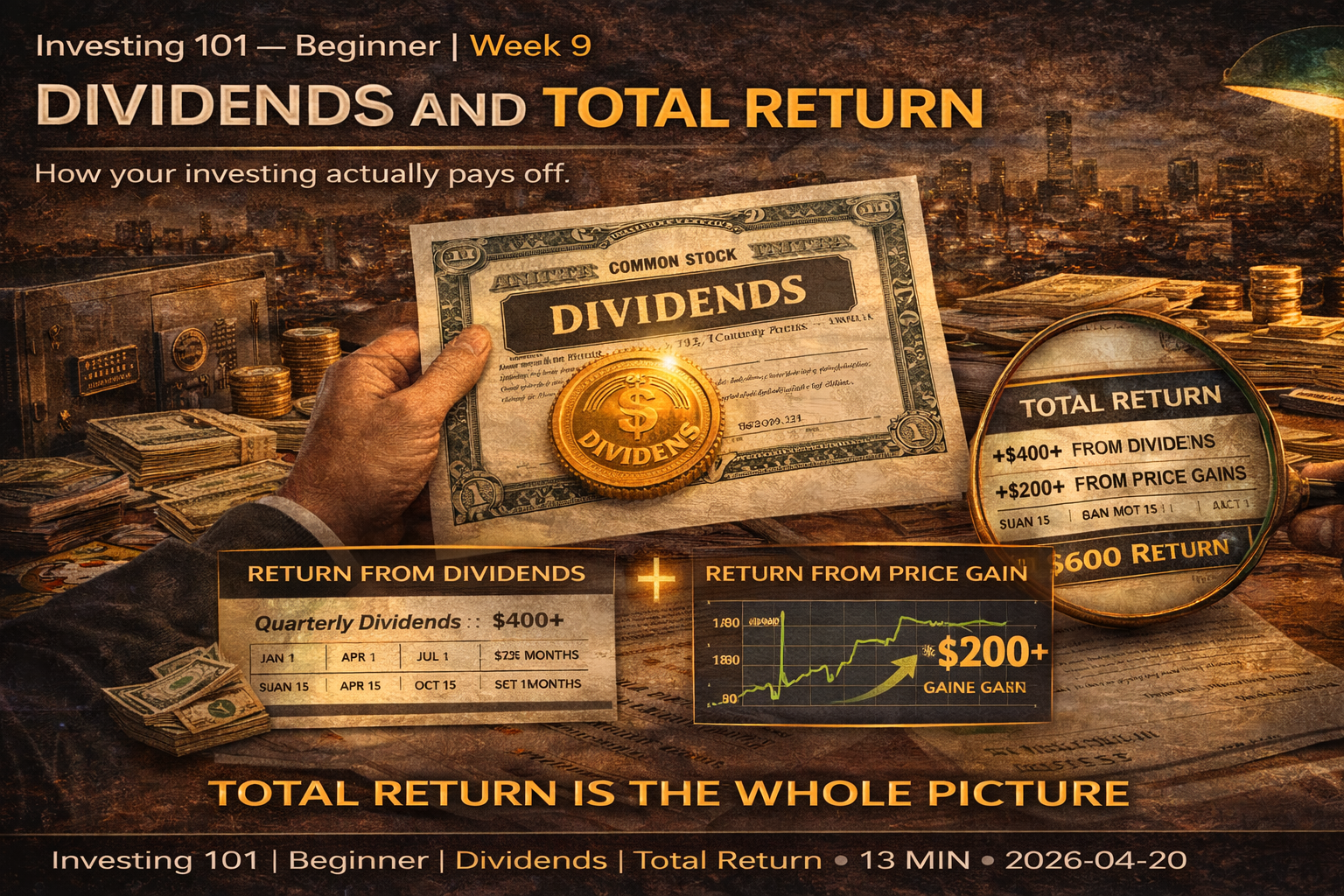
Total return is the full return you earn from owning a stock over a period, combining both sources of return — dividends and price change.
Total Return = (Ending Price − Starting Price + Dividends Received) / Starting Price
If you buy a stock at $100, hold it for a year during which it pays $3 in dividends, and sell it for $105, your total return is:
($105 − $100 + $3) / $100 = 8%
Five percent came from price appreciation. Three percent came from dividends. Total return is 8%.
This is the correct way to think about investment returns. Looking at price alone misses the dividends. Looking at dividends alone misses the price. Only the combined figure — total return — captures what actually happened to your money.
The implication matters. Two stocks might both produce 10% total returns over a decade — but one might do it entirely through price appreciation (zero dividends, 10% average price gain), while the other does it through 5% dividends and 5% price appreciation. Both make you the same amount of money, but they feel very different as experiences, they have different tax implications, and they pair with different life circumstances. An investor in retirement, who needs income to pay bills, might prefer the dividend-heavy version. A younger investor in accumulation mode, for whom dividends would just get reinvested anyway, might prefer the pure-growth version.
The important thing is that you do not get confused about which you are comparing. A stock with a "4% yield" is not automatically better than a stock with "2% yield." What matters is what each one's total return will be over the period you actually hold it.
The Historical Record
One of the most remarkable and underappreciated facts in investment history is how much of the stock market's long-term return has come from dividends, not price appreciation.
Studies of very long-term US stock market returns — going back to the 1800s — consistently find that dividends and dividend reinvestment have been responsible for roughly 40% to 50% of total return, depending on the time period. Price appreciation is the more visible component, but dividends plus reinvestment compound quietly in the background and end up contributing almost as much to the final result.
This is counterintuitive to anyone who grew up watching the stock ticker and assuming "return" means price movement. But the math is unambiguous. Over decades, the regular arrival of cash — reinvested into more shares, which then generate their own cash — produces enormous cumulative value.
The implication for how you think about investing is direct. If you are focused solely on stocks you expect to rise dramatically in price, you are focused on half of the historical return engine and ignoring the other half. The boring, steady, cash-generating businesses that pay and grow dividends are not boring in terms of long-term compounding. They are, collectively, one of the most powerful wealth-creation mechanisms in the history of markets.
This does not mean every investor should buy dividend stocks. It means that dismissing them because they are "not exciting" is missing what makes investing work.
What You Should Do This Week
Check dividends on your target company. Same one you have been following. Does it pay a dividend? If yes, what is the current yield? What has been the growth rate over the past five or ten years? If no, what does the company say about why not, and does that reasoning make sense to you?
Calculate the yield on cost for a hypothetical past investment. Pick a dividend-paying company with a long history. Find the stock price ten years ago. Find the current annual dividend. Divide today's dividend by the ten-year-old price. That is what your yield would be today if you had bought then. For good dividend growers, this number can be surprisingly high — 5%, 7%, sometimes more — even on stocks that look like they yield 2% or 3% to a new buyer today.
Decide on DRIP. If you already have an account, look at whether dividend reinvestment is enabled. If you are building a long-term portfolio with dividend-paying holdings, strongly consider enabling it. The decision takes two clicks and can meaningfully change your compound outcome over decades.
Think about the total return question. For one stock you are interested in, imagine you hold it for ten years. What fraction of your return would come from dividends, and what fraction from price appreciation? There is no right answer, but having an expectation forces you to think about what you actually expect from the holding.
Closing Thoughts on Valuation
Weeks 7, 8, and 9 have covered the "why" questions of investing. Why does this business work? What is it worth? What return does it actually produce? These are thinking questions. They do not yield to a formula. They require judgment, and judgment develops over years.
But you now have the conceptual tools. You can read a business model. You can assess valuation using the major ratios without being misled by them. You can think about total return honestly, combining both sources of value.
These are the tools. Now we turn to putting them into practice — which is a different kind of skill entirely.
Looking Ahead
Next week: diversification and portfolio basics. You do not invest in one stock; you invest in a portfolio — a collection of holdings whose combined risk and return matter more than any individual component. How many stocks should you own? How should they be distributed across sectors, industries, and geographies? How do different holdings interact? The answers to these questions determine how much risk you are actually taking, which is often very different from what you think you are taking.
Investing 101 — Beginner Series. Week 9 of 12.
Next week: Diversification and Portfolio Basics.
Educational content only. Not investment advice. Always do your own research.