Valuation Basics: P/E, P/B, PEG
Price and value are not the same thing. Learn the three ratios that beginners need to understand before buying anything — what they mean, how they lie, and how to use them honestly.
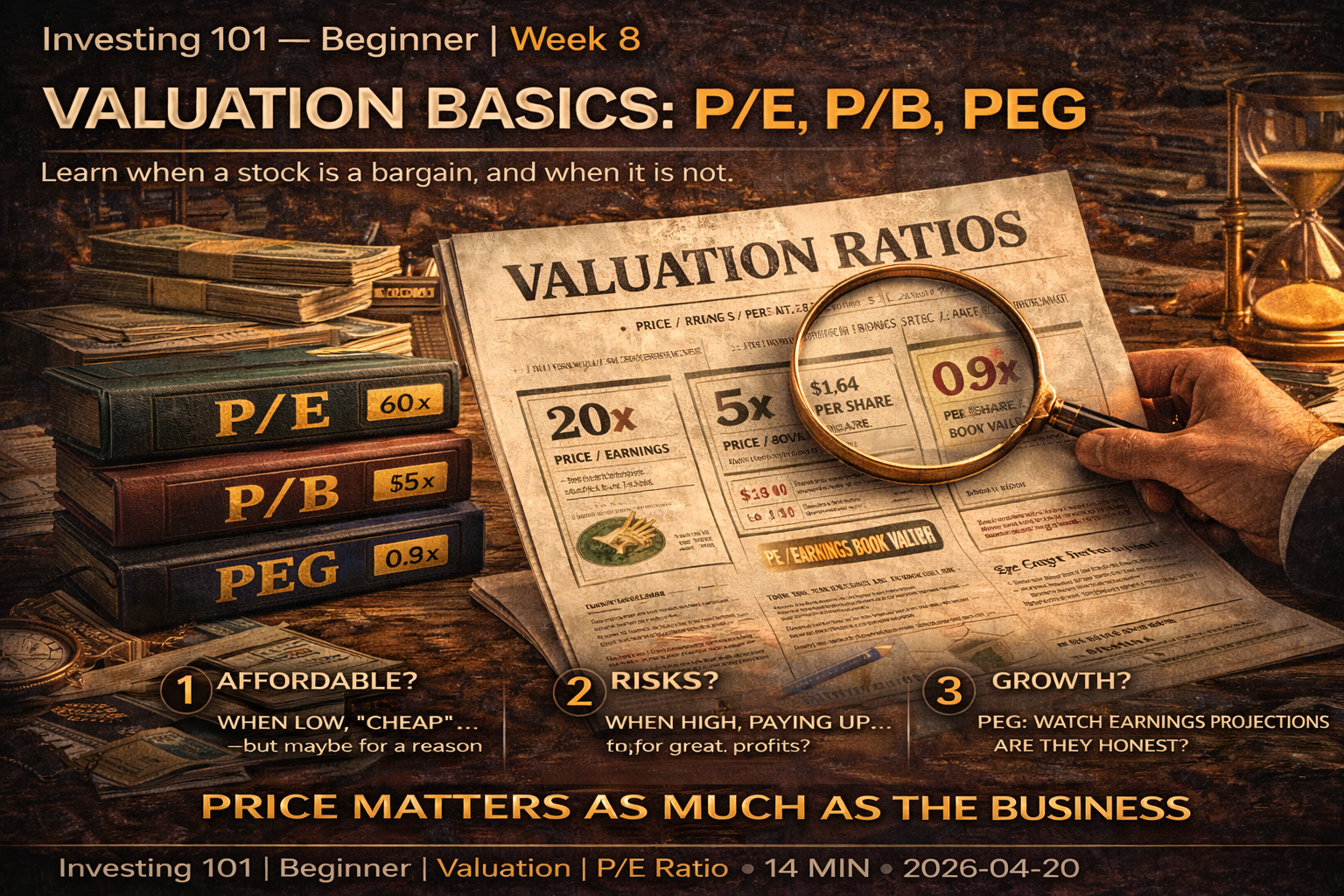
Valuation Basics: P/E, P/B, PEG
Here is one of the most important sentences in this entire course: a great business can be a terrible investment, and a mediocre business can be a great one.
The difference is price.
If you pay too much for a share of Apple, you will earn disappointing returns even if Apple continues to be an excellent company. If you pay very little for a share of a company with declining fundamentals, you can still make money as the market eventually corrects its pessimism. The business matters. The price matters. Both matter, and you cannot ignore either.
The skill of deciding what a business is worth is called valuation, and it is the part of investing that separates people who understand what they are doing from people who are guessing. This week we cover the three most common beginner valuation ratios — what they actually mean, when they work, and the specific ways they mislead people who use them without understanding them.
Why Valuation Matters
Every share of stock you buy is a claim on a stream of future cash flows from the underlying business. What that share is worth, in the most fundamental sense, is the value of all those future cash flows, discounted back to today at an appropriate rate.
In theory, that is the entire answer. In practice, nobody knows what future cash flows will actually be, which rate to discount them at, or how long the business will last. So the theoretical approach, while correct, cannot be applied with precision. Instead, investors use shortcuts — ratios that compare the stock's current price to some current measure of the business — as approximations of value.
These ratios are not magic. They do not tell you what a stock is "really" worth. What they do, when used carefully, is put the current price in context. A stock trading at 50 times earnings is expensive relative to a stock trading at 10 times earnings, assuming the two are otherwise comparable. Whether either is a good buy depends on what those earnings will do over time, which is a judgment call no ratio can make for you.
Understanding this limitation is the beginning of valuation literacy. The ratios are tools, not answers. Experienced investors use them to frame questions, not to settle them.
The Price-to-Earnings Ratio (P/E)
The price-to-earnings ratio is the most widely used valuation metric in the world. It is simple:
P/E = Current Share Price / Earnings Per Share
If a stock trades at $100 and the company earned $5 per share last year, the P/E is 20. Another way to read this: at the current price, investors are paying $20 for every $1 of annual earnings the company produced.
Or, flipped around: an earnings yield of 5% (1 divided by 20). If the company kept earning exactly $5 per share forever, and you paid $100 today, you would earn a 5% annual yield on your investment, forever.
This is a useful frame. A P/E of 10 is an earnings yield of 10%. A P/E of 30 is an earnings yield of about 3.3%. A P/E of 100 is an earnings yield of 1%. When P/E ratios get very high, the implicit assumption is that earnings will grow dramatically over time — otherwise you are paying a lot of money today for a small current return.
There are two common versions of the P/E ratio, and you should know the difference.
Trailing P/E uses the earnings from the past twelve months — what the company has actually earned. This is the more conservative measure because it is based on reality, not projections.
Forward P/E uses analysts' consensus estimates for the next twelve months of earnings. This is more speculative because those estimates might be wrong, but it is more forward-looking, which is what valuation is supposed to be.
Most financial sites show both. When someone says "this stock has a P/E of 18," it is worth asking whether they mean trailing or forward, because the numbers can differ significantly — especially for growing companies, where forward P/E is typically much lower.
What a P/E Ratio Actually Tells You
A low P/E can mean one of three things:
The market is pricing in bad news. The company's earnings are expected to decline, and the low P/E reflects that expectation. If you buy based on a low current P/E without understanding why it is low, you may be walking into a business whose earnings are about to collapse.
The market is wrong. The company is healthier than the current price reflects, and the low P/E represents a real opportunity. This is the value investor's dream scenario — paying a low multiple for a business that will continue to earn well.
The company is in a low-multiple industry. Some sectors just trade at lower multiples structurally. Banks, utilities, and traditional industrials often trade at single-digit or low-double-digit P/Es because their growth rates are modest and their earnings are cyclical or regulated. A bank at P/E 10 is not cheap by bank standards; a software company at P/E 10 would be deeply out of favor.
A high P/E can also mean several things:
The market expects strong growth. If earnings are going to double or triple over the next several years, a high current P/E becomes reasonable because the earnings denominator is about to grow dramatically. You are paying for future earnings, not just current ones.
The business is high-quality. Durable businesses with strong moats tend to trade at higher multiples than commodity businesses, because their earnings are more predictable and the stream is expected to last longer. A high-quality software company might trade at P/E 40 while a commodity producer trades at P/E 8, and both might be fairly priced.
The market is overexcited. High multiples often reflect temporary enthusiasm rather than genuine fundamentals. When you hear phrases like "this time it's different" applied to very high valuations, be cautious. Excited markets periodically assign extreme multiples to stocks that later revert to more normal levels — sometimes violently.
The P/E ratio does not tell you which of these situations you are in. It gives you a number. The work is figuring out the context.
The Limits of P/E
P/E is useful but has specific blind spots you need to understand.
It requires positive earnings. A company that is losing money has no meaningful P/E ratio. This excludes many early-stage companies, turnaround situations, and cyclical businesses in a trough. For these, you need other tools.
It is distorted by accounting choices. Depreciation schedules, one-time charges, tax strategies, and stock-based compensation all affect reported earnings in ways that may not reflect underlying economic reality. Two companies with genuinely similar business performance can report different earnings because of different accounting choices. P/E compares stated earnings, not economic reality.
It does not account for the balance sheet. A company with massive debt and a company with massive cash reserves can have the same P/E, but they are not the same investment. The former is riskier because its earnings have to cover interest payments; the latter has optionality and safety that the number alone does not capture.
It does not capture growth trajectory. A company earning $5 per share that grows earnings 30% per year is worth much more per dollar of current earnings than a company growing earnings 3% per year. P/E alone treats them the same.
It is subject to earnings manipulation. Earnings can be managed — legally — to hit targets. Over any single quarter or year, reported earnings may be higher or lower than "true" earning power. P/E inherits these distortions.
Because of these limits, experienced investors rarely use P/E as the sole basis for a decision. It is a starting point. It tells you where a stock sits in relation to the broader market and its own history. It does not tell you whether to buy.
Price-to-Book Ratio (P/B)
The price-to-book ratio compares a company's market value to its accounting book value.
P/B = Current Share Price / Book Value Per Share
Recall from Week 5: book value is shareholders' equity — what would remain for owners if every asset were sold at its accounting value and every liability paid. Book value per share is that total divided by shares outstanding.
A P/B of 1.0 means the market is valuing the company at exactly its accounting net worth. A P/B below 1.0 means the market thinks the business is worth less than the value of its recorded assets minus liabilities — which can indicate either deep pessimism or genuine underlying problems. A P/B above 1.0 means the market sees value beyond what is on the balance sheet — brand, future growth, intangible assets, etc.
P/B is most useful for two types of companies:
Asset-heavy businesses. Banks, insurance companies, real estate investment trusts, and traditional industrials have balance sheets where the assets are a meaningful part of the business's value. For these companies, book value is a reasonably honest estimate of underlying worth, and P/B becomes a relevant comparison.
Deep value situations. When a company is trading at a very low P/B — especially below 1.0 — the question becomes whether the assets on the balance sheet are really worth what they say. If they are, you may be getting a business for less than its liquidation value. If they are not — if inventory is obsolete, receivables will not be collected, or property is overstated — then the low P/B is a warning, not an opportunity.
For capital-light businesses, P/B is much less useful. A software company's value is not in its buildings or equipment; it is in its code, customers, and brand, most of which do not appear on the balance sheet in any meaningful way. A software company with a P/B of 20 is not necessarily overvalued — its real assets are simply not on the balance sheet.
This is why P/B is a specialist tool. It works well in specific contexts and poorly in others. Know when to use it and when to ignore it.
The PEG Ratio
The PEG ratio attempts to solve one of P/E's biggest weaknesses — that it does not account for growth.
PEG = P/E Ratio / Annual Earnings Growth Rate (as a percentage)
If a company has a P/E of 20 and is growing earnings at 20% per year, its PEG is 1.0. If it has a P/E of 40 but is growing at 40%, its PEG is also 1.0. The idea is that stocks growing faster deserve higher multiples, and PEG normalizes this.
The general rule of thumb, popularized by Peter Lynch (which we have covered in the Brutal Edge blog series), is:
- PEG below 1.0 — potentially undervalued relative to growth.
- PEG around 1.0 — fairly valued given growth.
- PEG above 1.0 — potentially overvalued relative to growth.
The appeal of PEG is obvious: it lets you compare growth companies against each other, and against slower-growing peers, on a more even basis than raw P/E.
But PEG has serious limits that beginners often overlook.
Growth rates are estimates. PEG uses an expected future growth rate, which is a projection. If the projection is wrong, the PEG is wrong. A company with a PEG of 0.8 on an expected 30% growth rate looks cheap — but if actual growth turns out to be 10%, the retroactive PEG is 2.4, and the stock was expensive after all.
PEG ignores the quality of growth. A company growing 30% because it is opening profitable new markets is different from a company growing 30% because it is selling below cost to gain share. PEG cannot tell the difference. Both look the same in the numerator and denominator.
PEG ignores the balance sheet. Like P/E, PEG says nothing about debt, cash position, or financial health. A heavily-leveraged company with a low PEG is not the same as an unlevered company with the same PEG.
PEG assumes growth is linear and continuous. It treats a 30% growth rate as equivalent whether it is expected for 2 years or 20. In reality, growth rates decelerate as companies mature, and high growth rates are almost never sustained for long periods.
PEG is a useful screening tool, but like P/E, it is a starting point, not a conclusion. A PEG below 1.0 is worth looking at further; it does not automatically mean "buy."
How to Use These Ratios Honestly
Beginners often try to use valuation ratios the way you use a calculator — plug in the numbers, get the answer, execute the trade. This does not work, and understanding why not is the entire point.
Here is how to use these three ratios well.
Compare within the same industry. A P/E of 15 means very different things for a software company and a steel producer. Software companies typically trade in the 20-40 range; steel producers typically trade in the 5-15 range. The right comparison is not "is 15 high?" but "is 15 high relative to other software companies?" or "is 15 high relative to other steel producers?"
Compare against the company's own history. A stock trading at a P/E of 25 today might be cheap if its ten-year average P/E is 35, or expensive if its ten-year average P/E is 15. Historical context on a single stock often tells you more than comparison against the broader market.
Consider the trajectory of the underlying business. A high P/E is acceptable for a business whose earnings are growing rapidly and sustainably. A low P/E is a warning for a business whose earnings are declining. The ratio alone does not tell you which situation you are in. You have to form a view on the business itself.
Use multiple ratios together. A stock that looks cheap on P/E but expensive on P/B, or cheap on PEG but with deteriorating free cash flow, tells a more complex story than any single number captures. Triangulate.
Never buy a stock purely because it is "cheap" on a single ratio. Cheap often means problematic. The market is not stupid most of the time. When a stock trades at an unusually low multiple, there is usually a reason, and that reason is often worth more than the apparent discount. Your job is to figure out whether the reason is temporary (opportunity) or structural (trap).
The Concept of a Margin of Safety
Benjamin Graham, the father of modern security analysis and Warren Buffett's mentor, gave us the concept that should underlie all beginner valuation work: the margin of safety.
The idea is simple. You cannot value a business perfectly. Your estimate of what it is worth will always be uncertain. So when you buy, do not buy at a price that assumes your estimate is exactly right. Buy at a price that gives you room to be wrong.
If you estimate a business is worth $100 per share, do not pay $100. Pay $70. The $30 gap is your margin of safety. It absorbs the errors in your analysis, the surprises the business itself delivers, and the mood swings of the market.
In practical terms, this means: do not buy stocks at valuations that only make sense if everything goes right. Buy at valuations that still make sense if things go partly wrong. High P/Es, high P/Bs, low PEGs on uncertain growth — all of these leave little margin of safety. Reasonable multiples on durable businesses leave room.
This is the difference between speculating and investing. Speculating requires things to go well to make money. Investing allows you to make money even when things go less well than expected.
What You Should Do This Week
Calculate the three ratios. Same company you have been studying. Look up the current share price, earnings per share, book value per share, and expected growth rate. Calculate P/E, P/B, and PEG yourself. Do not just read them off a finance site — calculate them from the raw inputs, so you understand what they are.
Compare to industry peers. Take the same three ratios for two direct competitors. You now have a comparison. Which is most expensive on P/E? Which on P/B? Which on PEG? What do the differences tell you about how the market is valuing each business?
Compare to historical range. Most free finance sites show a stock's historical P/E range. Is the current P/E near the high end of the range? The low end? The middle? This tells you how the market's current assessment compares to its past views.
Ask the most important question. For each ratio, ask: if this ratio is near the high end, do the fundamentals justify it? If near the low end, is there a reason to believe the market is wrong? Write down your reasoning. You do not need to be right. You need to be thinking.
Looking Ahead
Next week: dividends and total return. P/E tells you what you are paying for current earnings. Dividends are one of the two ways you actually capture value from ownership — direct cash distributions from the business to you. Some of history's most successful long-term returns have come from high-quality dividend-paying businesses compounded over decades. Understanding dividends, and the concept of total return, fills in an important piece of the picture.
Investing 101 — Beginner Series. Week 8 of 12.
Next week: Dividends and Total Return.
Educational content only. Not investment advice. Always do your own research.