What Is a Business Model?
Financial statements show you the numbers. The business model explains why those numbers exist. Without understanding the engine, you cannot judge whether the output will continue.
What Is a Business Model?
After three weeks of financial statements, you know how to read the output of a business. Revenue, margins, cash flow, debt — the numbers that tell you what happened.
But numbers alone are backwards-looking. They tell you that Apple earned $100 billion last year. They do not tell you whether Apple will still be earning $100 billion a decade from now. For that question, you need to understand something the financial statements cannot directly show you: the business model — the underlying engine that produces those numbers.
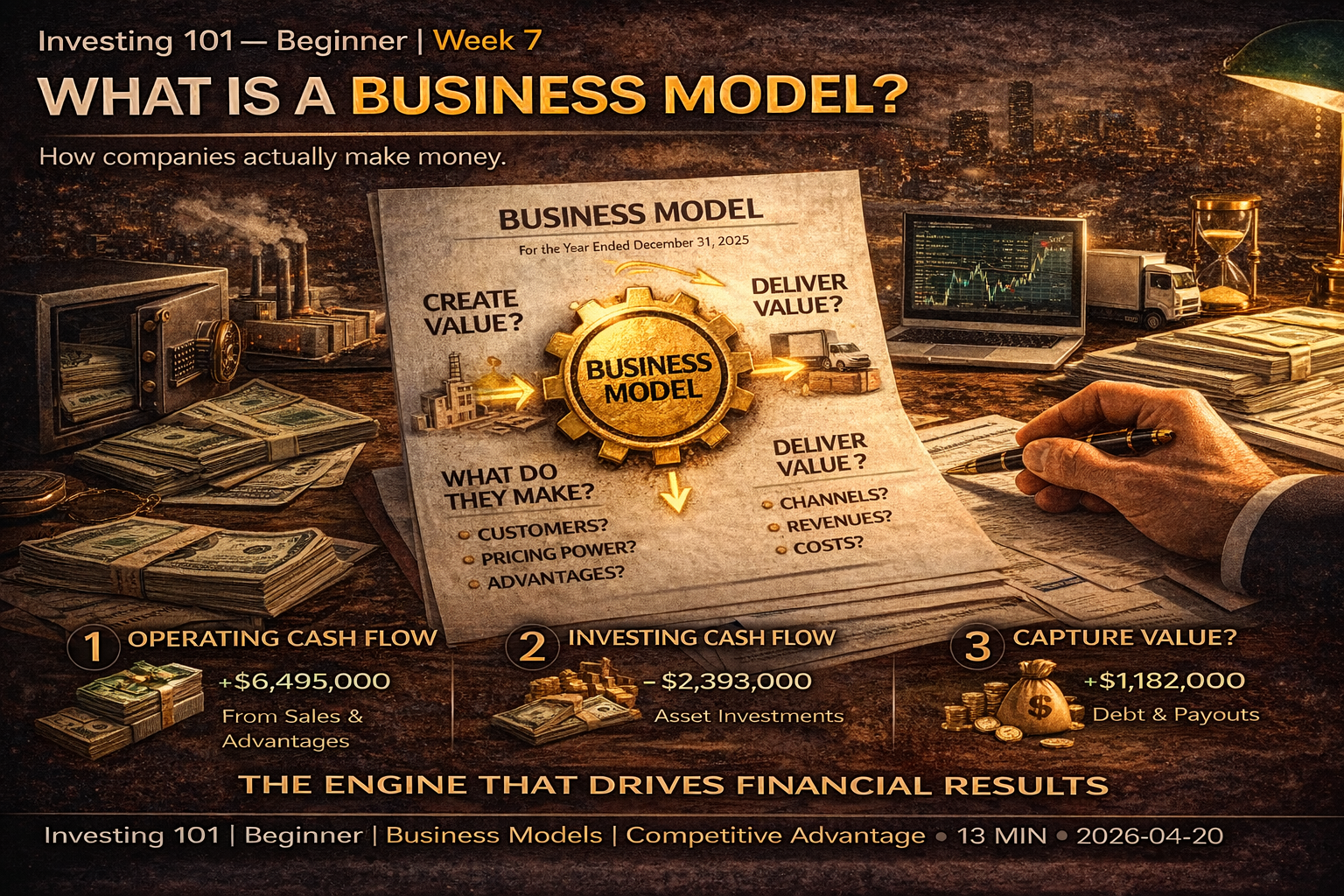
A business model is how a company creates value for customers and captures value for itself. It is the logic of the enterprise. Why does the customer pay? What does the company deliver? How is that delivery structured so that the company ends up with more money than it spent? And most importantly — why does the model keep working year after year, rather than being copied, undercut, or made obsolete?
If you cannot answer those questions for a company, you are not really investing in it. You are gambling on a stock ticker.
The Basic Anatomy of a Business Model
Every business model has the same four core components, regardless of industry, geography, or size. Once you see the pattern, you can apply it to any company you look at.
1. What does the company sell? The product or service being offered. This sounds trivial, but precision matters. Starbucks does not sell coffee — it sells a third place between home and work, with coffee as the vehicle. Netflix does not sell movies — it sells a subscription to an ever-refreshing library of content. McDonald's does not sell burgers — it sells fast, predictable, convenient meals at consistent prices in any country on earth. Defining what the company actually sells, in terms the customer experiences, is the start of understanding the business.
2. Who buys it, and why? The customer base and the motivation. A luxury handbag company and a discount clothing chain may both sell "apparel," but they serve completely different customers buying for completely different reasons. One serves aspirational status signaling; the other serves budget-conscious practicality. These are not the same business, and their economics will never converge.
3. How is the product delivered and monetized? The operational mechanics. Does the customer pay upfront, or subscribe, or transact per use? Is the product physically manufactured, digitally distributed, or delivered as a service? Is it sold directly by the company, or through retailers, or through a marketplace? The delivery and monetization structure has enormous implications for margins, working capital, and growth patterns.
4. What prevents competitors from taking it away? The durability of the model. This is the question most retail investors skip entirely, and it is usually the most important of the four. If any competitor could replicate what the company does and sell it cheaper, the company's margins would eventually collapse. What specifically prevents that from happening? We will spend most of this lesson on this question, because it is where the real investment edge lives.
The Taxonomy of Business Models
Most businesses fit into one of a handful of broad archetypes. Knowing the archetype tells you a lot about the economics, the risks, and the path to durable profitability.
Product sales. The company makes or sources a physical good and sells it. Revenue is transactional — one customer, one sale, one payment. Examples: Nike, Toyota, Home Depot. The key question for product businesses is unit economics — the profit per item sold — and whether the brand or distribution has pricing power that protects those unit economics.
Subscription or recurring service. The customer pays regularly in exchange for ongoing access or service. Revenue is predictable and cumulative. Examples: Netflix, Microsoft (Office 365), most SaaS companies. The key question is retention — how long does the average customer stay? A subscription business with 95% annual retention is a fundamentally different economic animal than one with 70% retention, even if they charge the same price per month.
Marketplace or platform. The company operates infrastructure that connects buyers and sellers, taking a fee on each transaction. Examples: eBay, Airbnb, Visa, Uber. The key question is network effects — does the platform get more valuable as more users join, making it harder for competitors to displace? Strong two-sided network effects create some of the most durable business models in the world.
Advertising-supported. The company provides a free or low-cost service to end users and monetizes by selling their attention to advertisers. Examples: Google Search, Meta, most free mobile apps. The key question is the quality and scale of the audience — advertisers pay based on reach and targeting precision, not based on what the user consumes.
Licensing or royalty. The company owns intellectual property and charges others for the right to use it. Examples: pharmaceutical companies with patented drugs, chip designers like ARM, entertainment studios with character franchises. The key question is the strength and duration of the underlying IP. A drug patent that expires in two years is a very different asset than a trademark that renews forever.
Capital-intensive operation. The company runs expensive physical infrastructure that produces revenue over long time horizons. Examples: utilities, pipelines, railroads, telecom networks. The key question is the regulatory and economic environment — these businesses are often semi-monopolies whose returns are shaped by regulators as much as by markets.
Most real companies are blends of more than one archetype. Apple sells products, collects App Store fees (platform), and increasingly operates services (subscription). Amazon is simultaneously a retailer, a marketplace, a subscription service (Prime), and a capital-intensive operator (AWS). Understanding the mix, and which piece drives which portion of profit, is central to understanding the business.
Unit Economics: The Building Block Beneath the Model
Regardless of archetype, every business model eventually reduces to unit economics — the economics of a single customer, a single product, or a single transaction.
The question is simple: when the company delivers one unit of whatever it sells, does it make money, and how much?
For a product business, the unit might be a single product sold. Revenue per unit minus cost per unit equals unit gross profit. If unit gross profit is negative, the company is losing money every time a customer buys — a situation that cannot be fixed by selling more.
For a subscription business, the unit is usually a single customer's lifetime. Customer lifetime value (LTV) is the total profit a customer is expected to generate during their time with the company. Customer acquisition cost (CAC) is what it costs the company to win that customer — marketing spend, sales commissions, onboarding costs. The ratio LTV/CAC is the single most important metric in subscription businesses. A ratio above 3 is generally considered healthy; a ratio below 1 means the company is losing money on every customer it acquires, no matter how fast it grows.
For a marketplace, the unit might be a single transaction. Gross merchandise volume (the total value of transactions running through the platform) and take rate (the percentage the platform keeps) together define revenue. Operating costs per transaction tell you whether the unit is actually profitable.
Good unit economics do not automatically make a company valuable. A business with beautiful unit economics but a tiny market can never grow large enough to matter. But bad unit economics are almost always fatal — a business that loses money per unit can only grow if someone keeps funding the losses, and that funding eventually ends.
The first test you should apply to any business model is this: does the company make money on each incremental sale, after all its true costs? Companies that pass this test at scale are real businesses. Companies that do not are projects, experiments, or in some cases elaborate wealth-destruction mechanisms. Learning to tell them apart is one of the most valuable skills you can develop.
The Moat: Why Durability Matters Most
We return now to the fourth question from the opening: what prevents competitors from taking the business away?
Warren Buffett popularized a metaphor that has since become standard in investment thinking. He described a great business as a "castle" surrounded by a "moat" — a defensive barrier that keeps competitors out and allows the castle to keep collecting its wealth undisturbed. The strength of the moat determines how long the castle can stand.
Without a moat, a profitable business is only profitable temporarily. Any high-margin business attracts imitators. As imitators enter, prices fall, margins compress, and the original business's advantage is competed away. Economists call this "reversion to the mean" — profits above the economic average tend to attract competition until they return to average.
With a moat, a business can sustain above-average profits for years, decades, or in rare cases centuries. The moat is not a temporary advantage. It is a structural feature of the business that makes it genuinely hard for competitors to replicate what the company does.
There are a limited number of real moat types, and most durable competitive advantages trace back to one or a combination of these.
Scale advantages. Some businesses get cheaper per unit as they get bigger. Walmart can negotiate lower wholesale prices than smaller retailers because of its volume. Amazon can spread fulfillment infrastructure costs over more transactions. Chip foundries require such enormous fixed-cost investments that only a few global players can afford the latest technology. Scale advantages tend to be self-reinforcing — the biggest player has the lowest costs, which lets them price most aggressively, which lets them take more share, which makes them even bigger.
Network effects. Some businesses become more valuable as more people use them. A marketplace with 100 million buyers is more attractive to sellers than one with 10 million, and vice versa. A social platform with your friends on it is more useful than one without them. A payment network accepted by more merchants is more useful to cardholders, which makes it more attractive to more merchants. Network effects create winner-take-most dynamics and are one of the strongest moat types in the modern economy.
Switching costs. Some products are costly or painful to switch away from, even if a cheaper alternative appears. Enterprise software that a company has integrated into its workflows. A bank account with direct deposits, auto-pay bills, and years of transaction history. Medical devices where doctors have been trained on a specific manufacturer's equipment. High switching costs mean the company retains customers even when competitors offer technically superior alternatives.
Brand and trust. Some products command higher prices because customers associate them with quality, status, safety, or reliability in ways that cannot be easily replicated by a new entrant. Coca-Cola's brand. Apple's design reputation. Rolex's status positioning. A generic drug that is chemically identical to Advil can be sold for less, but many customers still pay for Advil. That premium is the brand moat translated into dollars.
Proprietary technology or intellectual property. Patents, trade secrets, and hard-to-replicate technological know-how can protect a business from competition. A new drug under patent protection cannot be legally copied for years. A semiconductor manufacturer with decades of process engineering expertise has advantages that cannot be replicated simply by spending money. The strength of this moat depends on the duration and defensibility of the underlying IP.
Regulatory or structural position. Some businesses benefit from regulatory protections or natural monopoly positions. Local utilities. Government-granted licenses. Incumbents in industries with high regulatory approval barriers. These moats can be extremely durable, but they also come with regulatory constraints that limit how much the business can charge or grow.
The strongest businesses in the world usually combine multiple moat types. Apple has brand, switching costs (iOS ecosystem), and scale advantages simultaneously. Microsoft has switching costs (enterprise integration), scale, and network effects (Office compatibility). These compounding moats are why these specific companies have sustained extraordinary profitability for decades while competitors have tried and failed to displace them.
How to Evaluate a Moat in Practice
Identifying which moat type applies to a business is the first step. The harder question is evaluating whether the moat is actually holding, strengthening, or eroding. Here are the signals to watch.
Is the moat reflected in the numbers? Strong moats produce observable financial signatures — consistently high gross margins, stable or rising market share, high return on invested capital sustained over years, pricing power in the face of inflation. A company whose margins erode whenever competitors push is showing you directly that its moat is weaker than management claims.
How is the moat changing over time? Moats are not static. Brand value can decay. Network effects can flip to favor a competitor. Scale advantages can be neutralized by new technology. Switching costs can be reduced by industry standards or new entrants. You want businesses whose moats are being widened — reinforced, expanded, deepened — not merely defended.
What would it take for a well-funded competitor to replicate this business? Imagine a company with unlimited capital attempting to build a direct competitor. How long would it take? What would they be unable to replicate? If the answer is "they could build a comparable product in two years with enough engineers," the moat is not strong. If the answer is "they could not replicate the customer base, brand, and supplier relationships in any reasonable timeframe," the moat is real.
Is the moat visible to the customer? Strong moats usually manifest as customer loyalty — customers who do not shop around, do not switch when alternatives appear, and do not complain about prices that are clearly higher than competitors'. If you cannot identify specific customer behaviors that reflect the moat, you may be imagining one that does not actually exist.
Most investment mistakes involve either missing the moat (investing in a business with no durable advantage and being surprised when margins collapse) or imagining a moat where none exists (convincing yourself that a currently-profitable business has structural protections that will sustain it, when in fact it is just benefiting from temporary conditions). Rigor on this question prevents a lot of expensive errors.
Revenue Quality and Predictability
One final lens on business models: not all revenue is created equal. Two companies with the same revenue in the same year can have very different economic value, because their revenue streams have different qualities.
Recurring vs. transactional. A software company selling annual subscriptions that renew at 95% knows most of its revenue next year before the year begins. A consulting firm selling project work has to win every quarter's revenue essentially from scratch. The first is far more valuable per dollar of revenue because it is far more predictable.
Concentrated vs. diversified. A company whose top customer accounts for 30% of revenue has a concentration risk — losing that customer would be catastrophic. A company with no customer above 5% of revenue is far more resilient. Customer concentration is often buried in 10-K filings under "risk factors" and is worth checking.
Contracted vs. at-will. Revenue secured by long-term contracts is more predictable than revenue that can be turned off at any time. A defense contractor with a ten-year government contract has a very different business from an advertising-supported content site where advertisers can cut spending overnight.
Structurally growing vs. cyclical. Some end markets grow reliably for structural reasons — aging demographics for healthcare, digitization for cloud services, electrification for grid infrastructure. Other markets are cyclical — they expand and contract with the broader economy. Revenue tied to structural tailwinds is worth more than revenue tied to cyclical patterns, because the direction of future revenue is more confident.
Evaluating revenue quality is not a separate exercise from evaluating the business model — it is a consequence of the business model. Subscription businesses produce recurring revenue because their model requires it. Marketplaces produce diversified revenue because their model aggregates many small transactions. The patterns you see in the financial statements are the output of the model, and they tell you whether the model is producing high-quality or low-quality revenue.
What You Should Do This Week
Pick one company. Same one you have been analyzing for three weeks, or a new one. Your choice.
Write the model in four sentences. Using the framework: what they sell, who buys and why, how it is delivered and monetized, what prevents competitors from taking it away. Write each one in a single sentence. Precision matters — vague answers mean you have not actually understood the model.
Identify the moat type. Which of the moat categories from this lesson applies to the business? Can you point to specific evidence — financial, operational, customer-behavioral — that confirms the moat is real?
Evaluate unit economics. What is the unit of this business, and does the company make money per unit? If it is a product business, what is the gross margin per product? If subscription, what is the retention rate? If marketplace, what is the take rate and is it profitable after operating costs?
Imagine the competitor attack. Suppose a well-funded competitor with $10 billion and a team of excellent engineers and operators decided to take this business away. What would they be able to replicate easily, and what would they struggle with? This thought experiment is the single best test of whether a moat is real or imagined.
Looking Ahead
Next week we move from understanding businesses to valuing them. A great business at the wrong price is still a bad investment. The financial statements and business model together tell you what you are buying. Valuation tells you whether the price you are being asked to pay makes sense given what you are getting.
We will start with the most common valuation metrics — P/E, P/B, PEG — what they mean, when to use them, and where they mislead. These are the tools you will use to answer the question every investor eventually faces: "Is this stock cheap, expensive, or fair?"
Investing 101 — Beginner Series. Week 7 of 12.
Next week: Valuation Basics — P/E, P/B, and PEG.
Educational content only. Not investment advice. Always do your own research.