The Great Energy Shift: UAE Exits OPEC, Hormuz Burns, and Why Energy Is No Longer a Sector — It Is American Strategic Infrastructure
The UAE's exit from OPEC is not Middle East political drama. It is a regime change in how global energy markets organize themselves — and the opening of a multi-year re-rating of the American energy complex from cyclical sector to strategic infrastructure.
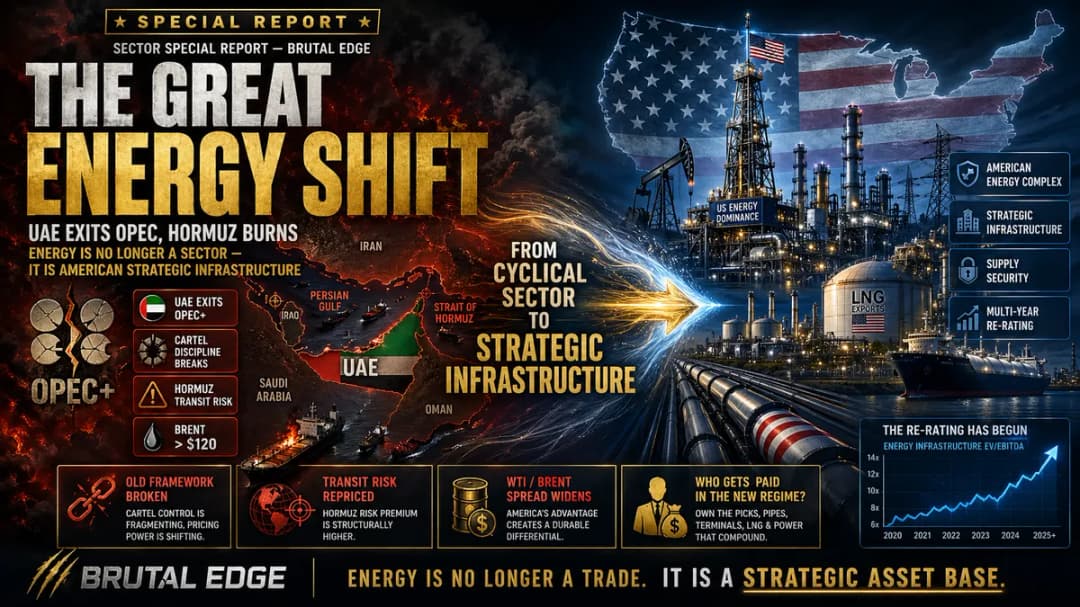
# The Great Energy Shift
Sector Special Report — Brutal Edge
Framework-based analysis of energy's transition from cyclical sector to strategic infrastructure
Executive Summary
On April 28, 2026, the United Arab Emirates officially announced its exit from OPEC and OPEC+, effective May 1. After more than fifty years inside the cartel, one of its largest producers walked out — explicitly framing the move around national capacity, sovereign production policy, and long-term strategic priorities.
The market reaction was loud. The structural read is louder.
This is not a Middle East political drama. It is a regime change in how global energy markets organize themselves. The cartel discipline that has anchored oil pricing for half a century is no longer reliable. At the same moment, transit risk through the Strait of Hormuz has returned to the center of macro pricing, with Brent crossing $120 in the most acute phase of the April shock and the Brent-WTI spread hitting cycle highs.
The Brutal Edge view is straightforward. Investors who treat this story as "OPEC drama" or "another oil spike" will miss the actual trade. The actual trade is a multi-year re-rating of the American energy complex — not as a cyclical sector, but as part of the strategic infrastructure base of the United States.
This report breaks down what changed, why the old framework is broken, who gets paid in the new one, and what to watch over the next four quarters.
1. What Actually Happened
The UAE decision on its own would be significant. The context around it is what makes it consequential.
| Event | Date | Significance |
|---|---|---|
| UAE announces OPEC/OPEC+ exit | Apr 28, 2026 | Effective May 1 — first major OPEC exit in over a decade |
| UAE 2027 capacity target | ~5M bpd | Implies sustained capex incompatible with quota discipline |
| Brent crude peak | Above $120 (late April) | Hormuz disruption + war risk premium |
| Brent-WTI spread peak | April 2026 | EIA STEO confirms widest spread driven by transit risk |
| US Treasury sell-off | Late April | Inflation expectations re-rated, rate cut path delayed |
| Gulf-US dollar liquidity discussions | Ongoing | Currency-swap arrangements support dirham-dollar peg |
These are not separate stories. They are one story about the breakdown of a 50-year producer alliance happening simultaneously with the worst energy transit shock in years.
The cartel framework depended on collective restraint. A member with ambitions to expand to roughly 5 million barrels per day by 2027 has obvious reasons to prefer flexibility over quotas. That alone does not destroy OPEC. But it makes the cartel less unified, less predictable, and less able to function as the world's stabilizing force in moments of stress.
This is the moment that stress arrived.
2. The Old Framework Is Broken. Most Investors Haven't Updated.
For two decades, the operating mental model for energy markets was simple:
OPEC sets the floor. Geopolitics sets the spike. Shale sets the ceiling. Demand cycles do the rest.
This model is no longer sufficient.
The cartel can no longer set the floor reliably when its largest non-Saudi producer walks out citing sovereign capacity priorities. Geopolitics no longer just creates spikes — it creates persistent transit risk premiums that change the structural shape of the curve. Shale still functions as a flexibility layer, but the relevant unit is no longer just barrels per day. It is the integrated capacity of upstream + midstream + LNG export + financing infrastructure.
The Brutal Edge view: anyone still trading energy on the old four-line model is reading a map of a country that no longer exists.
The new framework has to account for four things the old one did not:
1. Cartel fragmentation risk — the probability that quota discipline fails in the next stress event
2. Persistent transit premium — Hormuz, Suez, Bab el-Mandeb risk does not mean-revert quickly
3. Strategic supply infrastructure — US LNG export capacity is a geopolitical asset, not a commodity business
4. Energy-finance coupling — dollar liquidity, swap lines, and Treasury markets are part of the energy complex
This is the lens through which the rest of this report is written.
3. The American Position — From "Top Producer" to "Strategic Anchor"
For years, investors used "swing producer" almost reflexively for Saudi Arabia. That language stopped being accurate around 2019. After the events of late April 2026, it is no longer even a useful starting point.
The United States is not a cartel manager. It does not set OPEC-style quotas. But it occupies a position no other country can replicate:
| Capability | US Position |
|---|---|
| Crude oil production | World's largest, ~13M+ bpd sustained |
| LNG export capacity | World's largest, projected to exceed Qatar by ~40% by end of decade |
| Capital markets depth | Deepest energy financing infrastructure globally |
| Dollar reserve currency | Default settlement layer for global oil trade |
| Pipeline + midstream network | Largest integrated network in the western hemisphere |
| Strategic Petroleum Reserve | ~370M+ barrels, policy-deployable |
| Allied LNG distribution | Direct supply lines to Europe, Japan, Korea, Taiwan |
This stack is not "the energy sector." It is energy as American strategic infrastructure.
When OPEC was reliable, this stack was an interesting commercial business. When OPEC becomes unreliable, this stack becomes the global system's actual balancing mechanism — and gets repriced accordingly.
The Brutal Edge view: the American energy complex is in the early innings of a multi-year re-rating from "cyclical commodity sector" to "strategic infrastructure with cyclical exposure." Those are very different multiples.
4. Why "More US Supply Means Lower Oil" Is the Wrong Question
The intuitive read is straightforward. UAE leaves OPEC — cartel weaker — more future supply — oil falls — American producers benefit moderately.
This frame is too small.
Over a long horizon, more non-OPEC supply does cap price spikes. But over the next 4-8 quarters, that mechanism is overwhelmed by three forces moving in the opposite direction:
| Force | Effect | Why It Dominates Short-Term |
|---|---|---|
| War risk premium | Adds $15-30 to Brent | Insurance + shipping + tanker rerouting |
| Cartel fragmentation premium | Adds $5-15 to Brent | Buyers price uncertainty into long contracts |
| Transit infrastructure premium | Adds $5-20 to spread | Hormuz, Red Sea, Suez all simultaneously stressed |
Even if US production rises sharply, supply response takes 18-36 months to fully play through capex cycles, permitting, midstream buildout, and export terminal expansion. Meanwhile the premium effects price in immediately.
The right framework is not "UAE exits, oil falls."
The right framework is: the cartel got weaker, the market got more fragmented, and US supply flexibility became more valuable in both bullish and defensive scenarios.
In a bullish scenario, US producers capture more market share at high prices. In a defensive scenario, US LNG and midstream become irreplaceable to allies looking for secure supply. Both paths re-rate the same complex upward.
5. The Four-Layer American Energy Stack
Most energy commentary collapses the entire complex into one trade. That is the same mistake people made about AI in 2023 — treating a structurally diverse supply chain as a single thematic bet.
The Brutal Edge framework breaks the American energy stack into four layers, each with different beta, different moats, and different exposure to the regime change above.
Layer 1 — Integrated Majors (Volatility Absorbers)
These are the firms with global reach, refining margins, trading desks, and balance sheets large enough to absorb commodity volatility while monetizing global flow shifts.
| Company | Ticker | Brutal Edge Read |
|---|---|---|
| ExxonMobil | XOM | Most diversified flow exposure, largest US refining footprint, strong LNG positioning |
| Chevron | CVX | Permian + global LNG, capital discipline narrative still credible |
| ConocoPhillips | COP | Pure-play E&P at scale, Permian dominance, LNG ramp |
Layer thesis: These names get the cyclical upside without the small-cap fragility. They benefit from any scenario where oil stays elevated longer than consensus expects.
Layer 2 — US Shale Responsiveness (Flexibility Premium)
This is where US "swing producer" language lives in practice. Shale operators can adjust capex on shorter cycles than offshore or oil-sands producers. In a fragmented cartel world, that flexibility is worth more.
| Company | Ticker | Brutal Edge Read |
|---|---|---|
| EOG Resources | EOG | Best-in-class capital allocation, lowest breakeven among large-cap shale |
| Devon Energy | DVN | Pure shale exposure with disciplined capital return |
| Diamondback Energy | FANG | Permian-focused, high-margin, shareholder-friendly |
Layer thesis: The smaller and more flexible, the more value the market should assign to that flexibility in a regime change. Multiples here have been compressed for a decade. They deserve to expand.
Layer 3 — Midstream + Export Infrastructure (Strategic Utility)
This is where the regime change matters most. LNG export terminals and pipeline networks are no longer commodity infrastructure. They are strategic assets to allied governments, regulated utilities to customers, and chokepoint operators in a fragmented supply world.
| Company | Ticker | Brutal Edge Read |
|---|---|---|
| Cheniere Energy | LNG | Largest US LNG exporter, direct beneficiary of European + Asian security buying |
| Kinder Morgan | KMI | Largest US natural gas pipeline operator, infrastructure that cannot be replicated |
| Enterprise Products Partners | EPD | Diversified midstream, NGL exports, fee-based cash flow |
| Williams Companies | WMB | Natural gas transmission backbone, AI data center power demand exposure |
| Energy Transfer | ET | Permian-to-Gulf pipeline + LNG export facility under development |
Layer thesis: This is the strongest re-rating story in the entire complex. Midstream has been treated as boring yield for too long. In a strategic infrastructure regime, these are utility-like assets with embedded geopolitical optionality.
Layer 4 — Energy Services + Industrial Suppliers (Capex Cycle)
When the strategic importance of energy infrastructure rises, capex follows. Drilling services, completion equipment, and industrial suppliers benefit from sustained activity even when individual barrels stay volatile.
| Company | Ticker | Brutal Edge Read |
|---|---|---|
| SLB (Schlumberger) | SLB | Largest oilfield services, international + US exposure |
| Halliburton | HAL | Pressure pumping leader, US shale-leveraged |
| Baker Hughes | BKR | Diversified services + LNG equipment exposure (turbines, compressors) |
| Cactus | WHD | Wellhead equipment, high-margin niche |
Layer thesis: This is the late-cycle layer. It outperforms when capex is sustained, not just when oil spikes. Watch for any sign that 2026-2028 capex guidance from majors expands materially — that is the trigger for this layer.
6. The De-Dollarization Story Just Quietly Collapsed
One of the most repeated narratives of the past three years has been that energy stress accelerates de-dollarization. The intuition is simple: oil-exporting countries get squeezed, they look for alternatives to the dollar, BRICS settlement grows, dollar dominance erodes.
The April 2026 events tell the opposite story.
When Hormuz disruption peaked, the UAE did not move further away from the dollar. Reporting indicates Emirati officials discussed expanded dollar access with the US Treasury as a form of wartime financial insurance. Currency-swap arrangements have been described as liquidity support for the dirham-dollar peg, not evidence of any move away from it.
This is the pattern the de-dollarization narrative consistently misses. In stable times, marginal alternatives to the dollar look attractive at the margin. In crisis times, the demand for actual dollar liquidity, Treasury market access, and US financial reassurance increases — sometimes dramatically.
The Brutal Edge view: every major energy crisis in the past 20 years has reinforced dollar centrality, not weakened it. The UAE exit from OPEC, paradoxically, may strengthen US financial influence by demonstrating that even producers seeking strategic independence still want dollar access as their settlement layer.
7. Energy Is No Longer Just an Inflation Input
The single biggest analytical mistake in the next 12 months will be treating oil as a pure macro variable.
Oil affects inflation. That part is real. The April spike pushed Treasury yields higher and delayed rate cut expectations.
But oil also does something the macro-only frame misses. It changes the political economy of energy.
In a world shaped by AI data center electricity demand, electrification mandates, defense industrial policy, and fragile shipping routes, energy stops being a passive cost input. It becomes a strategic asset with political pricing power.
| Old Frame | New Frame |
|---|---|
| Oil up = inflation up | Oil up = strategic infrastructure repriced |
| Energy = cyclical sector | Energy = part of national security stack |
| OPEC controls supply | Cartel fragmentation + US flexibility = shared control |
| LNG = commodity export | LNG = allied supply guarantee |
| Refining = mature business | Refining = sanctions-resilience asset |
Countries that can deliver reliable hydrocarbons and LNG under secure legal and financial frameworks gain bargaining power, trade leverage, and a more central role in the global capital system. The United States is the only country that can do all of those things at scale.
8. The Bear Case (Honest Version)
Brutal Edge does not write one-sided reports. The bear case here is real and deserves equal weight.
Stagflation risk: If Brent stays elevated above $110-120 and Hormuz disruption persists, the result is not a clean handoff to American producers. It is an environment where higher input costs hit consumer demand, corporate margins compress, and the Fed loses room to ease. That hurts equity multiples broadly — including energy equities, which sell off in growth scares even when commodity prices are high.
Demand destruction: Sustained $120+ Brent eventually destroys demand. EV adoption accelerates, industrial substitution kicks in, and the long-cycle trajectory shifts toward lower oil intensity.
Capex discipline failure: US producers have spent the last five years rebuilding credibility with shareholders by maintaining capital discipline. If they break that discipline at the wrong point in the cycle — capex-heavy at the peak — multiples compress regardless of commodity prices.
Diplomatic resolution risk: The current premium structure assumes Hormuz risk persists. A diplomatic resolution that re-opens transit cleanly would compress the premium quickly.
Cartel resilience: OPEC has been declared dead many times before. Saudi Arabia retains immense market influence. A coordinated production cut response to UAE's exit could partially restore cartel credibility and undermine the fragmentation thesis.
These risks do not invalidate the thesis. They define the shape of position sizing, scenario planning, and which layer of the four-layer stack deserves more capital at each point in the cycle.
9. What to Watch Over the Next Four Quarters
Q2 2026:
- Brent average price (above $100 = thesis intact)
- Brent-WTI spread (above $8 = transit risk premium persisting)
- US LNG export volumes vs. 2025 baseline
- OPEC response to UAE exit (coordinated cut = cartel resilience signal)
- Major US producer Q2 capex guidance (upward revision = thesis confirmation)
Q3 2026:
- US strategic petroleum reserve activity
- New LNG export terminal FID announcements
- Cheniere, Kinder Morgan capex commentary on multi-year contracts
- Saudi Arabia signaling on quota policy
- China oil import patterns
Q4 2026:
- 2027 capex guidance from majors and shale operators
- Midstream consolidation activity (M&A is a re-rating signal)
- Dollar strength vs. major Gulf currencies
- US energy export policy changes
Q1 2027:
- Annual production data confirming or refuting capacity buildout
- LNG global market share data
- Realized vs. forecast Brent average for 2026
10. Brutal Edge Coverage Integration
| Coverage | Connection |
|---|---|
| [Hot Sector Energy (April 2026)](/reports/hot-sector-energy-april-2026) | Foundational sector framework; this report extends to geopolitical regime |
| [The Structural View Vol. 2: Distribution Layer Wars](/research/the-structural-view-vol-2-distribution-layer-wars) | Same frame applied to a different layer — who owns the rails matters more than who builds the train |
| [Special Report: The Token Economy](/reports/special-token-economy-april-2026) | Cross-sector confirmation — infrastructure sovereignty is being repriced across AI, energy, and data |
| [The Mental Game #003: Confirmation Loop](/research/the-mental-game-003-confirmation-loop) | Energy investors must avoid the temptation to keep buying the same thesis at the wrong point in the cycle |
The unifying thread: the next phase of US equity returns will be driven by who owns infrastructure that becomes more valuable as systems fragment.
11. Final Judgment
The UAE's exit from OPEC is one of the clearest signals in recent years that the old energy order is under structural strain. That does not mean OPEC disappears. It means investors should stop assuming the cartel framework remains the sole organizing logic of the oil market.
In a world of Middle East transit risk, weaker quota discipline, rising LNG demand, and persistent geopolitical volatility, the United States becomes more important — not just as a producer, but as a flexible supplier, energy exporter, and financial anchor for the entire system.
Stop thinking of energy as a cyclical sector. Start thinking of it as part of America's geopolitical and financial infrastructure.
That is the lens through which this story becomes most investable. The market spent the last decade pricing US energy as a cyclical commodity business. The next decade may price it as something closer to what it actually is — strategic infrastructure with cyclical exposure.
That is a much higher multiple than the one currently embedded in consensus.
12. Risk Disclosure
This Special Report has a 30-day shelf life. Energy markets are volatile, geopolitical conditions can change rapidly, and any of the underlying premises — UAE policy posture, Hormuz status, OPEC response, US production trajectory, capex cycles — can shift materially within the shelf life of this report.
Brutal Edge does not provide personalized investment advice. This content is for educational and informational purposes only. Specific tickers mentioned are for analytical illustration of the four-layer framework, not buy/sell recommendations. Investment decisions should be based on individual circumstances, risk tolerance, and consultation with qualified financial advisors. Past performance does not guarantee future results.
Brutal Edge. Frameworks over forecasts. Signal over noise.
About
This content is for educational and informational purposes only. It does not constitute financial advice, investment advice, or any recommendation to buy or sell securities. Investment decisions should be made based on your own research and consultation with qualified financial advisors. Past performance does not guarantee future results. Brutal Edge and DHLM Studio do not assume any liability for losses incurred from investment decisions made based on this content.
Read full Financial Disclaimer →Share your analysis
Keep it data-driven. No investment advice.
- Keep it data-driven and respectful
- No investment advice (buy / sell / hold)
- No spam, promotion, or solicitation
- No profanity or offensive content
- Violations are automatically removed
Data: Financial Modeling Prep, Alpha Vantage, CoinGecko
NOT investment advice. Always do your own research.