The Masters: Charlie Munger Part 1 -- Don't Try to Be Brilliant. Just Stop Doing Stupid Things.
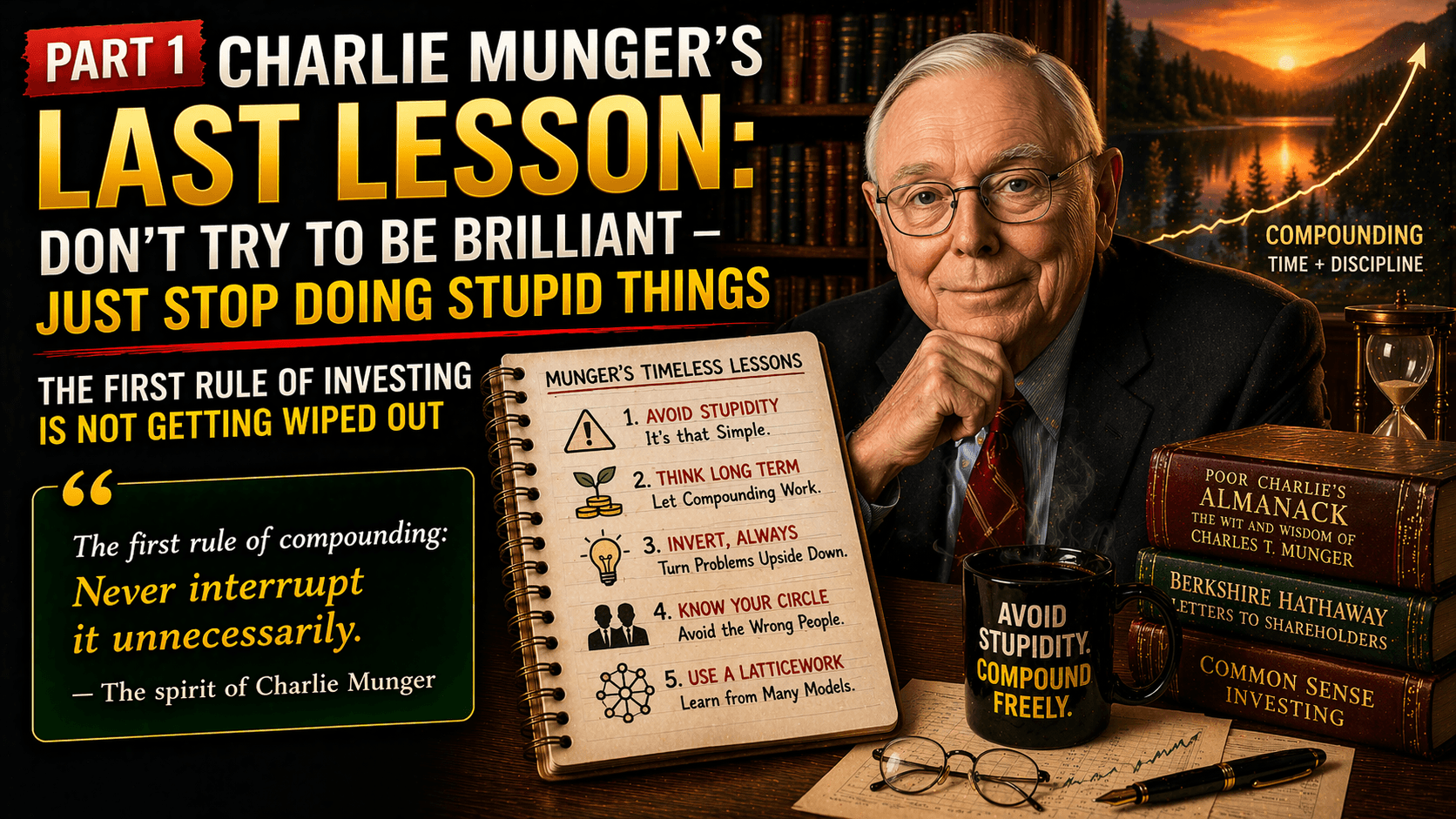
The first rule of investing is not getting wiped out. Charlie Munger spent his career teaching that spectacular success depends less on doing extraordinary things than on not doing fatal ones. Why avoidance of stupidity beats pursuit of brilliance -- and why that lesson matters more in 2026 than ever.
The Wrong Starting Point
Most investors are told the path to wealth begins with genius.
Faster insight. Sharper predictions. Better models. Better timing. Better courage. The winning investor gets framed as someone who sees what others miss, bets bigger than others dare, and proves they are right faster than the market.
Charlie Munger spent his career teaching the opposite.
**He did not believe great investing began with brilliance. He believed it began with avoiding catastrophe.**
That sounds simple. It is not. Because the human mind is naturally drawn toward heroic stories. We want wealth to come from boldness, conviction, and dramatic moves. We want the legend. We want the ten-bagger before everyone else sees it. We want to feel early, different, and right.
Munger's worldview was colder. More practical. More durable.
He understood that in investing, as in life, spectacular success often depends less on doing a few extraordinary things than on **not doing a few fatal things.**
That is the real first principle.
- Not maximizing upside
- Not sounding clever
- Not catching every rally
- Not proving you are right
**Just staying alive.**
This is Part 1 of a five-part series on Charlie Munger for 2026 markets. If you read only one part of the series, read this one -- because every other lesson he taught assumes you have already accepted this one.
---
The Real First Rule Is Not Performance -- It Is Survival
Warren Buffett's famous line -- "Rule No. 1: Never lose money. Rule No. 2: Never forget Rule No. 1" -- gets repeated like a slogan, a joke, or folksy wisdom.
Munger treated it as something more serious: **a survival code.**
Markets are unforgiving toward investors who treat loss as a temporary inconvenience rather than a structural threat.
- A 10% loss is irritating.
- A 20% loss is painful.
- **A 50% loss is transformational** -- not because of ego, but because of math.
Lose 50%, and you do not need a good year to recover. You need a 100% return just to get back to where you started.
That is the cruelty of investment mathematics. **A bad mistake does not just reduce capital. It distorts time.**
And time is the real asset.
A great investor is not merely someone who earns high returns. A great investor is someone who protects the one thing compounding requires above all else:
> **The ability to remain in the game.**
Munger was unusually clear-eyed about this. He did not romanticize risk. He did not worship aggression. He did not admire recklessness disguised as conviction.
He knew investors rarely die from lack of intelligence. They usually die from one of three things:
- Ego
- Impatience
- The inability to imagine things can go badly
**"Don't lose money" is not about avoiding every drawdown. That's impossible.**
It is about avoiding **irreversible damage.**
There is a difference. Temporary pain is survivable. Permanent impairment is not. That distinction belongs at the center of every serious portfolio.
---
Before You Learn How to Make Millions, Learn How Not to Lose Thousands
This may be the most unglamorous investment principle ever taught. It is also one of the most useful.
Most investors begin in the wrong place. They start by asking:
- What should I buy?
- What will double?
- What is the next major theme?
- What stock has the most upside?
- How do I make serious money quickly?
Munger would treat these as second-order questions. The first-order question is much duller:
> **What are the most reliable ways people destroy themselves financially -- and how do I build a system that prevents me from doing those things?**
That question has no drama. It has enormous utility.
If you avoid:
- Leverage blowups
- Valuation insanity
- Overconcentration in fragile ideas
- Panic selling
- Ego-driven decisions
...you have already removed a huge percentage of the mistakes that permanently damage portfolios.
And once you remove those, something surprising happens.
**You no longer need to be extraordinary to get good results.**
This was part of Munger's genius. Investing is not only about intelligence. It is about error minimization. In that sense, investing resembles engineering more than storytelling.
**A bridge does not remain standing because the architect was inspirational. It remains standing because obvious failure points were anticipated and removed.**
Your portfolio should be designed the same way.
---
The Hardest Truth -- One Stupid Decision Erases Years of Discipline
Compounding is powerful. It is also fragile.
It can take decades to build wealth and one bout of arrogance to destroy it.
That is why Munger distrusted certain kinds of financial behavior so intensely. Not because he was conservative by temperament. Because he was **realistic about asymmetry.**
A person can make smart, patient decisions for years and still undo much of it by:
- Reaching for leverage late in a cycle
- Overpaying for certainty
- Confusing a bull market with personal genius
- Taking on risks they do not understand because they are tired of feeling left behind
This is one reason Munger's philosophy feels so modern in 2026.
We live in an age of instant information, financial influencers, AI-generated conviction, thematic manias, constant comparison, and an endless stream of reasons to feel late.
That environment is not just intellectually noisy. **It is psychologically corrosive.**
It encourages investors to think in extremes:
- All in
- All out
- Maximum conviction
- Maximum urgency
- Maximum explanation
Munger's approach pushes the other way.
He asks you to slow down. To remove the need to perform intelligence in public. To stop treating investing as a stage on which your boldness must be displayed.
**Because the market does not pay extra for personality.**
It rewards survival. And then, over time, it rewards discipline.
---
Investing Is Not a Home Run Derby. It's an Endurance Sport.
Modern market culture teaches investors to think in episodes.
- This quarter's theme
- This month's breakout
- This week's AI winner
- This cycle's "must-own" stock
Everything gets framed as if investing were a sequence of sprints.
Munger thought in a completely different way. He thought in terms of **lifetime outcomes.**
And once you think that way, the whole game changes.
You stop asking:
> "How do I make the most money this month?"
And begin asking:
> "What kind of behavior would make it most likely that I'm still compounding 20 or 30 years from now?"
That question leads to a very different portfolio.
A portfolio built for endurance is not optimized for excitement. **It is optimized for resilience.**
That means:
- Fewer dramatic bets
- Less need for prediction
- More respect for valuation
- More skepticism toward leverage
- A much lower tolerance for permanent damage
**This kind of portfolio often looks boring.** That is usually a good sign.
Because boring portfolios tend to lack the ingredients of self-destruction. And self-destruction is far more common than most investors realize.
The graveyard of capital markets is not filled only with idiots. **It is filled with smart people who reached too hard, too late, for too much.**
Munger knew this. That is why his advice often sounded less like motivation and more like guardrails. He was not trying to make investors feel powerful. **He was trying to keep them from becoming casualties.**
---
Why This Lesson Matters More in the AI Era -- Not Less
At first glance, Munger's philosophy may sound too conservative for a fast-moving era shaped by AI, robotics, defense technology, energy infrastructure, tokenization, and massive capital rotation.
**The opposite is true.**
His ideas matter more in these periods, not less.
Why? Because periods of major technological change create the most seductive investing conditions:
- Genuinely world-changing ideas
- Rapidly rising valuations
- Extraordinary narratives
- Career pressure
- Comparison pressure
- The illusion that caution equals irrelevance
**That is exactly when investors become most vulnerable to stupidity.**
Not because the technology is fake. Because real technological revolutions often produce fake certainty.
That distinction is what many investors miss.
> A technology can be real.
> A company can be excellent.
> And the stock can still be priced in a way that makes it dangerous.
Munger would never tell you to ignore innovation. But he would insist that **innovation does not suspend arithmetic.**
If anything, revolutionary periods require more discipline, not less.
They require the investor to ask:
- What can go wrong here?
- What assumptions are already embedded in the price?
- What happens if this takes longer than expected?
- What if I am directionally right but financially early?
- What if the narrative is true but the valuation is still absurd?
**That is the kind of thinking that keeps people alive through bubbles. And staying alive through bubbles is one of the few reliable ways to be there for the compounding that follows.**
---
What "Avoiding Stupidity" Looks Like in Practice
This philosophy only matters if it becomes actionable. So what does Munger's first principle actually look like in investor behavior?
It means building a portfolio and a decision framework around a few very plain questions:
**1. Can this position kill me?**
Not emotionally. **Financially.**
Every position should be judged not only by upside, but by the damage it could do if you are wrong.
**2. Am I relying on favorable conditions that may not persist?**
Cheap money, high multiples, endless liquidity, perfect demand, investor enthusiasm -- all of these feel normal until they stop.
**3. Is this thesis understandable in plain English?**
If the investment only works when described in jargon, model sensitivity tables, and layered assumptions, **caution is warranted.**
**4. Am I reaching because I feel late?**
Some of the worst decisions in investing are not made out of analysis. **They are made out of emotional comparison.**
**5. What must be true for this to work?**
This question forces intellectual honesty. If too many things must go right, the risk is often higher than the story makes it seem.
**6. If I lose on this, will it be because I was unlucky, or because I was stupid?**
**This may be the most Munger-like question of all.**
Bad luck is part of investing. **Preventable stupidity is optional.**
---
A Different Definition of Intelligence
One of the most liberating things Munger offers is a better definition of what it means to be "smart" in markets.
In markets, many people use intelligence performatively. They want to sound early, deep, contrarian, sophisticated, or visionary.
**Munger's version of intelligence was far less theatrical.**
To him, being smart often meant:
- Not overreacting
- Not overreaching
- Not borrowing when you do not need to
- Not pretending certainty where none exists
- Not getting seduced by envy
- Not interrupting compounding
- Not turning temporary discomfort into permanent damage
**That is not flashy intelligence. It is defensive intelligence.**
But defensive intelligence is precisely what allows offensive results over time.
This is one of the deepest paradoxes in investing:
> **The path to extraordinary long-term outcomes often begins with a willingness to look unremarkable in the short term.**
That is a hard lesson for modern investors, especially in public environments where everyone is broadcasting wins, ideas, themes, and conviction.
But it is still true.
**You do not need to look brilliant every quarter. You need to avoid being foolish in the moments that matter.**
---
The First Habit of a Serious Investor
Stop asking "How much can I make?" before you ask "How much can I lose?"
This is the mindset shift that separates speculation from stewardship.
**Speculators begin with upside. Stewards begin with fragility.**
Munger was always trying to move people from the first mindset to the second. Not because upside does not matter. Because upside only matters after survival is secured.
That is why the first habit of a serious investor should be:
When evaluating any opportunity, first write down:
- What could go wrong
- How bad it could get
- How likely that scenario is
- Whether you could survive it without compromising the rest of your life or portfolio
**Only then should you think about return.**
This does not make you timid. It makes you durable.
And durability is what turns a series of reasonable decisions into a lifetime of compounding.
---
Core Takeaway From Part 1
Investing does not begin with brilliance. **It begins with avoidance.**
- Avoiding the obvious mistake
- Avoiding the fatal error
- Avoiding the temptation to turn a manageable risk into a permanent wound
Charlie Munger's first great lesson was not about how to get rich quickly. **It was about how not to do something so stupid that getting rich slowly becomes impossible.**
That is not merely caution. It is wisdom.
And in markets, wisdom usually looks much less exciting than people hope.
But it also tends to last much longer.
---
Munger's One-Line Principle for Part 1
> **"It is remarkable how much long-term advantage people like us have gotten by trying to be consistently not stupid, instead of trying to be very intelligent."**
**Next in the series:**
**Part 2 -- It's Not Ignorance That Ruins You. It's Ego.** Why the most dangerous force in investing is not the market, but the part of you that wants to feel smart, right, early, superior, and in control.
---
Appendix -- The Munger Survival Checklist (Part 1)
Before you buy anything, ask yourself:
1. Could this position cause permanent damage if I am wrong?
2. Am I underestimating how fragile this business or thesis really is?
3. Am I focusing on upside before I have fully understood downside?
4. Is this investment attractive because it is good, or because I feel left behind?
5. Am I treating survival as a side issue instead of the main issue?
6. If this goes badly, will I still be financially and psychologically able to continue investing rationally?
**If you cannot answer these calmly, you may not have found an opportunity. You may have found temptation.**
---
Related Reading
- [The Masters: Peter Lynch Part 5 -- If Lynch Were Investing in 2026](/blog/masters-peter-lynch-part5-2026-synthesis-april-2026)
- [The Mental Game #001: Why Bull Markets Make You Worse at Investing](/research/mental-game-001-bull-market-psychology)
- [The Mental Game #002: How to Survive an AI Bubble Without Denying the Technology](/research/mental-game-002-ai-bubble-survival)
- [The Masters: Livermore -- The Price of Abandoning Your Rules](/blog/masters-jesse-livermore-price-confirmation-april-2026)
---
*For informational and educational purposes only. Not investment advice. The author has no position in any security mentioned. Always conduct your own research.*
*For the edge that cuts through the noise -- Brutal Edge.*
Share your analysis
Keep it data-driven. No investment advice.
- Keep it data-driven and respectful
- No investment advice (buy / sell / hold)
- No spam, promotion, or solicitation
- No profanity or offensive content
- Violations are automatically removed
Content is for informational purposes only. Always verify data from primary sources.