The Masters: Charlie Munger Part 2 -- It's Not Ignorance That Ruins You. It's Ego.
The invisible enemy in investing is usually the one in the mirror. Why the most dangerous force in markets is not lack of information, but the part of you that wants to feel smart, right, early, and in control. Fear, greed, and envy -- the emotional trinity that empties portfolios.
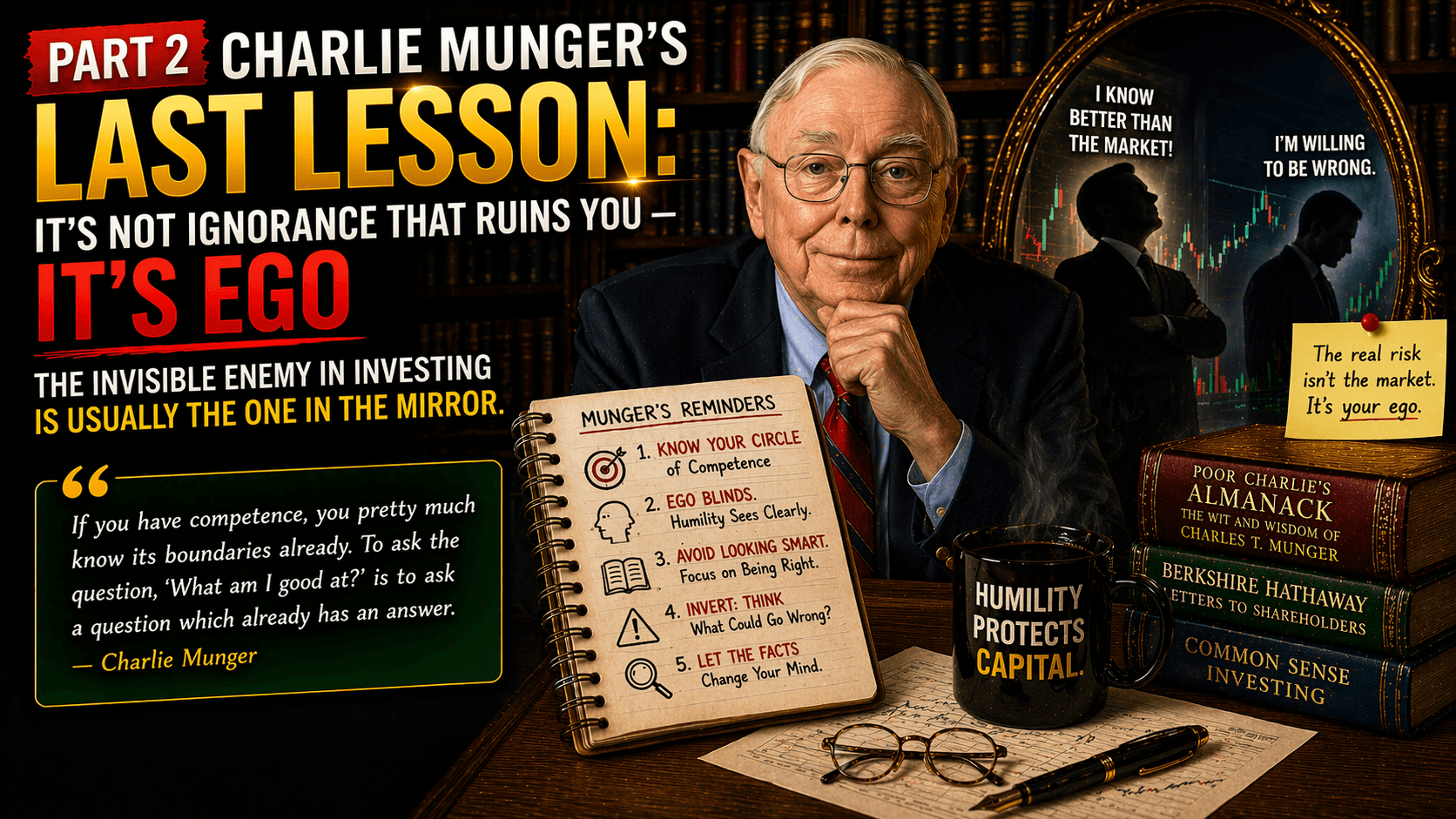
The Enemy Inside
Most investors spend far too much time trying to defeat the market.
Charlie Munger spent his life trying to teach people to defeat something else first:
**Themselves.**
That sounds simple, almost motivational. It is not.
Munger did not mean "believe in yourself less" in a vague self-help sense. He meant something much sharper, much more uncomfortable, and much more useful:
> **The most dangerous force in investing is not lack of information. It is the part of you that wants to feel smart, right, early, superior, and in control.**
That force has many names:
- Ego
- Pride
- Envy
- Overconfidence
- Emotional fragility
- The inability to admit error
Whatever you call it, the result is the same.
**It makes investors do irrational things for psychological reasons -- and then explain those decisions with financial language after the fact.**
That is the real danger.
People rarely say out loud:
- "I bought this because I was jealous."
- "I doubled down because I could not bear being wrong."
- "I sold because I was humiliated by the decline."
- "I chased this because everyone else seemed to be making money."
Instead, they construct narratives:
- "The setup looked compelling."
- "The market was mispricing future optionality."
- "This is a transformational category."
- "The correction was overdone."
- "I'm thinking long term."
Sometimes those statements are true. **Very often, they are just well-dressed emotional reactions.**
Munger understood this with brutal clarity. The average investor's problem was not that they lacked knowledge. It was that their psychology kept corrupting whatever knowledge they had.
If Part 1 was about avoiding obvious stupidity, Part 2 is about identifying the source from which much of that stupidity emerges:
**Ego.**
---
The Market Is Not Your Real Opponent
Investors love to speak as if the market were an external adversary.
- "The market is irrational."
- "The market is overreacting."
- "The market doesn't understand the story."
- "The market is punishing good companies."
- "The market is driven by fear."
Sometimes all of that is true.
But Munger would push the investor to look somewhere harder first.
**Before asking what the market is doing wrong, ask: what am I doing wrong in response to it?**
This is where investing becomes morally uncomfortable in the best possible way.
Because the market may be volatile, manic, euphoric, stupid, cruel, and inconsistent -- but none of those things can actually destroy you unless they provoke you into self-destructive behavior.
- The market can offer temptation. It cannot force you to accept it.
- The market can create panic. It cannot force you to liquidate good assets in emotional collapse.
- The market can make your neighbor rich. It cannot force you to buy late out of humiliation.
**That last part matters more than many investors admit.**
Because in modern investing, emotional damage is often social before it is financial.
You do not just feel the pain of loss. You feel the pain of comparison.
**And comparison is one of the most expensive habits in finance.**
---
Fear, Greed, and Envy -- The Emotional Trinity That Empties Portfolios
If Munger had to reduce much of investor failure to a few enduring emotional patterns, three would stand above the rest:
- Fear
- Greed
- Envy
Each one is dangerous alone. Together, they are devastating.
**Fear**
Fear makes people sell what they should hold, hesitate when they should act, and confuse volatility with permanent damage.
**Fear is not only about downside. It is also about embarrassment.**
People do not just fear losing money. They fear:
- Looking foolish
- Feeling out of control
- Being the last one holding
- Being unable to explain why they stayed in
That is why fear makes investors shorten their time horizon at exactly the wrong moment.
They stop asking:
- Is the business still good?
- Is the balance sheet still intact?
- Has the thesis really changed?
And start asking:
- **How do I stop feeling this now?**
That is emotional liquidation masquerading as prudence.
**Greed**
Greed is easier to spot. Harder to resist.
Greed tells investors:
- A good gain is not enough
- Concentration proves conviction
- Leverage is efficiency
- Risk control is for people without imagination
- What went up yesterday deserves even more capital tomorrow
**Greed is especially dangerous late in a cycle because it is usually celebrated socially before it is punished financially.**
In a rising market, the greedy person often looks like the genius. That is what makes greed so seductive.
**It pays first, then destroys later.**
**Envy**
This may be the most underappreciated force of the three.
Munger spoke often and sharply about envy because he understood how corrosive it is.
- Fear hurts.
- Greed seduces.
- **But envy humiliates.**
It makes you feel left behind by the success of others. And once that feeling enters the portfolio, discipline begins to collapse.
- People who were patient become impulsive.
- People who were rational become narrative-driven.
- People who knew better suddenly buy things they do not understand because not participating has become emotionally unbearable.
**That is the true cost of envy. It does not simply distort your mood. It distorts your standards.**
---
Envy Is a Tax Paid by the Undisciplined
One Munger-like way to frame this:
> **Envy is the tax investors pay when they cannot emotionally tolerate someone else's success.**
That tax is rarely visible on a brokerage statement. **But it is enormous.**
It appears when investors:
- Rotate late into overheated themes
- Abandon their process because someone else got richer faster
- Increase risk to "catch up"
- Suddenly decide that their old standards are too conservative for the current market
This is especially dangerous in an era of public performance.
Modern investors do not just compete with the market. They compete with:
- Social media timelines
- Screenshots of winning trades
- Influencer conviction
- Selective storytelling
- Algorithmic highlight reels
You are exposed constantly to other people's apparent success, almost always stripped of context:
- No position size
- No downside path
- No luck attribution
- No tax consequences
- No earlier mistakes
- No emotional cost
**Just the outcome.**
That environment is a machine built to manufacture envy.
And envy changes investor behavior in extremely predictable ways:
- You buy later
- Bigger
- At worse prices
- With less analysis
- Under more emotional pressure
Because the goal is no longer long-term success. **The goal becomes emotional relief.**
**You are not buying the stock. You are trying to erase the feeling of being behind.**
That is one of the worst reasons to own anything.
---
Ego Doesn't Just Make Investors Arrogant. It Makes Them Brittle.
When people think of ego, they usually think of loud overconfidence:
- The investor who predicts everything
- The personality who speaks in absolutes
- The trader who mistakes one good year for permanent genius
**That is one version of ego.**
But Munger would point to another form that is quieter and often more destructive: **ego as fragility.**
This is the ego that cannot tolerate:
- Being wrong
- Looking wrong
- Changing its mind
- Sitting still while others appear smarter
This investor does not necessarily sound arrogant. They may even sound modest.
**But their portfolio behavior reveals the truth:**
- They average down because selling would be admission
- They refuse to trim because trimming would imply uncertainty
- They chase because not participating feels like inferiority
- They reject opposing evidence because it threatens identity
This is ego as psychological rigidity. **And rigidity is costly.**
Markets are dynamic. They require adaptation.
The investor who cannot emotionally adapt because identity is tangled up with being "right" will eventually pay for that rigidity.
**The market does not punish people for having opinions. It punishes people for turning opinions into ego commitments.**
---
The Investor in the Mirror
> The real problem is not always in the market. It is often in the part of you that cannot endure the market.
That is a hard sentence. It is also one of the most useful sentences an investor can carry.
**Every portfolio eventually becomes a mirror.**
A downturn does not just reveal what you own. It reveals what you are.
- Are you patient, or only patient when things go well?
- Are you long-term, or only long-term when your stock is up?
- Are you disciplined, or only disciplined when discipline feels easy?
- Are you genuinely rational, or simply confident in favorable conditions?
This is why Munger valued temperament so highly.
He knew that investing success is not built on intelligence alone. **It is built on behavior under emotional pressure.**
And behavior under pressure is not determined by IQ. It is determined by character, structure, and self-awareness.
**This is also why many brilliant people perform terribly in markets.** They are so used to being right, so identified with their own intelligence, that they react badly when markets refuse to reward them immediately.
They become:
- Impatient
- Theatrical
- Defensive
- Reckless
The market has no respect for that. **It simply takes the money.**
---
Build Your System on Temperament, Not Idealized Self-Image
One of Munger's deepest practical lessons: **you should not build an investment system around the fantasy of who you wish you were.**
You should build it around the reality of who you are.
If you know that:
- Large drawdowns destabilize you
- Concentrated positions make you obsessive
- Frequent news flow tempts you into overreaction
- Social comparison affects your judgment
- Volatility reduces your decision quality
...then your system must account for that.
**This is not weakness. It is maturity.**
A good investment system is not built for the investor you become in a calm spreadsheet environment.
It is built for the investor you become:
- After a 30% decline
- After missing a huge winner
- After seeing a friend get rich faster
- After two bad decisions in a row
- After months of underperformance
**That is the real investor. And that is the person your rules must protect.**
Munger did not admire self-deception. He admired people who could understand their own weaknesses early enough to prevent those weaknesses from becoming financial disasters.
In practice, that may mean:
- Smaller position sizes
- Fewer holdings you monitor obsessively
- Less leverage
- Less exposure to highly socialized themes
- More written rules
- Slower decision speed
**None of that is glamorous. All of it can be life-saving.**
---
Humility Is Not Passive. It Is Protective.
In investing, humility is often misunderstood as lack of conviction.
Munger viewed it differently.
Humility means:
- Knowing what you do not know
- Respecting uncertainty
- Understanding the limits of your edge
- Refusing to behave as though confidence itself creates safety
**This is protective because markets are full of situations where your knowledge is partial, your timing is imperfect, and your conclusions are vulnerable to error.**
The humble investor does not freeze. They simply refuse to make oversized decisions on undersized certainty.
That is a very different posture from the modern market habit of aggressive certainty.
**Humility is not about becoming timid. It is about becoming structurally harder to kill.**
That is one reason Munger aged so well as a thinker. He never pretended that investing could be reduced to cleverness.
He understood that judgment without humility becomes overreach, and overreach eventually becomes damage.
---
The Hidden Cost of Needing to Feel Smart
Here is one of the most dangerous motives in finance:
> **The desire to feel intelligent through your portfolio.**
This motive ruins people because it changes the function of investing.
Instead of being a process for compounding capital, investing becomes:
- A form of self-expression
- A public identity
- A performance of sophistication
- A way to prove one's insight
**Once that happens, the portfolio becomes emotionally contaminated.**
You stop asking:
- What is most likely to work?
- What is properly sized?
- What fits my process?
- What is fairly priced?
And start asking:
- What makes me look insightful?
- What narrative feels elevated?
- What position proves I'm ahead?
- What idea makes me feel distinct?
**This is where ego and capital collide.**
Munger's philosophy quietly rejects all of this. He invites investors to stop using their portfolio as a mirror for self-worth.
That is one of the most liberating ideas in investing.
> **You do not need your portfolio to make you feel superior. You need it to survive, compound, and serve your future.**
Those are very different goals.
---
What This Means in 2026
This chapter becomes even more relevant in a market shaped by:
- AI winner-take-most narratives
- Public scorekeeping
- Fast thematic rotation
- Billionaire-founder mythology
- Social proof loops
- Cultural pressure to always be "positioned"
**These are ideal conditions for ego-driven mistakes.**
Why? Because the biggest dangers are no longer only analytical. They are emotional and comparative.
In such a market, investors are constantly tempted to:
- Abandon discipline for relevance
- Substitute excitement for process
- Confuse visibility with inevitability
**Munger's voice cuts through all of that.**
He reminds you that:
- Being impressed is not an investment thesis
- Being left behind emotionally is not a valuation framework
- Needing to feel smart is not a risk management system
In fact, those are often the very things that destroy one.
---
Core Takeaway From Part 2
Part 1 taught survival through avoiding stupidity.
Part 2 identifies one of stupidity's deepest sources: **ego.**
Not ego only in the loud sense. But ego in all its expensive forms:
- Envy
- Overconfidence
- Emotional fragility
- The inability to admit ignorance
- The need to catch up
- The need to be right
- The need to feel superior
Charlie Munger understood that a great investment system is not built on idealized intelligence.
**It is built on a temperament sturdy enough to withstand:**
- Other people's success
- Your own uncertainty
- Market volatility
- The ongoing insult of not always being the smartest person in the room
That is what makes it so durable.
> **Intelligence can impress. Temperament can endure.**
And in the end, endurance is what lets compounding do its work.
---
Munger's One-Line Principle for Part 2
> **"It is not greed that drives the world, but envy."**
**Next in the series:**
**Part 3 -- When You Feel Safest, You May Be Most Exposed.** Why the paradox of safety, the value of cash, and the illusion of stability are often where real risk hides.
---
Appendix -- The Munger Temperament Checklist (Part 2)
Before making any major investment decision, ask:
1. Am I acting from analysis, or from comparison?
2. Would I still like this idea if nobody else were talking about it?
3. Am I increasing risk because the opportunity is great -- or because I feel left behind?
4. Is my reluctance to sell based on conviction, or on ego?
5. Am I emotionally equipped to handle being wrong on this position?
6. Have I built my system around my real temperament -- or my fantasy temperament?
7. Is this portfolio serving my future, or my ego?
**If those questions make you uncomfortable, that is useful. Discomfort is often the first sign that ego has entered the investment process -- and that is usually the moment discipline matters most.**
---
Related Reading
- [Part 1 -- Don't Try to Be Brilliant. Just Stop Doing Stupid Things.](/blog/masters-charlie-munger-part1-stupidity-may-2026)
- [The Mental Game #001: Why Bull Markets Make You Worse at Investing](/research/mental-game-001-bull-market-psychology)
- [The Masters: Livermore -- The Price of Abandoning Your Rules](/blog/masters-jesse-livermore-price-confirmation-april-2026)
---
*For informational and educational purposes only. Not investment advice. The author has no position in any security mentioned. Always conduct your own research.*
*For the edge that cuts through the noise -- Brutal Edge.*
Share your analysis
Keep it data-driven. No investment advice.
- Keep it data-driven and respectful
- No investment advice (buy / sell / hold)
- No spam, promotion, or solicitation
- No profanity or offensive content
- Violations are automatically removed
Content is for informational purposes only. Always verify data from primary sources.