The Masters: Charlie Munger Part 3 -- When You Feel Safest, You May Be Most Exposed
The paradox of safety, the value of cash, and why real security is resilience. What feels safe is often only what feels familiar -- and the moment something feels unquestionably secure may be the moment risk is most underpriced.
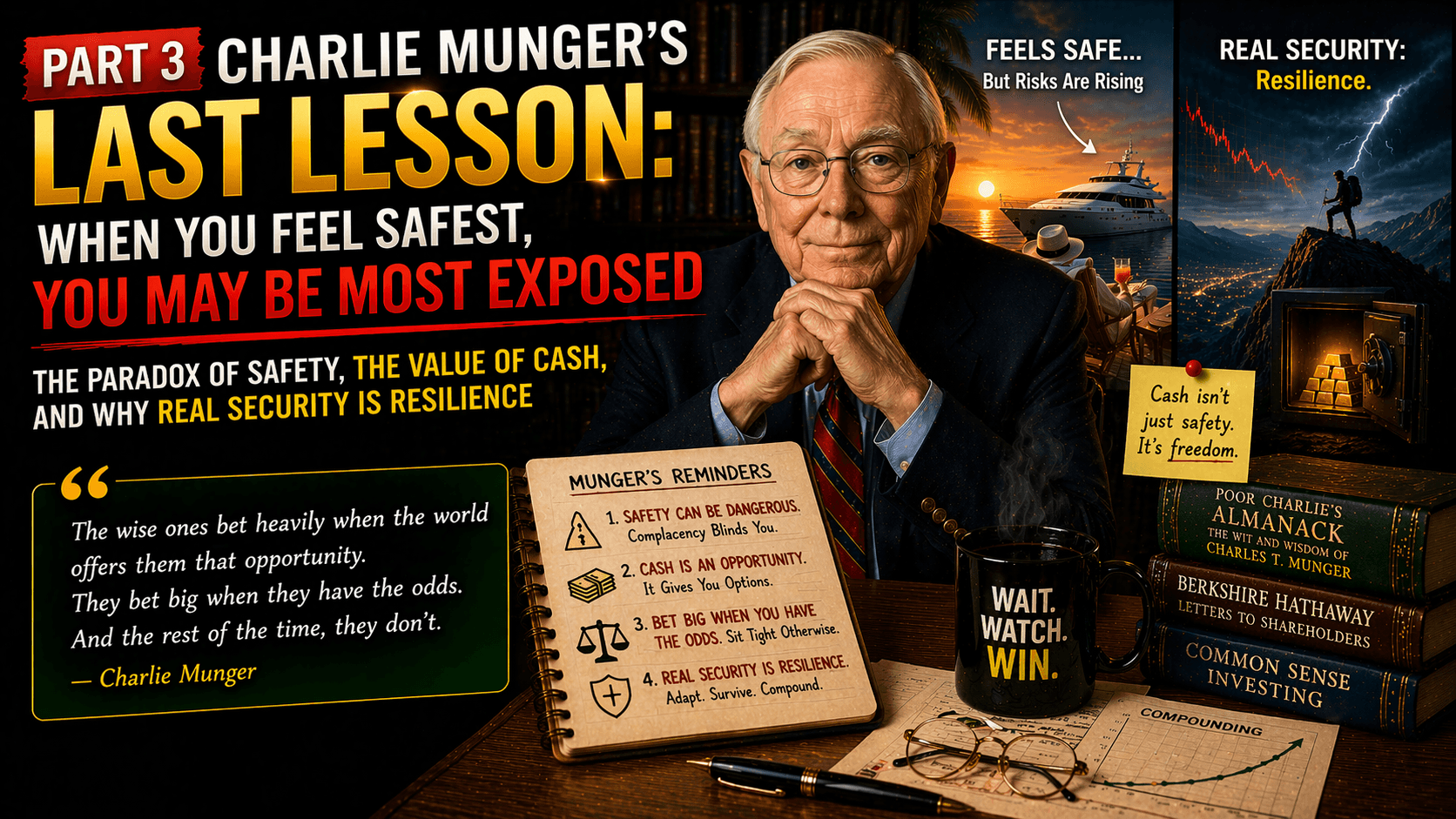
The Most Dangerous Word in Markets
One of the most dangerous words in investing is **safe.**
People use it constantly:
- "This stock feels safe."
- "This market is stable."
- "This sector is defensive."
- "This asset has low volatility."
- "Everyone owns it."
- "The downside seems limited."
Charlie Munger understood something most investors never fully absorb:
> **What feels safe is often only what feels familiar. And what feels familiar is often what has already been widely accepted, widely owned, and widely believed.**
That distinction matters because markets do not reward comfort. They often punish it.
- Comfort is not the same thing as safety.
- Price stability is not the same thing as resilience.
- Consensus is not the same thing as protection.
Some of the worst losses in financial history did not come from investors taking obviously reckless bets. They came from investors who believed they were standing on solid ground because everyone around them believed the same thing.
**This is the paradox of safety.**
The moment something feels unquestionably secure, it may also be the moment when:
- Expectations are highest
- Valuations are most stretched
- Positioning is crowded
- Imagination about downside is at its weakest
If Part 1 was about survival, and Part 2 was about ego, Part 3 is about the illusion that usually appears right before real danger:
**The feeling of safety.**
---
Stability Can Be the Most Expensive Illusion in Markets
Investors are naturally drawn to stability.
That is understandable. Volatility is unpleasant. Stability is soothing. The mind equates predictability with safety because predictability reduces emotional stress.
**But markets are more treacherous than that.**
A calm chart can hide:
- Overvaluation
- Excessive leverage
- Poor forward returns
- Crowded ownership
- A narrative so universally accepted that no margin of safety remains
This is one of Munger's core practical insights:
> **Real danger often enters not when investors are terrified, but when they are deeply reassured.**
When everyone agrees that an asset is safe, they stop demanding compensation for risk.
That is when:
- Valuations expand
- Skepticism collapses
- Position sizes increase
- People begin to talk about permanence
They stop saying "this seems attractive." They begin saying "this can't really go wrong."
**That shift is subtle. It is also often the moment risk becomes most underpriced.**
The market has a habit of punishing certainty, especially when certainty becomes socially contagious.
Some of the most dangerous words in finance:
- "This time it's different."
- "It's a core holding."
- "It's too important to fail."
- "Everyone owns it for a reason."
- "There's nowhere else to go."
**None of those are risk controls. They are emotional anesthetics.**
---
Real Safety Is Not the Absence of Bad Outcomes
It is the ability to survive them.
This may be the most important distinction in the chapter.
Most investors think of safety as a world in which bad things do not happen.
Munger thought in a more durable way. He would ask:
> **What happens if bad things do happen?**
**That is a radically better question.**
Because real investing safety is not built on the fantasy that:
- Markets will remain calm
- Correlations will behave
- Liquidity will stay available
- Financing will remain easy
- Narratives will stay intact
Real safety is built on **resilience.**
Resilience means:
- Your balance sheet can take a hit
- Your portfolio can take a drawdown
- Your psychology can absorb discomfort
- Your process can function during volatility
- Your capital structure does not force you into bad decisions at the worst moment
**This is where many investors get trapped by the aesthetics of safety.**
They want assets that look smooth, sound respectable, and make them feel protected.
But Munger's worldview suggests that true protection lies elsewhere. It lies in building a system where, when bad things arrive -- and they always do eventually -- you are not forced into permanent damage.
The truly safe investor is not the one who says:
> "Nothing bad will happen."
It is the one who says:
> **"Bad things can happen, and I will still be standing when they do."**
That is a much harder standard. It is also much more useful.
---
Why Comfort Is Often a Late-Cycle Emotion
There is a psychological pattern Munger would have recognized immediately:
**The longer markets behave well, the more investors mistake good recent conditions for permanent structure.**
This happens in every cycle.
- First, people are cautious
- Then they become constructive
- Then confident
- Then comfortable
- Then certain
**And certainty is where danger often begins.**
Why? Because comfort changes behavior.
When investors feel safe, they:
- Buy more aggressively
- Question less
- Borrow more easily
- Accept lower return compensation
- Hold more crowded assets
- Stop imagining scenarios outside the recent past
**That is how fragile structures get built. Not in panic, but in calm. Not in fear, but in ease.**
A late-cycle market often does not feel dangerous. It feels effortless. That is what makes it so seductive.
A truly dangerous market environment is rarely announced with warning sirens. It often arrives disguised as:
- Smooth trends
- Strong consensus
- Repeated dip-buying success
- The growing social belief that risk has been domesticated
**Munger's mindset cuts straight through this.**
He would remind investors that markets are not safer because they have been pleasant recently. If anything, long periods of comfort often increase the likelihood that people have silently accumulated exposures they no longer fully respect.
---
Cash Is Not Dead Weight. It Is Optionality.
This is one of the most misunderstood ideas in investing, especially during bull markets.
Many investors think of cash in only one way:
- Low return
- Inflation drag
- Idle capital
- Underperformance
- Embarrassment during rallies
Munger saw something more important.
He understood that **cash is not only a return decision. It is a positioning decision.**
Cash does not merely sit there. It does something structurally valuable:
> **It preserves the ability to act when other people cannot.**
**That is optionality.**
In a panic, the value of cash changes. It stops being "lazy capital" and becomes:
- Buying power
- Emotional stability
- Tactical freedom
- The capacity to take advantage of forced selling by others
This is one reason Munger and Buffett always treated liquidity with more respect than many market participants did. Not because they loved inactivity, but because they understood that **the ability to respond in moments of stress is one of the greatest advantages an investor can possess.**
Cash gives you:
- Time
- Patience
- The ability to choose
**And in markets, the ability to choose under stress is rare and valuable.**
This does not mean investors should always sit heavily in cash. It means they should stop viewing cash only through the lens of short-term yield comparison.
> **Cash is not just return foregone. It is resilience stored.**
---
The Visible Cost. The Invisible Value.
One reason investors undervalue cash is that its cost is obvious while its benefit is delayed.
**The cost of holding cash is easy to see:**
- You underperform in strong rallies
- You feel foolish while others are fully invested
- You may appear overly conservative
- Your portfolio looks less "efficient"
**The value is harder to see because it shows up only under stress:**
- When assets dislocate
- When leverage is forced out
- When correlations break
- When prices detach from value
- When fear creates opportunity
That is why emotionally immature investors often hate cash. **Its cost is social and immediate. Its value is strategic and intermittent.**
But Munger's framework encourages a longer view.
He would almost certainly prefer the investor who occasionally looks too cautious during euphoria over the investor who becomes fully extended precisely because caution has become socially inconvenient.
> **In investing, short-term embarrassment is often the entry fee for long-term flexibility.**
That is one of the quiet truths most people learn too late.
---
The Need to Feel Safe Can Make Investors Structurally Unsafe
Another paradox worth sitting with.
Investors often pursue emotional comfort in ways that **reduce actual safety.**
For example:
- They crowd into overowned "safe" assets
- They avoid temporary discomfort by abandoning cash
- They buy fully priced quality at any multiple because it feels less dangerous
- They hold what others respect rather than what is actually resilient
- They treat recent stability as evidence of permanent durability
All of these behaviors share one thing: **they are attempts to reduce discomfort.**
But discomfort reduction is not the same thing as risk reduction.
> **If your main objective is to feel comfortable, you may end up assuming far more hidden risk than you realize.**
That is because true resilience often requires temporarily uncomfortable choices:
- Holding liquidity
- Being patient while others are euphoric
- Accepting underperformance in narrow rallies
- Refusing leverage when it looks tempting
- Declining to participate in consensus trades that seem too obvious
**These choices rarely feel good in the moment. That is why they remain so valuable.**
The market usually pays people not for doing what feels best now, but for doing what preserves strength later.
---
Why "Defensive" Can Be Dangerous
In every cycle, investors eventually create categories they emotionally treat as untouchable:
- Defensive sectors
- Safe dividend names
- Quality compounders
- Treasury proxies
- Core holdings
- All-weather assets
Some of these labels are useful. Some become lazy.
**The danger comes when the category replaces the analysis.**
An asset does not become safe because it is widely called defensive. It becomes attractive only when:
- The valuation is reasonable
- The balance sheet is sound
- The downside is survivable
- The expected return still compensates for the risk
If a so-called defensive asset is massively overowned, richly valued, and implicitly expected to behave perfectly -- **it may be less defensive than it appears.**
This is where Munger's skepticism becomes so valuable.
He would not be impressed by labels. He would look through them.
He would ask:
- What are we paying?
- What is being assumed?
- What happens if those assumptions change?
- Is this "safe" because it truly is resilient, or because the crowd has become emotionally dependent on believing that it is?
**That last question is especially important.**
Because once investors become emotionally dependent on an asset's image of safety, they often stop imagining how quickly that image can crack.
---
The Emotional Cost of Resilience
One reason resilience is so rare is that it carries emotional cost long before it provides financial reward.
Resilience often means:
- You look too cautious near the top
- You seem underexposed during euphoric phases
- You may sit with cash while others outperform
- You may hold back while the crowd celebrates
- You may feel "wrong" for longer than is comfortable
**This is why resilience is often mislabeled as timidity.**
But the two are not the same.
> Timidity avoids action out of fear.
> **Resilience preserves capacity out of discipline.**
Munger understood that serious investors must be able to tolerate periods of:
- Underparticipation
- Social discomfort
- Strategic boredom
**That is not weakness. It is one of the prices of staying structurally alive.**
Investors who cannot bear these temporary costs often end up paying something much larger later.
---
What Resilience Looks Like in Practice
This philosophy matters only if it can be translated into decisions.
**1. Keeps some form of optionality**
That may mean cash, short-duration instruments, or simply not being fully extended in fragile assets.
**2. Sizes positions so that stress does not force action**
A position may be logically attractive and still too large for your temperament or liquidity needs.
**3. Focuses on businesses and structures that can survive bad scenarios**
Not "no bad scenarios." **Bad scenarios.**
**4. Avoids dependence on a single favorable macro condition**
If an investment only works when:
- Rates fall
- Multiples stay high
- Liquidity stays abundant
- The narrative remains intact
...then the margin of safety is likely weaker than it looks.
**5. Treats emotional comfort as a warning signal, not confirmation**
If an asset feels universally safe, the next question should not be "How much more can I buy?"
It should be: **"What am I not seeing because this feels so easy?"**
That is a very Munger-like posture.
---
Core Takeaway From Part 3
Part 1 taught that survival is the first law of investing.
Part 2 taught that ego is often the enemy within.
Part 3 offers the next crucial lesson:
> **The desire to feel safe can itself become a source of danger.**
Charlie Munger's version of safety was never sentimental. It was structural.
He did not trust:
- Smooth price action
- Consensus comfort
- The emotional relief that comes from owning what everyone else calls secure
He trusted resilience.
He trusted:
- Balance sheet strength
- Liquidity
- Optionality
- Patience
- Systems that could withstand reality instead of assuming it would remain pleasant
**That is why his philosophy still cuts so sharply through modern markets.**
Because what investors often call "safe" is just what helps them sleep tonight.
**What Munger cared about was different. He cared about what would still let you sleep after the storm had already arrived.**
---
Munger's One-Line Principle for Part 3
> **"It's not the bad event that ruins you. It's being positioned in a way that leaves you unable to survive it."**
**Next in the series:**
**Part 4 -- The Fastest Road to Ruin Is the Desire to Get Rich Fast.** Leverage, overconfidence, and the fatal seduction of speed -- why intelligent people blow up in markets not from ignorance, but from impatience.
---
Appendix -- The Munger Resilience Checklist (Part 3)
Before you label anything "safe," ask:
1. Is this truly resilient, or merely familiar?
2. Does the current price still offer protection, or only comfort?
3. Am I underestimating risk because recent experience has been calm?
4. If a bad event happened tomorrow, would I still have optionality?
5. Am I holding enough liquidity to act if others are forced to sell?
6. Is my portfolio designed to survive unpleasant reality, or only pleasant assumptions?
7. Have I confused short-term discomfort with long-term danger?
**If these questions feel inconvenient, that may be exactly why they matter. True safety is rarely built in moments of ease. It is built by preparing for moments when ease disappears.**
---
Related Reading
- [Part 1 -- Don't Try to Be Brilliant. Just Stop Doing Stupid Things.](/blog/masters-charlie-munger-part1-stupidity-may-2026)
- [Part 2 -- It's Not Ignorance That Ruins You. It's Ego.](/blog/masters-charlie-munger-part2-ego-june-2026)
- [The Mental Game #002: How to Survive an AI Bubble](/research/mental-game-002-ai-bubble-survival)
---
*For informational and educational purposes only. Not investment advice. The author has no position in any security mentioned. Always conduct your own research.*
*For the edge that cuts through the noise -- Brutal Edge.*
Share your analysis
Keep it data-driven. No investment advice.
- Keep it data-driven and respectful
- No investment advice (buy / sell / hold)
- No spam, promotion, or solicitation
- No profanity or offensive content
- Violations are automatically removed
Content is for informational purposes only. Always verify data from primary sources.