The Masters: Charlie Munger Part 4 -- The Fastest Road to Ruin Is the Desire to Get Rich Fast
Leverage, overconfidence, and the fatal seduction of speed. Why intelligent people blow up in markets not from ignorance, but from impatience -- and why the desire to accelerate wealth creation almost always destroys it.
The Three Accelerants
There are many ways to lose money in markets.
But when Charlie Munger looked at the truly catastrophic failures -- the collapses that destroy not just performance but whole financial lives -- he kept coming back to the same small group of causes:
- Leverage
- Overconfidence
- The irresistible human urge to accelerate what should have been allowed to compound
**This is where investing becomes especially dangerous for intelligent people.**
The biggest blowups are rarely caused by ignorance alone. They are often caused by people who know quite a lot, have had some success, and begin to believe that:
- Their edge is larger than it is
- Their timing is better than it is
- Their conviction deserves more size than it does
- Money can be made faster if one simply pushes harder
**That is the seduction.**
Munger understood it deeply. He knew markets do not merely reward intelligence. They also punish the **emotional misuses of intelligence:**
- Arrogance
- Speed
- Impatience
- The inability to distinguish between a good opportunity and an excuse to overreach
Part 1 was about survival.
Part 2 was about ego.
Part 3 was about false safety.
Now we arrive at one of the most direct engines of financial self-destruction:
**The attempt to get rich faster than reality allows.**
---
Leverage Does Not Create Fragility. It Reveals It.
Many investors think leverage is dangerous only because it increases volatility.
**That is incomplete.**
Volatility is the visible part of leverage. Fragility is the real part.
Leverage does not merely magnify outcomes. **It changes the structure of your decision-making.**
- Without leverage, a bad position can hurt you.
- With leverage, a bad position can remove your ability to choose.
That is the crucial distinction.
A normal investor can be wrong, wait, reassess, even recover. **A leveraged investor often does not get that privilege.**
They do not lose because the thesis was permanently impossible. They lose because the path was too violent to survive.
That is what Munger meant when he spoke so harshly about leverage. **It transforms what might have been a temporary setback into permanent impairment.**
This is why leverage is so deceptive. It seems like a rational enhancer when conditions are favorable.
- If the asset is good, why not own more?
- If conviction is high, why not amplify it?
- If rates are manageable, why not optimize capital structure?
- If everyone else is using leverage, why should I stay conservative?
**Because the entire problem with leverage is that it works beautifully right up until the moment it makes survival impossible.**
That moment often comes faster than anyone expects.
---
The Dream of Getting Rich Quickly Is Often Just Impatience in Disguise
Markets are filled with people who say they want wealth.
**What they often actually want is speed.**
That distinction matters.
There is nothing wrong with ambition. Munger respected rational ambition. What he distrusted was the **emotional impatience that turns ambition into recklessness.**
The investor who wants to get rich quickly behaves differently from the investor who wants to get rich well.
**The first investor asks:**
- How do I maximize upside immediately?
- How concentrated can I be?
- How much can I borrow?
- What is the fastest way to scale a winner?
- What if this is the opportunity of the decade and I'm underexposed?
**The second investor asks:**
- How do I remain financially alive if I'm wrong?
- What kind of compounding can I sustain over many years?
- What mistakes would permanently interrupt that compounding?
- What kind of portfolio can I actually live with through bad periods?
**These are two different psychologies.**
The tragedy is that the first one often looks more impressive in the short run.
- Fast money creates attention.
- Measured compounding creates boredom.
**Munger's worldview is brutally clear on this point:**
> **What looks exciting in finance is often what contains the seeds of ruin.**
That is especially true when speed becomes the governing objective.
Because once speed becomes central, all the pressure points worsen:
- Position size increases
- Patience decreases
- Leverage becomes tempting
- Risk controls begin to look like obstacles instead of protections
At that point, the investor is no longer managing capital. **They are chasing acceleration.**
And acceleration is expensive when reality resists it.
---
Overconfidence Usually Arrives Dressed as Evidence
If leverage is the visible weapon of ruin, overconfidence is often the invisible engine behind it.
**This is one of the hardest lessons in investing:**
> **Success itself can make you dangerous to yourself.**
When investors do well, especially in favorable markets, they naturally begin to believe some combination of the following:
- I understand this cycle better than most people
- My instincts are better than average
- I have developed real pattern recognition
- I know which risks matter and which don't
- I've earned the right to size up
Sometimes all of that feels rational because there is evidence.
After all:
- The portfolio is up
- The ideas worked
- The timing was good
- The gains are real
**So where is the danger?**
The danger is not in confidence itself. **The danger is in confusing favorable conditions with permanent personal skill.**
Munger knew markets are deeply capable of flattering people.
A strong environment can make:
- Weak processes look disciplined
- Lucky bets look brilliant
- Excess concentration look like courage
- Avoidable risk look like mastery
**This is why overconfidence often expands precisely when caution should be rising.**
The investor thinks:
- I was right last time
- I spotted this earlier than others
- I understood what the crowd missed
Maybe they did.
But the market has a cruel way of making one further thing true:
> **People who are right for the wrong reason often become larger, louder, and more fragile before the bill arrives.**
That is the nature of overconfidence.
It does not only change belief. **It changes size.**
And size is where mistakes become fatal.
---
The Most Expensive Sentence in Investing
**"I know what I'm doing."**
This sentence is rarely spoken out loud. It is usually implied through behavior.
You see it when investors:
- Stop writing down their downside
- Stop respecting valuation
- Stop preparing for disconfirmation
- Stop imagining unpleasant paths
- Begin treating capital preservation as a concern for less sophisticated people
**What happened? Nothing dramatic.**
They just gradually shifted from:
> "This could work"
to
> "I understand this well enough to press much harder."
**That shift is where danger enters.**
Munger's wisdom was not based on self-doubt in the weak sense. It was based on **structural respect for uncertainty.**
He understood that even very smart people are vulnerable to:
- Incomplete information
- Hidden correlations
- Behavioral blind spots
- The tendency to extrapolate recent success too far
That is why he was never seduced by the idea that intelligence itself created immunity.
**He knew better.**
In markets, intelligence without discipline often becomes **merely a more sophisticated path to self-destruction.**
---
Leverage Is a Character Test Disguised as a Financial Tool
There are many technical arguments against leverage:
- Path dependency
- Forced liquidation risk
- Margin calls
- Refinancing danger
- Volatility drag
- Liquidity mismatch
All of those matter.
But Munger's deeper point goes beyond technical structure.
> **Leverage is dangerous because it assumes a level of emotional steadiness that most people do not actually possess.**
People imagine leverage in spreadsheet conditions:
- Clean charts
- Calm assumptions
- Manageable drawdowns
- Rational responses
**Real leverage is experienced in a far uglier environment:**
- When prices gap
- When headlines turn hostile
- When liquidity disappears
- When your best idea is suddenly down 30%
- When your conviction collides with public humiliation
That is where leverage becomes not just a market instrument, but a **temperament test.**
**And most people fail that test.**
Not because they are foolish in general. But because pressure changes people.
- It narrows time horizons
- It intensifies shame
- It increases the need for immediate resolution
- It makes "I'll wait this out" psychologically unavailable
**This is why leverage is such a perfect destroyer.**
It turns temporary stress into forced action. **And forced action, at the wrong time, is where wealth gets broken.**
---
The Rabbit and the Turtle
There is an old temptation in markets to admire speed.
**The aggressive investor looks powerful:**
- More conviction
- More exposure
- More responsiveness
- More upside
- More drama
**The conservative investor looks slower:**
- More patient
- More liquid
- Less fully invested
- Less exciting
- Less impressive in a raging bull market
Munger's life work quietly argues that the second investor often wins in the end.
**Not because they are timid. Because they remain alive for long enough.**
This is where the rabbit and turtle metaphor matters.
**The rabbit:**
- Moves faster
- Looks smarter
- Attracts attention
- Gains ground quickly
- Seems obviously superior -- until fragility enters
**The turtle:**
- Compounds more slowly
- Tolerates boredom
- Survives stretches of underperformance
- Avoids catastrophe
- Keeps moving
Munger understood that in investing, survival has a strange way of looking unimpressive for very long stretches -- **until it suddenly turns out to have been the central advantage all along.**
Because the investor who avoids ruin gets to keep compounding. **And compounding, given enough time, becomes a force far more powerful than periodic brilliance.**
---
What Buffett's Famous Warning Really Means
One of the most profound investing lines associated with Buffett -- and completely aligned with Munger's worldview -- is:
> **"Never risk what you have and need for what you don't have and don't need."**
This is one of those quotes that sounds morally sensible but financially underappreciated.
Most investors hear it and nod. **Few internalize it.**
Because in practice, markets constantly tempt people into doing exactly the opposite.
**They risk:**
- Long-built wealth
- Future optionality
- Peace of mind
- Financial stability
**For:**
- Incremental upside
- Social validation
- The thrill of being right
- The fantasy of compressing years of compounding into one cycle
Munger would view this not as courage, but as **poor trade construction.**
Why? Because the asymmetry is wrong.
**If you already have enough capital to matter, enough future to protect, enough financial life to preserve, then the standard for taking existential risk should become extremely high.**
> The danger of greed is not merely wanting more. It is being willing to endanger what already matters in pursuit of what may not materially improve your life anyway.
**That is not ambition. It is miscalibrated appetite. And miscalibrated appetite destroys people faster than weak analysis.**
---
The Market Rewards Consistency More Than Heroics
There is a reason Munger's philosophy ages so well: **it is structurally compatible with how wealth is actually built.**
Wealth is not usually built through a sequence of heroic decisions. It is built through:
- Reasonable decisions
- Repeated over time
- With minimal interruption from catastrophic mistakes
**This is much less cinematic than people want. It also happens to be true.**
That is why the investor who:
- Avoids leverage
- Respects uncertainty
- Sizes prudently
- Accepts the slowness of compounding
...often achieves far better long-term results than the investor who keeps trying to force outsized outcomes through aggression.
**The market often transfers money:**
- From the impatient to the patient
- From the overconfident to the disciplined
- From the overleveraged to the liquid
- From those chasing velocity to those preserving endurance
That is one of Munger's deepest lessons.
> **He understood that the desire to accelerate wealth creation often does not accelerate wealth creation at all. It merely increases the odds that compounding is interrupted.**
And interruption is the true enemy.
---
What This Means in 2026
This chapter matters enormously in the current era because today's market environment encourages exactly the kinds of behavior Munger warned against:
- AI winners with cult-like conviction
- Concentrated thematic portfolios
- Leverage hidden inside ETFs or derivatives
- Social proof driven by screenshots and performance culture
- A widespread belief that extraordinary times justify extraordinary risk
- The constant pressure to "size up" because the opportunity feels historic
**The modern investor is surrounded by incentives to overreach.**
That is why Munger's warning feels so contemporary.
He would likely say:
- Yes, some opportunities are real
- Yes, technological shifts can create huge fortunes
- Yes, a few businesses will become massively valuable
**But none of that suspends the laws of financial fragility.**
- A great theme does not make leverage safer
- A brilliant idea does not eliminate path risk
- A rising market does not transform borrowed conviction into wisdom
If anything, big narratives make discipline more important because they make **emotional overextension easier to rationalize.**
That is how serious damage gets done in intelligent portfolios.
**Not through stupidity that announces itself. Through intelligent-sounding excess.**
---
Core Takeaway From Part 4
- Part 1 taught that survival matters more than brilliance.
- Part 2 taught that ego corrupts judgment.
- Part 3 taught that comfort can hide danger.
- Part 4 brings the lesson into its most destructive form:
> **The urge to get rich quickly is one of the shortest roads to permanent financial damage.**
Charlie Munger understood that leverage, overconfidence, and impatience are not separate problems.
**They are often the same problem appearing in different clothes.**
They all come from the same place:
- The refusal to let wealth build at its natural speed
- The unwillingness to accept ordinary compounding
- The dangerous belief that intelligence entitles one to press harder than reality safely allows
That is why the turtle so often wins.
**Not because slowness is morally superior. But because slowness, when paired with discipline, keeps compounding alive. And alive is what the market rewards in the long run.**
---
Munger's One-Line Principle for Part 4
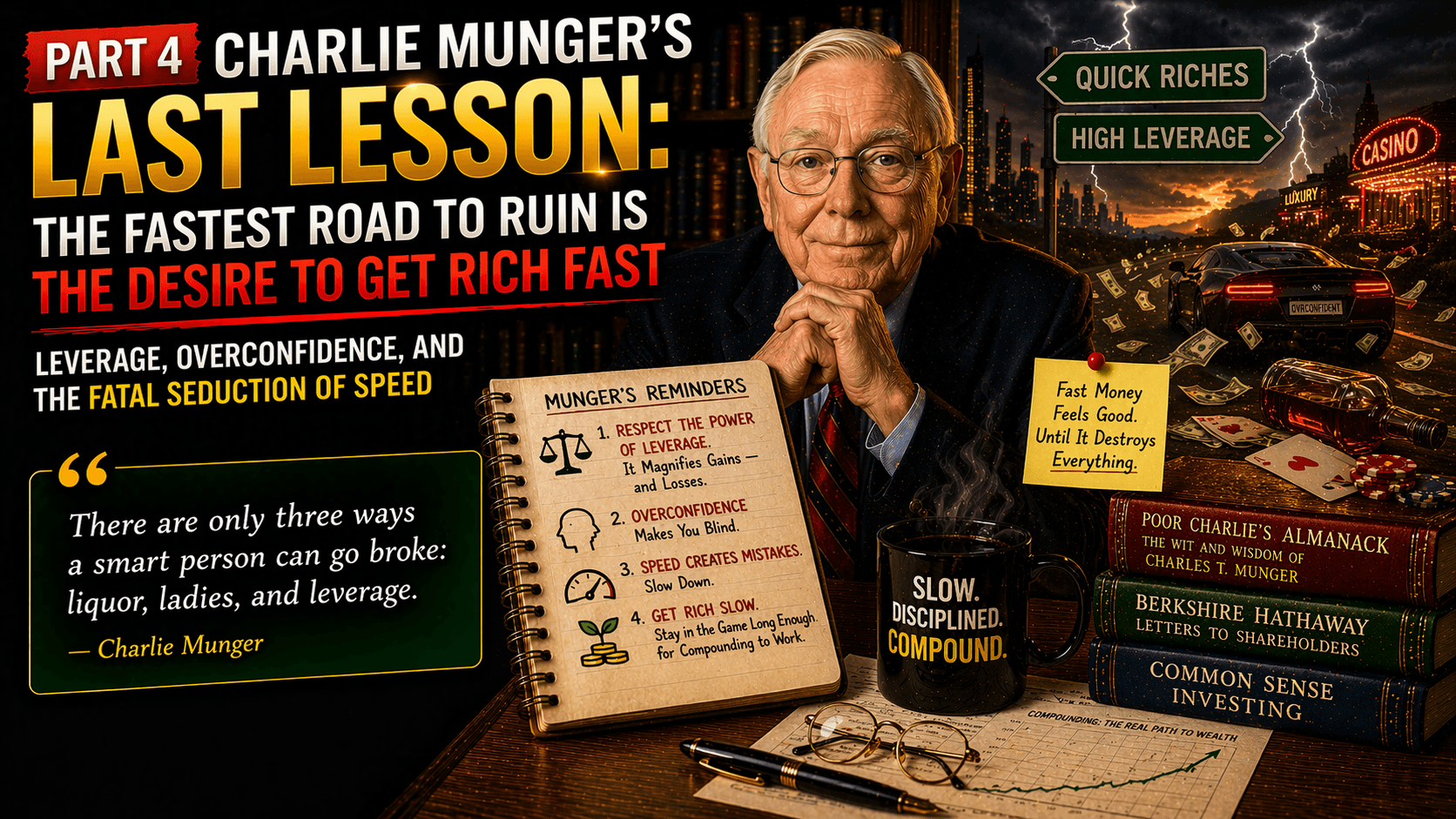
> **"There are only three ways a smart person can go broke: liquor, ladies, and leverage."**
**Next -- the final installment:**
**Part 5 -- The Quiet Truth of Compounding.** Why investing should be boring, why patience is a superpower, and why the investor who can tolerate silence has an advantage no market cycle can replicate.
---
Appendix -- The Munger Ruin Checklist (Part 4)
Before increasing risk, ask yourself:
1. Am I increasing exposure because the odds are truly exceptional -- or because I want speed?
2. Would this position still make sense without leverage?
3. Am I mistaking recent success for durable skill?
4. If this position moved sharply against me, would I still have freedom of action?
5. Am I risking something important for something ultimately unnecessary?
6. Is this decision driven by compounding logic -- or by the urge to accelerate my results?
7. If I were forced to explain this decision after a major loss, would the explanation reveal discipline or ego?
**If those questions feel uncomfortable, that is useful. Because leverage and overconfidence rarely arrive as obvious self-destruction. They arrive as opportunity, efficiency, urgency, and conviction. That is precisely why they are so dangerous.**
---
Related Reading
- [Part 1 -- Don't Try to Be Brilliant. Just Stop Doing Stupid Things.](/blog/masters-charlie-munger-part1-stupidity-may-2026)
- [Part 2 -- It's Not Ignorance That Ruins You. It's Ego.](/blog/masters-charlie-munger-part2-ego-june-2026)
- [Part 3 -- When You Feel Safest, You May Be Most Exposed.](/blog/masters-charlie-munger-part3-safety-june-2026)
- [The Masters: Livermore -- The Price of Abandoning Your Rules](/blog/masters-jesse-livermore-price-confirmation-april-2026)
---
*For informational and educational purposes only. Not investment advice. The author has no position in any security mentioned. Always conduct your own research.*
*For the edge that cuts through the noise -- Brutal Edge.*
Share your analysis
Keep it data-driven. No investment advice.
- Keep it data-driven and respectful
- No investment advice (buy / sell / hold)
- No spam, promotion, or solicitation
- No profanity or offensive content
- Violations are automatically removed
Content is for informational purposes only. Always verify data from primary sources.