The Masters: Charlie Munger Part 5 -- The Quiet Truth of Compounding
Why investing should be boring, and why patience is a superpower. The investor who can tolerate silence, resist unnecessary action, and let time do its work has an advantage that no market cycle can easily replicate.
The Fantasy Modern Markets Sell
If modern investing has a favorite fantasy, it is **movement.**
People want:
- More trades
- More action
- More catalysts
- More urgency
- More alerts
- More reasons to do something
Charlie Munger spent his life moving in the opposite direction.
He believed one of the hardest truths in investing is also one of the most profitable:
> **If your investing life is constantly exciting, there is a good chance something is wrong.**
That idea feels almost offensive to market culture. Because markets reward the appearance of activity:
- Commentary
- Forecast updates
- Tactical shifts
- Endless reactions
- Fresh ideas
- Visible decisiveness
**All of this makes investors feel productive.**
But Munger understood a harder truth:
> **Activity is not the same as progress. And in investing, it is often the enemy of it.**
This is where the series ends -- and where Munger's wisdom becomes most countercultural.
- **Part 1** taught that survival matters more than brilliance.
- **Part 2** taught that ego is often the real enemy.
- **Part 3** taught that comfort can disguise danger.
- **Part 4** taught that leverage and speed can destroy what years built.
**Now Part 5 teaches the final lesson:**
> Compounding requires boredom, and patience is not passive -- it is one of the highest forms of financial intelligence.
---
Why Investing Feels Harder Than It Is
**Investing is conceptually simple and behaviorally brutal.**
That sentence explains a great deal.
The core formula for long-term wealth is not mysterious:
- Buy good assets
- At sensible prices
- Avoid major mistakes
- Let time work
- Interfere as little as necessary
**That is not complex.**
What makes investing difficult is that this process is **emotionally unsatisfying for long stretches.**
- It does not flatter the ego
- It does not produce constant stimulation
- It does not give you the social reward of frequent visible action
- It often requires you to sit still while the world around you looks smarter, richer, faster, and more current
That is why Munger's philosophy can feel so severe.
He asks the investor not merely to think rationally, but to accept **a lifestyle of delayed emotional reward.**
**That is rare.**
- Most people would rather feel intelligent today than become wealthy slowly
- Most would rather act than wait
- Most would rather trade than endure silence
- Most would rather chase one more opportunity than trust a process that already works
And yet the market keeps redistributing wealth in exactly the same way:
> **From people who need motion to people who can live without it.**
That is one reason Munger's ideas age so well. Human beings keep changing technology. **They do not change temperament very much.**
---
If Your Portfolio Is Exciting, Ask Why
This is one of the best self-diagnostic questions an investor can ask.
> **Does your portfolio make you feel stimulated?**
**If the answer is yes, why?**
True long-term compounding portfolios often have a few distinct qualities:
- They are understandable
- They are stable enough to hold
- They do not require constant rescue
- They do not constantly invite dramatic intervention
**That often makes them look dull.**
Not always. But often.
A portfolio built for compounding is usually not optimized for storytelling. **It is optimized for endurance.**
It does not need:
- Weekly reinvention
- Dramatic tactical intelligence
- Endless prediction
- A stream of heroic decisions
It needs something much quieter:
- Judgment
- Discipline
- Repetition
- Time
Munger understood that this quietness was not a flaw in the process. **It was evidence that the process was probably functioning properly.**
This is why he could say, in essence, that **if investing feels like watching paint dry, you are probably closer to doing it right.**
That sentence sounds unserious until you realize how deep it is.
**Because boredom is what remains after:**
- Ego has been restrained
- Unnecessary action has been removed
- Leverage has been rejected
- The compulsion to prove intelligence has faded
**Boredom, in investing, is often a symptom of process purity.**
---
The Most Expensive Addiction in Investing Is the Need to Do Something
One of the quiet tragedies of investing: many people sabotage perfectly good outcomes because **inactivity feels emotionally unbearable.**
They have:
- A sensible portfolio
- A reasonable time horizon
- A sound thesis
- Acceptable diversification
- Manageable risk
- No urgent reason to act
But then nothing happens.
Or rather, the worst thing happens: **nothing demands them.**
- There is no emergency
- No crisis
- No dramatic insight
- No tactical necessity
- Only time
**That is where many investors begin to self-destruct.**
Because the absence of required action does not feel like success. **It feels like irrelevance.**
So they start to:
- Tweak
- Rebalance too aggressively
- Rotate into newer ideas
- Add speculative side bets
- Respond to noise
- Disturb a working process simply because stillness feels intolerable
This is what can be called **activity-induced self-sabotage.**
Munger recognized it clearly. **He knew that many investors do not lose money because they lacked opportunity. They lose money because they interrupted a process that would likely have worked if left alone.**
That interruption is one of the most underappreciated enemies of compounding.
> **Because compounding is not just about earning returns. It is about allowing returns to remain unbroken long enough to matter.**
Every unnecessary interruption weakens that force.
---
Compounding Is Powerful Because It Is Quiet, Not Because It Is Dramatic
People often speak about compounding as if it were magical.
**In reality, it is mechanical.**
That is exactly why it is so powerful.
Compounding does not depend on charisma. It does not depend on public recognition. It does not depend on constant brilliance.
**It depends on a few simple things staying intact for long enough:**
- Capital
- Time
- Discipline
- Reinvestment
This is another way of saying that compounding is not heroic. **It is accumulative.**
And accumulation rarely feels extraordinary while it is happening. That is one reason investors underestimate it. They compare slow compounding to fast narratives and feel underwhelmed.
**But Munger understood what most people only discover too late:**
> **The most impressive long-term outcomes often look unimpressive year to year.**
This is one of the great psychological divides in investing.
- Short-term thinking is naturally attracted to intensity
- Long-term wealth is usually built through persistence
The investor who understands compounding well eventually begins to ask different questions:
- Not "What can make me rich this year?" but "What can I keep doing for twenty years without ruining it?"
- Not "What idea is most exciting?" but "What structure is most durable?"
- Not "What is the next move?" but "What should I avoid touching?"
**That is the beginning of maturity.**
---
Patience Is Not a Lack of Action. It Is Resistance to Bad Action.
People often talk about patience as if it were merely passive waiting.
**Munger's patience was not passive. It was highly selective.**
He was not patient because he lacked opinions. He was patient because he did not confuse the existence of markets with the necessity of constant participation.
**That is a major distinction.**
Patience, in the Munger sense, means:
- Waiting until the odds are favorable
- Waiting until the business is understandable
- Waiting until the valuation is reasonable
- Waiting until emotional pressure has subsided
- Waiting until action is necessary rather than merely possible
**This kind of patience is active restraint.**
It is not laziness. **It is disciplined refusal.**
And disciplined refusal is one of the rarest skills in modern investing, because the system is built to erode it.
The world constantly whispers:
- React
- Rotate
- Optimize
- Stay current
- Do not miss it
- Do something
**Munger's philosophy says:**
> **No. Most of the time, your edge is not in action. It is in the ability to not act foolishly.**
That is patience. It is not glamorous. **It is enormously valuable.**
---
Humility Is the Soil in Which Patience Grows
There is a deep connection between humility and patience.
- The investor who believes they must constantly prove insight will struggle to wait
- The investor who thinks every market move demands interpretation will struggle to wait
- The investor who sees stillness as weakness will struggle to wait
**Patience becomes possible only when the need for self-demonstration weakens.**
That is why humility matters so much. Humility allows the investor to admit:
- I do not need to have a view on everything
- I do not need to respond to every move
- I do not need to chase every theme
- I do not need to outperform every month
- I do not need to feel brilliant in real time
**This is profoundly liberating.**
Because once the portfolio stops being a stage for identity, **it can become what it was supposed to be all along:**
> A tool for building wealth.
Munger understood that many people never reach this point. They remain psychologically dependent on involvement. They need constant evidence that they are engaged, intelligent, responsive, and relevant.
**That is one reason patience is so rare.**
It requires a certain freedom from self-display. **And that freedom is one of the greatest hidden advantages an investor can have.**
---
The Market Transfers Money From the Restless to the Patient
This is one of those lines that has become famous because it is true in a way that feels almost unfair.
**The market does not only reward intelligence. It rewards time horizon.**
More specifically, it rewards the investor whose time horizon can remain longer than the emotional noise of the crowd.
This does not mean patience alone is enough. Patience without judgment can become stagnation. Patience with a bad asset can become denial.
**But patience applied to:**
- Good businesses
- Sensible prices
- A durable process
**...becomes one of the strongest forces in investing.**
Why? Because so many people cannot do it.
They can:
- Analyze
- Discuss
- Model
- React
- Predict
- Explain
**But they cannot wait.**
And waiting is where much of the money is actually made.
The market often gives the appearance that money is made in dramatic entry points, rapid insights, or tactical rotations.
Sometimes that happens. **But far more wealth is built through:**
- Staying in good decisions
- Resisting bad interruptions
- Allowing time to magnify what judgment has already set in motion
**That is the quiet truth of compounding.**
---
Why Boredom Is a Privilege, Not a Problem
Investors often complain that disciplined investing is boring.
**Munger would say: exactly.**
Boredom in investing is often a sign that:
- You are not addicted to stimulation
- You are not relying on drama
- You are not confusing motion with progress
- Your system does not require constant emergency intervention
**In that sense, boredom is a privilege.**
It means the portfolio is not demanding daily emotional tribute.
**That is a remarkable place to reach.**
Because the opposite of boring is not always profitable. Very often, the opposite of boring is:
- Unstable
- Ego-driven
- Overactive
- Fragile
- Expensive
**Boring portfolios give the investor room to live.**
They do not require obsessive vigilance or constant emotional expenditure.
And that matters more than many people admit.
> **A portfolio should not only compound capital. It should preserve your ability to think, work, sleep, and make decisions without constant psychological turbulence.**
Munger's philosophy implicitly respects that. He did not see successful investing as an exciting lifestyle. **He saw it as a rational framework for long-term capital stewardship.**
That is far less marketable than excitement. **It is also far more durable.**
---
What This Means in 2026
This final chapter may be the most relevant of all in the current environment.
Modern markets are saturated with anti-patience:
- Always-on news
- Constant AI narrative rotation
- Social proof loops
- Performance broadcasting
- Short-cycle idea churn
- A culture that increasingly mistakes immediacy for intelligence
**These forces make patience harder than it used to be. They also make patience more valuable than it used to be.**
Because when everyone else is reacting, **the patient investor gains perspective.**
When everyone else is optimizing, **the patient investor preserves structure.**
When everyone else is overstimulated, **the patient investor retains clarity.**
**This is not old-fashioned. It is adaptive.**
In a world designed to fragment attention, the ability to remain steady becomes a genuine competitive advantage.
That is one reason Munger's philosophy still feels so alive.
Not because he offered some clever system for outsmarting markets every week. **But because he understood that markets are often easiest to lose in precisely when people become least willing to endure boredom, delay, and silence.**
**And those are exactly the conditions compounding requires.**
---
The Full Lesson of the Series
Let us gather the whole series now.
**Part 1:**
> Do not try to be brilliant. Avoid stupidity.
**Part 2:**
> The real enemy is often not ignorance, but ego.
**Part 3:**
> What feels safest can be where risk is most hidden.
**Part 4:**
> Leverage and speed are often just socially acceptable forms of self-destruction.
**Part 5:**
> Compounding works best when you stop interrupting it with the need to feel active, fast, and clever.
**That is Munger's last great gift to investors.**
He did not offer a secret formula for market dominance. He offered something much rarer:
> **A way to behave that makes long-term success more probable.**
Not guaranteed. But more probable. **And in investing, probability managed over time is almost everything.**
---
Final Takeaway
If this final chapter can be reduced to one principle, it is this:
> **The investor who can tolerate boredom, resist unnecessary action, and let time do its work has an advantage that no market cycle can easily replicate.**
Charlie Munger understood that great investing should not feel like a thriller. **It should feel like a process so rational that most people are too impatient to follow it consistently.**
That is why patience is not weakness. **It is not passivity. It is not indecision.**
It is a form of strength.
**A superpower, really.**
Because in the long run, the market does not pay extra for being entertained.
> **It pays for being right, staying alive, and waiting long enough for the mathematics of compounding to become visible.**
That is the quiet truth. **And it may be the most important truth of all.**
---
Munger's One-Line Principle for Part 5
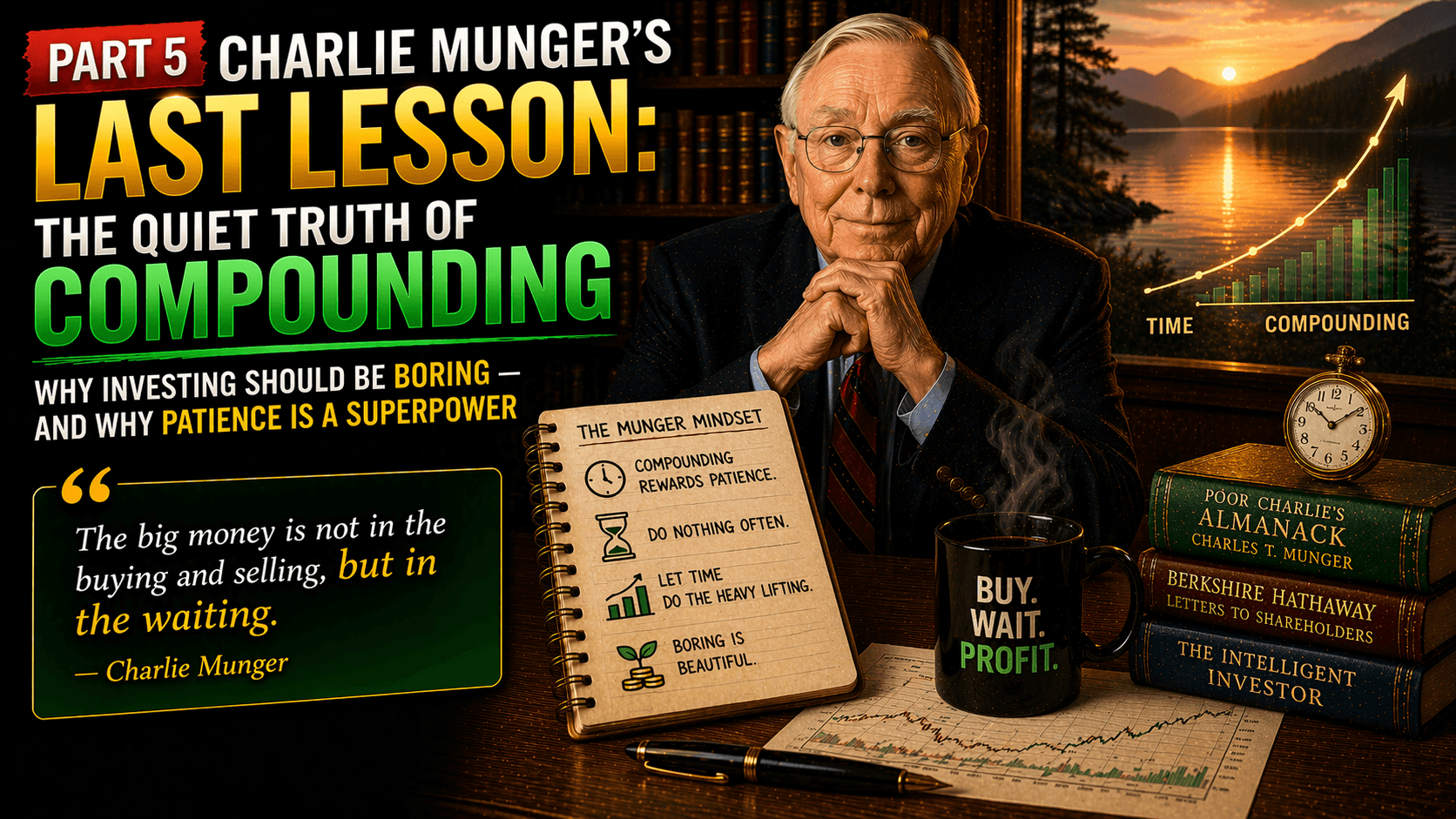
> **"The big money is not in the buying and selling, but in the waiting."**
---
The Complete Series
- [Part 1 -- Don't Try to Be Brilliant. Just Stop Doing Stupid Things.](/blog/masters-charlie-munger-part1-stupidity-may-2026)
- [Part 2 -- It's Not Ignorance That Ruins You. It's Ego.](/blog/masters-charlie-munger-part2-ego-june-2026)
- [Part 3 -- When You Feel Safest, You May Be Most Exposed.](/blog/masters-charlie-munger-part3-safety-june-2026)
- [Part 4 -- The Fastest Road to Ruin Is the Desire to Get Rich Fast.](/blog/masters-charlie-munger-part4-leverage-june-2026)
- **Part 5 -- The Quiet Truth of Compounding** *(you are here)*
---
Appendix -- The Munger Compounding Checklist (Part 5)
Ask yourself:
1. Is my portfolio boring enough to be durable?
2. Am I interrupting compounding just because inactivity feels uncomfortable?
3. Do I mistake activity for progress?
4. Is my desire to act coming from process -- or from restlessness?
5. Would my long-term returns improve if I simply did fewer unnecessary things?
6. Am I building wealth -- or performing involvement?
7. Can I endure the emotional quiet that real compounding requires?
**If these questions feel difficult, that is normal. Because patience is not difficult intellectually. It is difficult emotionally. And that is exactly why it is so valuable.**
---
Related Reading
**The Masters series:**
- [Druckenmiller -- Rules-based compounding](/blog/masters-stanley-druckenmiller-real-edge-april-2026)
- [Livermore -- The price of abandoning rules](/blog/masters-jesse-livermore-price-confirmation-april-2026)
- [Peter Lynch 5-part Bible](/blog/masters-peter-lynch-part1-ten-bagger-april-2026)
**The Mental Game series:**
- [#001: Why Bull Markets Make You Worse at Investing](/research/mental-game-001-bull-market-psychology)
- [#002: How to Survive an AI Bubble](/research/mental-game-002-ai-bubble-survival)
**The Structural View series:**
- [Vol.1: Palantir vs Anthropic](/research/structural-view-001-palantir-vs-anthropic-april-2026)
---
*For informational and educational purposes only. Not investment advice. The author has no position in any security mentioned. Always conduct your own research.*
*For the edge that cuts through the noise -- Brutal Edge.*
Share your analysis
Keep it data-driven. No investment advice.
- Keep it data-driven and respectful
- No investment advice (buy / sell / hold)
- No spam, promotion, or solicitation
- No profanity or offensive content
- Violations are automatically removed
Content is for informational purposes only. Always verify data from primary sources.