The Peter Lynch Bible, Part 4: Numbers Don't Lie
The financial checklist that turns a story into an investment. Debt, cash, PEG, inventory, margins, free cash flow -- how to test whether an investment idea survives contact with reality before it deserves capital.
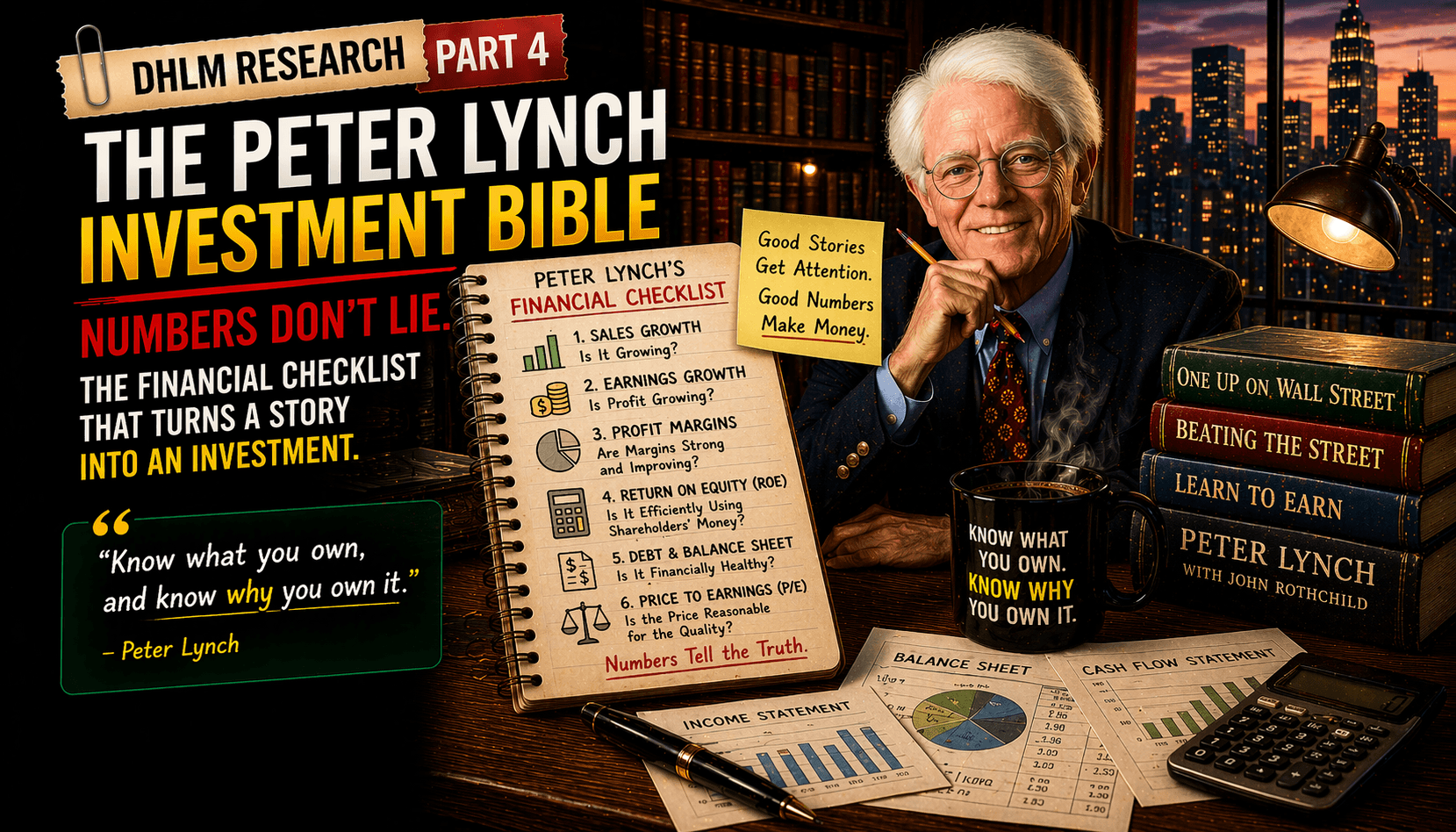
Where Bad Investment Ideas Finally Die
By the time most retail investors reach the numbers, they are already emotionally attached to the story.
That is the problem.
They discover a company. They like the product. They admire the founder. They see the market opportunity. They imagine the upside.
And only after all that do they look at the financials -- often hoping the numbers will confirm what they already want to believe.
Peter Lynch did not work that way.
He loved finding ideas in the real world. But he never treated observation as enough. The moment a stock became interesting, the next step was always the same:
> Check the numbers.
This is where discipline becomes real. Because stories are flexible. Numbers are far less forgiving.
A company can have:
A great product
A compelling narrative
A hot industry
Strong social buzz
Famous backers
???and still be a terrible investment. Because the balance sheet is weak, the cash flow is fragile, the valuation is absurd, the inventory is rising, or the "growth" is far less profitable than it looks.
Part 1 was about finding ideas.
Part 2 was about classifying the stock correctly.
Part 3 was about surviving your own psychology.
Now we reach the point where many bad ideas finally die:
The financial checklist.
This is not about building an institutional-grade model for every stock. It's about learning how to test whether the story is actually investable.
Numbers Are Not the Enemy of Conviction -- They Are the Test of It
Many retail investors think numbers are what make investing complicated.
Numbers are what keep investing honest.
If you skip them, you are not simplifying the process. You are removing the part that protects you from self-deception.
Lynch's genius wasn't that he ignored spreadsheets. It was that he connected common-sense observation with practical financial verification. That's the model to learn from.
The simplified process:
1. Notice something interesting in the real world
2. Ask what category the stock belongs to
3. Check whether the numbers support the story
4. Compare valuation to growth and risk
5. Decide whether the stock is still attractive at today's price
A stock can fail in multiple ways even when the product looks promising:
Growing but unprofitable
Profitable but over-leveraged
Popular but overpriced
Efficient but cyclically peaking
Asset-rich but with no catalyst
Improving but still too fragile
The numbers separate what is exciting from what is investable. Those are not the same set.
Debt -- Can This Company Survive When the Story Gets Harder?
If you remember one thing from this chapter, remember this:
> A weak balance sheet can destroy a good story.
Debt is the first thing serious investors should check because debt changes everything:
How much pain the company can absorb
Whether it can survive a downturn
Whether it can invest through weakness while competitors retrench
Whether shareholders still have upside if the macro environment turns hostile
A company with low debt and strong cash flow can survive mistakes.
A company with heavy debt often cannot.
Debt is not inherently bad. Some businesses handle debt well. Real estate, utilities, stable infrastructure -- these can carry significant leverage because their cash flows are predictable.
But for most businesses, debt removes flexibility. And flexibility is often what separates survivors from casualties when conditions change.
What to actually look at:
Total debt
Cash on hand
Net debt (total debt minus cash)
Debt-to-equity ratio
Interest coverage (can EBITDA cover interest payments comfortably?)
Debt maturity schedule (when does refinancing risk arrive?)
You don't need to become a credit analyst. You do need to know whether the company is:
Conservatively financed
Reasonably financed
Financially stressed
Why this matters more in 2026:
In a high-rate, narrative-heavy market, balance-sheet strength matters more than it did during the cheap-money era. Companies that grew up in the zero-rate environment often look less impressive when capital stops being free.
A weak balance sheet is survivable in a boom. It becomes lethal in a slowdown.
The Lynch-style question:
> If the story goes wrong, can this company live long enough to recover?
That is what debt analysis answers.
Cash -- Dry Powder or Just Optimism?
Debt is one side of the balance-sheet story. Cash is the other side -- and it's equally important.
Investors often focus on debt and forget to ask:
> Does this company have the financial room to act strategically?
Cash matters because strong businesses don't just survive downturns. They use downturns to get stronger.
A cash-rich company can:
Keep investing while competitors retrench
Repurchase stock opportunistically at depressed prices
Acquire distressed assets at favorable valuations
Protect margins longer than peers
Buy time when growth slows
Cash is strategic flexibility. It is optionality with a balance-sheet value.
This matters enormously in:
Fast-changing industries
Cyclical downturns
Periods when refinancing conditions may worsen
What to actually look at:
Cash and short-term investments
Net cash vs net debt (positive or negative?)
Free cash flow generation (is cash position growing?)
Cash burn rate (if unprofitable, how fast is runway shrinking?)
Cash trajectory over time (growing, stable, or declining?)
A company can look exciting on the income statement but be quietly weakening on the cash side.
The critical question:
> Is this company funding its future from internal strength -- or from market generosity?
That question becomes decisive in speculative sectors, where growth can hide fragility far longer than it should.
When the "market generosity" dries up (rates rise, risk appetite falls, IPO window closes), companies dependent on external capital suddenly face existential pressure. Companies funded by internal cash generation keep executing.
PEG -- Lynch's Favorite Reality Check
If one metric is most closely associated with Peter Lynch, it is PEG.
PEG = Price/Earnings divided by Growth Rate
Lynch liked PEG because the logic was simple:
> A high P/E alone does not mean a stock is expensive.
> A low P/E alone does not mean a stock is cheap.
> You must compare valuation to growth.
That's what PEG does. It's a filter that prevents two common retail errors:
Error 1 -- Rejecting a genuinely strong growth company because the P/E looks high.
A company growing earnings at 25% may justify a much higher multiple than one growing at 5%. If you only look at P/E, you'll reflexively pass on the better business.
Error 2 -- Buying a weak slow-growth company because the P/E looks low.
A company trading at 12x earnings with 3% growth may actually be more expensive than one at 30x with 25% growth. The low-P/E looks safe and turns out to be a value trap.
The rough Lynch intuition:
PEG near 1 or below is attractive. Above 2 is usually demanding. Context always matters -- a stalwart might never have PEG below 1.5, but that doesn't mean it's always overpriced.
Where PEG works best:
Profitable growth companies
Visible earnings expansion
Businesses where growth is real, not narrative-driven
Where PEG misleads:
Deep cyclicals (earnings are volatile by nature)
Turnarounds with unstable earnings
Very early-stage companies without meaningful profit
Businesses with distorted current earnings (one-time items, accounting noise)
PEG is not a magic number. It is one filter among several. But it's one of the most useful filters in the Lynch toolkit because it forces you to evaluate price relative to the specific growth profile of each company -- not just compared to a generic market multiple.
Inventory -- Is Demand Real, or Is the Business Quietly Clogging?
This is one of the most underused indicators in retail investing -- and one of the most valuable.
When a company sells physical products, inventory can tell you whether reality matches the story.
If sales are supposedly strong but inventory is building too fast, that may signal:
Weakening end demand
Overproduction
Poor channel discipline
Misread customer behavior
Margin risk ahead (inventory eventually has to be moved, often via discounts)
Why this matters: Inventory problems typically show up in the numbers before the market fully understands them. The company may still be talking about strong demand while inventory quietly tells a different story. That gap -- between narrative and inventory reality -- is where the best short signals live, and where early warnings for long positions appear.
What to actually look at:
Inventory growth relative to revenue growth
Inventory days (how long to sell current stock at current velocity?)
Management commentary on channel conditions
Markdown risk (will margins compress to clear inventory?)
Working capital trends
If revenue is up 10% but inventory is up 40%, something is wrong. Maybe not immediately. But the mismatch means one of two things:
Demand is weakening faster than management admits
The company is pushing product into channels that can't absorb it
Either way, the margin story is about to get worse.
Not every inventory build is a warning sign. Sometimes inventory builds ahead of launches, seasonal demand, or supply-chain hedging. Management often explains these builds credibly. But unexplained inventory growth is almost always worth investigating further.
Where inventory signals are most valuable:
Consumer goods
Retail (especially apparel and electronics)
Automotive
Semiconductors
Industrials
Cyclical manufacturing
In each of these sectors, when demand weakens, inventory is usually where the stress first appears.
The principle:
> A company can fake enthusiasm longer than it can fake sell-through.
> Eventually, inventory tells the truth.
Margins -- Is Growth Becoming More Valuable, or Less?
Revenue growth gets the headlines. Margins tell you whether that growth is actually becoming more valuable.
A company whose revenue rises but whose margins keep deteriorating may be buying growth rather than creating it.
This is a crucial distinction. Not all growth is good growth.
What to watch:
Gross margin (pricing power vs. input costs)
Operating margin (overall business efficiency)
Net margin (bottom-line reality)
Margin trend over time (improving or eroding?)
Whether margin compression is temporary or structural
Some margin pressure is healthy if it comes from:
Expansion investment (opening new markets)
Temporary launch cycles (new products have setup costs)
Strategic reinvestment (R&D, brand-building)
Early scaling costs (operations not yet at efficient scale)
But recurring margin compression can signal:
Weak pricing power
Rising competition
Bloated cost structures
Business model scaling worse than expected
The question mature investors learn to ask:
> Is this company growing into higher-quality earnings -- or just growing more expensively?
That one question filters out many companies that look like growth plays but are actually just capital-destroying revenue accumulators. Growth at the cost of margins is not always a red flag. Growth at the cost of structurally declining margins usually is.
Free Cash Flow -- Can This Business Actually Produce Money?
Few metrics separate durable businesses from narrative stocks more clearly than free cash flow.
A company can report:
Strong "adjusted" earnings
Exciting revenue growth
Impressive user metrics
Enormous addressable-market claims
???while still failing to generate real cash for shareholders.
That's why free cash flow matters. It tells you whether the business converts accounting success into economic success.
Why free cash flow matters:
Strong FCF means the company can:
Self-fund growth (no dilution, no debt dependence)
Reduce debt from internal resources
Repurchase shares opportunistically
Survive downturns without external support
Retain strategic flexibility
Weak FCF means the company stays dependent on:
External financing
Favorable capital markets
Optimistic investors willing to fund losses
In easy markets, that dependence stays hidden. In harder markets, it becomes obvious -- usually at the worst possible time.
Peter Lynch didn't use modern cash flow language exactly the way investors do today, but his instinct was identical: great businesses eventually have to produce real financial results, not just interesting stories.
A company that has been "investing for growth" for 10 years and still can't produce free cash flow is not investing. It is subsidizing a business model that doesn't work.
Valuation -- A Great Company Can Still Be a Bad Stock
This is the hardest lesson for retail investors to truly internalize.
A company can be:
Excellent
Admired
Category-leading
Growing
Profitable
???and still be a poor investment if the price already assumes too much.
That's why valuation is not optional.
Lynch was never a "buy anything great and hold forever at any price" investor. He wanted:
The story
The category
The numbers
AND the price
All four to line up.
What valuation is really asking:
Valuation is not asking "Is this company good?"
It is asking:
> How much future success is already embedded in this stock's price?
That's a much harder and more useful question.
Common valuation traps:
Paying hypergrowth multiples for companies whose growth is already maturing
Treating low P/E as value when earnings are cyclically peaking
Ignoring dilution (share count keeps rising)
Comparing companies across the wrong category (cyclical vs. stalwart)
Using story logic to excuse every multiple expansion
Valuation is where discipline confronts enthusiasm. And enthusiasm usually argues harder -- because enthusiasm is what got you interested in the first place, while valuation is asking you to be less excited than you want to be.
A Modern Lynch Worksheet for 2026
If Lynch were investing today, his common sense would likely translate into something like this:
Balance sheet
Is debt manageable?
Is cash sufficient?
Could this company survive a bad 12-24 months without external help?
Business quality
Are margins stable or improving?
Is growth profitable?
Does the company have pricing power?
Operating reality
Is inventory under control?
Is management honest about demand trends?
Are there warning signs beneath headline growth?
Valuation
What category of stock is this?
Is PEG reasonable (if applicable)?
Is the current price already pricing in perfection?
The final test
> If the market closed for two years and I could only judge this business by its numbers, would I still be comfortable owning it?
That last question is powerful because it removes emotional dependence on price action. It forces you back into business reality.
If the answer is yes -- you probably have a real position.
If the answer is no -- you probably have a trade wearing investment clothes.
Core Takeaway From Part 4
The entire chapter reduces to one principle:
> A good story becomes a real investment only when the financials prove it deserves capital.
Lynch's gift was not that he ignored complexity. It was that he simplified investing without becoming lazy.
He did not say:
> "Only trust the numbers."
He also did not say:
> "Ignore the numbers and follow instinct."
He did something harder and wiser:
> Use real-world observation to find the idea.
> Use numbers to test whether the idea survives contact with reality.
That is the entire discipline.
Without it, even the most exciting stock can become an expensive lesson. With it, ordinary observations get upgraded into durable positions -- because the observation is now backed by evidence, not just enthusiasm.
Lynch's One-Line Principle for Part 4
> "The story must survive the spreadsheet."
Next -- the final installment:
Part 5 -- If Peter Lynch Were Investing in 2026. How Lynch's framework applies to AI, space, energy, and the modern narrative-saturated market. What he would likely avoid, where he would most likely look, and the updated formula for "invest in what you know" in the information-overload era.
Appendix -- The Lynch-Style Checklist (Part 4)
Before buying any stock, ask:
1. How much debt does the company carry relative to earnings and cash flow?
2. Does it have enough cash to stay flexible through a bad 12-24 months?
3. Is earnings growth supported by real cash flow?
4. Is PEG reasonable for this category of stock?
5. Is inventory building faster than sales?
6. Are margins getting stronger or weaker over time?
7. Is the valuation still attractive if growth slows 30% from current trajectory?
8. Would I still want to own this if the stock price stopped moving for two years and I could only judge by the business?
If too many of these answers are weak, uncertain, or uncomfortable, the problem is not the market. The problem is that the story was never strong enough to deserve the investment.
Related Reading
Part 1 -- There's a Ten-Bagger Closer Than You Think
Part 2 -- Stocks Are Not All the Same
Part 3 -- The Cocktail Party Theory
Paper vs. Profit #003: Inflation Strategies -- When research meets execution
For informational and educational purposes only. Not investment advice. The author has no position in any security mentioned. Always conduct your own research.
For the edge that cuts through the noise -- Brutal Edge.
Share your analysis
Keep it data-driven. No investment advice.
- Keep it data-driven and respectful
- No investment advice (buy / sell / hold)
- No spam, promotion, or solicitation
- No profanity or offensive content
- Violations are automatically removed
Content is for informational purposes only. Always verify data from primary sources.