
Netflix Q1 2026: A -9.72% Selloff That Misreads the Transition
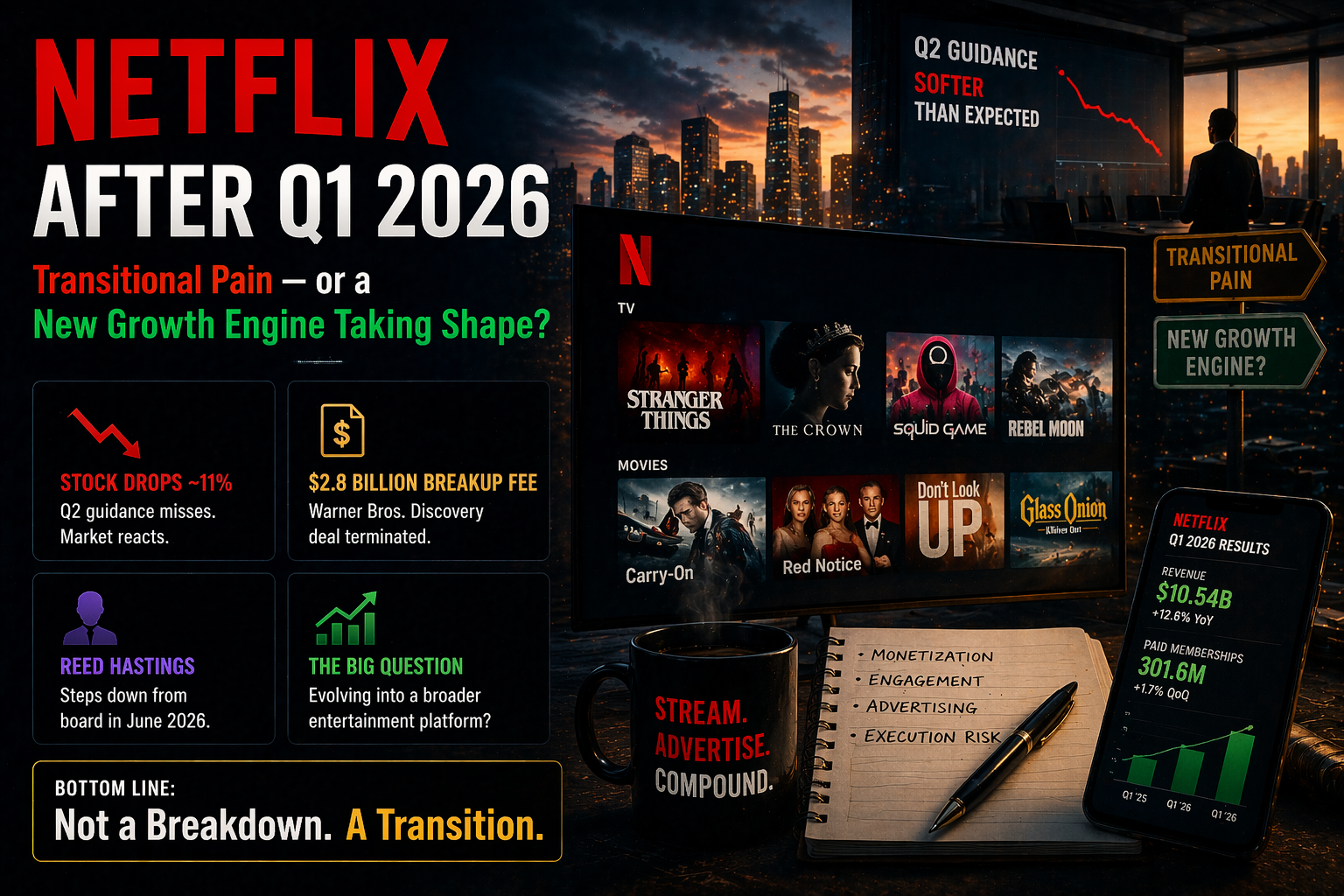
Netflix beat Q1 on every line. Revenue $12.25B. EPS $1.23. Ad revenue on track to double to $3B. Stock closed down 9.72%. The market is still valuing the old Netflix while the company is becoming something different.
The Numbers
Q1 2026 Actual:
- Revenue: $12.25B (+16.2% YoY, beat $12.18B consensus)
- EPS: $1.23 (vs $0.76 estimate — beat by 62%)
- Free cash flow: $5.09B (vs $2.66B YoY)
- Ad-tier signups: 60% of new users in ad-available markets
- Advertisers: 4,000+ (+70% YoY)
Stock reaction April 17:
- Closed: $97.31 (−9.72%)
- Trading volume: 124.7M shares (152% above 3-month average)
The quarter beat on every line. The stock got punished. The gap between those two facts is the entire story.
The Verdict
Transitional pain, not structural decay.
The market is pricing Netflix as if Q1 was flattered by a one-time windfall and Q2 margins are breaking. Both readings are partial. The deeper truth is that Netflix is transitioning from a subscriber-count business to a monetization-layer business — and the market hasn't finished re-rating that shift.
At $97.31, the stock trades at roughly 34x forward earnings. Not cheap. Not broken. Stuck in the gap between "premium compounder" (45-50x historical) and "damaged growth" (20-25x).
The asymmetry here isn't "beat stock that sold off." It's a company mid-transformation, getting marked down by investors using a framework the company is deliberately abandoning.
1. The Beat Quality Question — Framed Correctly
Every headline is calling the Q1 EPS boost a "breakup fee windfall." The framing matters because it changes whether this was a "manufactured beat" or "unusual item, clean operations."
What actually happened:
- Netflix bid on Warner Bros. Discovery assets
- Paramount SkyDance won the bidding war
- Netflix received $2.8B termination fee for walking away
What it means for the numbers:
- Q1 EPS of $1.23 includes the fee — genuine boost to bottom line
- Free cash flow $5.09B also partially boosted
- Q1 revenue of $12.25B is NOT boosted — fee is income, not revenue
The misreading to avoid:
This was not a "Paramount contract termination fee" or a standard content contract item. It was M&A accounting from a deal that never closed. That distinction matters because it reframes the conversation from "content noise" to "capital allocation signal."
The under-reported insight:
Netflix walking away from WBD wasn't weakness. It was the largest capital allocation discipline signal the company has given in years. The fee received is a consolation — but the fact that Netflix could have done the deal and chose not to is more important.
CFO Spencer Neumann confirmed: "Some of our initially planned costs for the deal... they won't fully materialize. But also, some that we were planning to carry into '27 were pulled forward into 2026." Translation: the WBD-related internal spend plan is partially executing anyway, just redirected.
Brutal Edge takeaway: Not every walked-away deal is a win. This one is. Netflix gets $2.8B, avoids $110B+ of integration risk, and keeps its balance sheet clean while Paramount SkyDance takes on the debt burden instead.
2. The Reed Hastings Departure — Symbolism vs Substance
Hastings exits the board in June 2026, ending nearly 30 years at Netflix. The market treats this as governance shock. It isn't.
The timeline most investors forget:
| Year | Event |
|---|---|
| 2023 | Hastings steps down as CEO, transitions to Executive Chairman |
| 2025 | Hastings becomes non-executive Chairman (per SEC filings) |
| June 2026 | Hastings fully exits board |
This is the completion of a multi-year succession, not a sudden exit. Bank of America's Jessica Reif Ehrlich: "completion of a long-planned succession process that began over a decade ago."
But symbolism is not nothing.
Hastings wasn't just another executive. He was Netflix's intellectual founder, culture architect, and long-term narrative anchor. Even with succession complete operationally, his final board exit removes an important psychological stabilizer for long-term holders.
What matters more than Hastings leaving:
Co-CEOs Ted Sarandos and Greg Peters have run Netflix operationally since 2023. The business model transition — ad tier launch, password crackdown, pricing restructure, engagement-first reporting — all happened under their leadership, not Hastings'. The actual strategic trajectory is unchanged.
3. The Real Signal — Netflix Is No Longer a Subscriber Story
This is the deepest change most investors still underappreciate.
What Netflix stopped doing in 2025:
- Reporting quarterly subscriber numbers
- Reporting ARM (Average Revenue per Member)
What Netflix reports instead:
- Engagement (hours watched — their stated "best proxy for customer satisfaction")
- Revenue growth
- Operating income
- Free cash flow
- Ad revenue specifically
The implication most investors miss:
When a company deliberately changes what it reports, it's telling you what it thinks investors should value. Netflix is announcing: "Stop counting subscribers. Start measuring monetization."
The market hasn't caught up. Most sell-side models still anchor on implied subscriber growth. That creates a valuation lag — the business is becoming something different, but the spreadsheets are still measuring the old version.
Brutal Edge takeaway: The right question is no longer "How many subs did Netflix add?" The right question is: how many hours of consumer attention can Netflix capture, and how efficiently can it monetize those hours?
Subscription tells you scale. Engagement tells you relevance. Monetization per hour tells you whether the platform is actually deepening its moat.
4. Advertising — The Most Misunderstood Part of the Bull Case
This is where the bull thesis gets structurally strong.
Key 2026 ad data:
| Metric | Value |
|---|---|
| 2026 ad revenue target | **$3B** (double 2025's $1.5B) |
| Q1 2026 new signups on ad tier (in ad markets) | **60%** |
| Total advertisers | **4,000+** (+70% YoY) |
| Ad tier price (US) | **$8.99/month** (+$1) |
The ad tier is three things at once:
1. Price absorption mechanism. When Netflix raises prices, the ad tier becomes the escape valve. Users don't cancel — they downgrade. Same user, different monetization path.
2. Second monetization channel on same content. The ad tier monetizes hours watched twice: once through the monthly fee, again through ad impressions.
3. Offensive growth lever. Cheaper entry point widens the top of funnel, while the ad market becomes a durable new earnings contributor. 4,000+ advertisers up 70% YoY is a network effect.
The valuation shift this triggers: pure subscription businesses trade on ARPU × subscribers. Advertising businesses trade on eCPM × impressions × engagement quality. The second framework removes the ceiling that pure subscription models hit.
5. The Q2 Guidance Cut — What It Actually Says
| Metric | Guidance | Street Estimate |
|---|---|---|
| Q2 Revenue | $12.57B | $12.64B |
| Q2 EPS | $0.78 | $0.84 |
| Q2 Operating Income | $4.11B | $4.34B |
The company's explanation:
"We expect Q2 to have the highest year-over-year content amortization growth rate in 2026, before decelerating to mid-to-high single digit growth in the second half of the year."
Translation: Netflix is front-loading content investment in 2026. More spending now, less later. Margins compress Q2, expand in H2.
Full year guidance — unchanged:
- Revenue: $50.7B–$51.7B
- Operating margin: 31.5%
A quarterly timing shift is not fundamental deterioration. The market is reacting to the pattern, not the math. Full-year revenue still growing 14–16%. Full-year margin still 31.5%.
6. Content Spend — Payback Quality Is the Real Question
Netflix is spending heavier in H1 2026. The market reads "margin pressure." The smarter read: not all content spending is equal.
Where the money is flowing:
- Live events and sports — drives urgency, ad appeal, and repeat visits
- Video podcasts — expanding engagement surface beyond scripted content
- Gaming — still an experimentation bucket, not a proven profit pool
- Localized content at scale — Asia and Latin America
- Vertical video formats — mobile-first discovery
The framework for judging content spend:
```
Bad spend: cost rises without engagement lift
Good spend: cost rises, but hours watched/user and
monetization/hour rise faster
```
BMO Capital's Brian Pitz: "key quality engagement metrics, though not specifically disclosed, hit an all-time high in the first quarter." That's the tell. If engagement is rising while content spend is rising, the math works.
7. The Competitive Context
Netflix isn't being analyzed in isolation. Peers moved in opposite directions:
| Stock | April 17 Close | Move |
|---|---|---|
| NFLX | $97.31 | **−9.72%** |
| DIS | $106.28 | +2.29% |
| WBD | $27.47 | +0.29% |
The market isn't panicking about streaming as a category. It's specifically punishing Netflix for the guidance pattern and governance signal. That's a narrower read than "streaming is broken." It's "Netflix needs to prove something in the next two quarters."
8. The Bear Case — Taken Seriously
1. Content amortization acceleration signals weakening returns.
If Netflix needed more H1 spend to hit the same engagement targets, that's declining content ROI.
2. Subscriber transparency cost.
By refusing to disclose subscriber numbers, Netflix makes underlying health harder to verify. The charitable read: "subscribers aren't the KPI." The uncharitable read: "subscribers are decelerating and we don't want it visible."
3. Price hike absorption limits.
Netflix raised prices twice in 15 months. Each hike works until it doesn't. At some point, churn starts accelerating even with ad tier as fallback.
4. Gaming remains unproven.
Gaming was supposed to be meaningful by now. It isn't. One pillar of the platform thesis remains hollow.
5. WBD walk-away raises organic execution bar.
If not scale through M&A, Netflix must prove it can replace acquisition-driven scale with "deeper monetization of existing global attention base." That is a harder story to tell quickly.
9. Valuation — What the Price Actually Implies
At $97.31, NFLX trades at roughly 34x forward earnings.
| Comparable | Forward P/E |
|---|---|
| NFLX (current) | **34x** |
| NFLX (5-year avg) | ~42x |
| DIS | 21x |
| WBD | ~15x |
The multiple sits between "broken growth stock" (20–25x) and "compounding premium" (45–50x).
For the multiple to expand back to 40x+:
- Deliver the $3B ad revenue target for 2026
- Show H2 margin recovery matching guidance
- Demonstrate engagement metrics compounding
- Keep FCF at or above $6–8B annually
For the multiple to compress toward 25x:
- Miss on ad revenue trajectory
- Flatline engagement metrics
- Sustained content spend pressure on margins
The risk/reward asymmetry is reasonable, not exceptional. This isn't a deep value setup. It's a "wait and see" setup with optionality on successful transition.
10. What to Watch — Q2 and Q3 2026
Four metrics will determine if this selloff was a buying opportunity or an early warning:
1. Ad revenue trajectory. Whether $3B for full-year 2026 is tracking, or falling short.
2. Engagement quality disclosures. Hours watched per user, content hit rates, and breadth of usage beyond serialized viewing.
3. Price increase resilience. Whether ad tier durably absorbs pricing pressure or churn starts accelerating.
4. Capital allocation post-WBD. Evidence that content and product investment is widening the platform, not just raising cost.
Final Verdict
Rating: Constructive / Outperform-leaning with near-term volatility likely elevated.
This selloff looks more like transitional pain than a broken engine. The market is mid-process of re-rating Netflix from a subscriber-count business to an engagement-monetization business, and the shift isn't complete.
For investors with a 12–24 month horizon who believe advertising becomes material, engagement compounds, and pricing power holds: Netflix at $97 is a reasonable entry.
For investors who require clean quarterly beats, smooth margin trajectory, and visible subscriber growth: this isn't the stock for 2026.
The most important Netflix metric was never subscriber count. It was always how much of your time they could own — and how many ways they could monetize it. Q1 2026 was the first quarter where that framework started to show up in the actual business model shift.
The market just hasn't caught up yet.
Related Reading
- Druckenmiller Masters Vol. 1 — Regime-shift thinking applied to valuation framework transitions
- Anthropic Private Investor Report — Monetization quality over user growth framework
- Paper vs. Profit #003 — When market mental models lag behind business reality
For informational and educational purposes only. Not investment advice. The author has no position in any security mentioned. Always conduct your own research.
For the edge that cuts through the noise — Brutal Edge.
About NFLX
Share your analysis
Keep it data-driven. No investment advice.
- Keep it data-driven and respectful
- No investment advice (buy / sell / hold)
- No spam, promotion, or solicitation
- No profanity or offensive content
- Violations are automatically removed
Data: Financial Modeling Prep, Alpha Vantage, CoinGecko
NOT investment advice. Always do your own research.