
Redwire (RDW): From Space Infrastructure to Defense Autonomy
Redwire at $9.91: $411.2M record backlog, Edge Autonomy UAS acquisition, ESA quantum-secure contract, $450-500M 2026 guidance. Real backlog. Real execution risk.
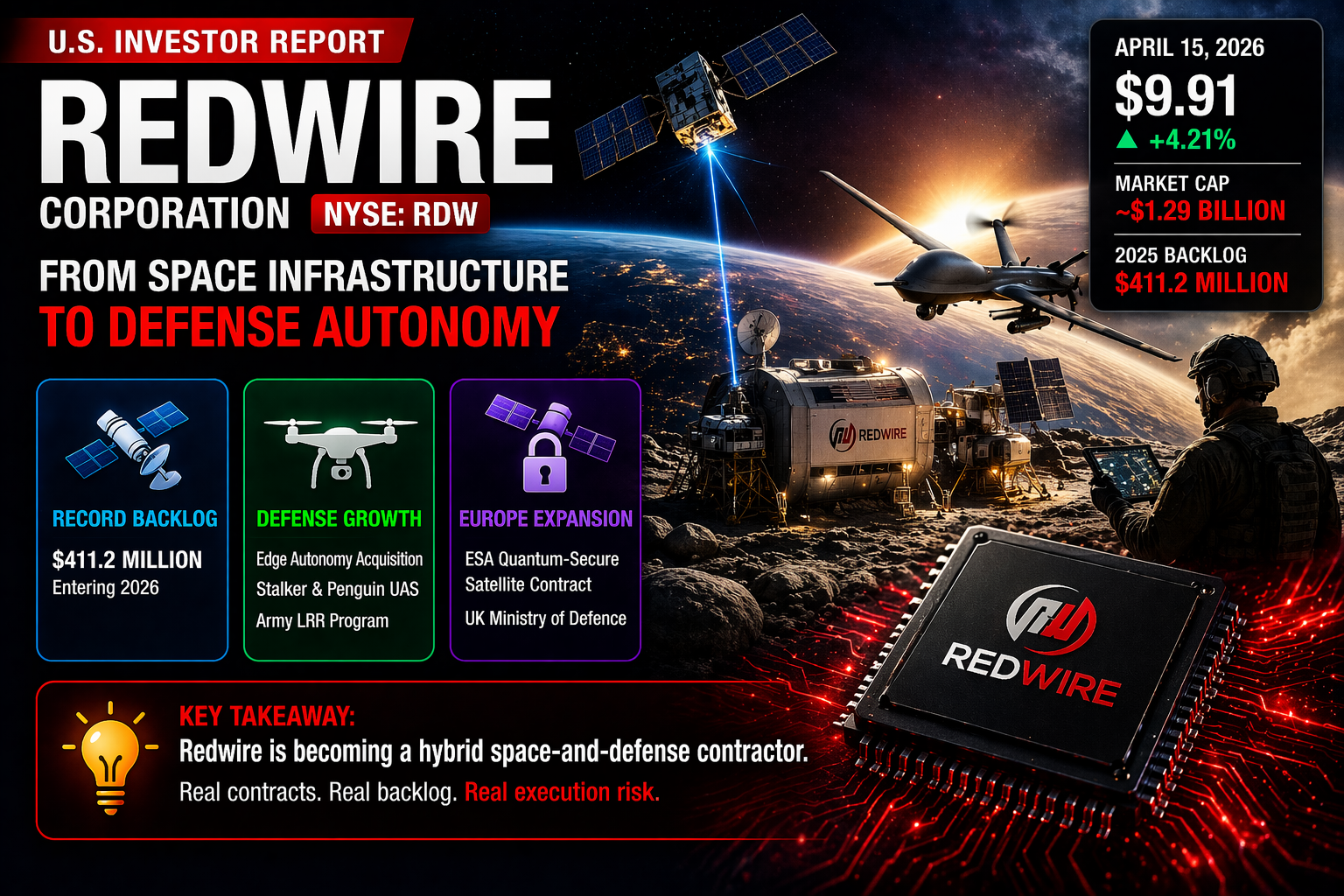
🔥 BRUTAL EDGE™ VERDICT
"Redwire is no longer just a thematic space stock. It is becoming a hybrid space-defense contractor with real backlog, combat-proven drones, and European expansion. The story is credible. The financials are not there yet. At $9.91, this is a show-me stock — and 2026 is the year it has to show."
The Company
Redwire (NYSE: RDW) provides space infrastructure and defense technology solutions for government and commercial customers. The company operates in two segments: Space and Defense Tech. It offers spacecraft sensors and avionics (star trackers, sun sensors, camera systems), deployable solar arrays (ROSA and ELSA product lines), digital engineering software, microgravity payloads, RF systems, and uncrewed autonomous airborne systems.
The identity changed materially in 2025 with the acquisition of Edge Autonomy. That deal gave Redwire combat-proven UAS platforms (Stalker and Penguin), autonomous airborne systems, and stronger links to U.S. and allied defense customers. Management described the acquisition as transformational and immediately accretive.
Approximately 1,300 employees across the United States and Europe. The company is positioning itself as a transatlantic defense-and-space platform, not a U.S.-only contractor with incidental overseas work.
The Numbers
| Metric | Value |
|---|---|
| Price (Apr 15) | ~$9.91 |
| Market Cap | ~$1.29B |
| 52-Week Range | $3.20 — $26.66 |
| FY2025 Revenue | $335.4M (+10.3% YoY) |
| 3-Year Revenue Growth | +27.8% |
| 5-Year Revenue Growth | +93.1% |
| FY2025 Net Loss | -$226.6M |
| Q4 2025 Net Loss | -$85.5M |
| Gross Margin | 5.2% |
| EBIT Margin | -64.2% |
| Record Backlog | $411.2M |
| 2026 Revenue Guidance | $450M — $500M |
| Liquidity (YE 2025) | $130.2M |
| Analyst Consensus | Strong Buy (median PT $13.50) |
| Analyst Range | $6.00 — $22.00 |
Revenue is growing. Losses are growing faster. That is the core tension. Management says 2025 included substantial non-recurring items, and the 2026 focus is moving development-stage programs into production to improve gross margin. That may be true. Investors should insist on proof.
The Bull Case
Defense and Autonomous Systems
The most important strategic change is Redwire's exposure to autonomous airborne systems. After closing the Edge Autonomy acquisition, the company delivered more than 100 Stalker/Penguin UAS in seven countries, including to the U.S. Army, U.S. Marine Corps, and NATO/allied nations. The Army's Long Range Reconnaissance (LRR) program is part of that momentum.
This matters because the public market rewards space names more reliably when they are tied to defense budgets and programs of record — not only long-duration space optionality. Redwire's management is leaning into exactly that repositioning.
European Expansion
In early April 2026, Redwire was awarded a contract under the European Space Agency's QKDSat program to develop a quantum-secure satellite, supplying a European-built Hammerhead spacecraft and avionics. Days later, the company opened a UK office to support current and future Ministry of Defence programs.
This is not headline revenue yet. It is strategically important. Quantum-secure communications have relevance far beyond civil space, and a transatlantic defense presence at this company size is rare.
NASA and Civil Space
Redwire retains real mission heritage. In 2025: 14 PIL-BOXes launched, 18 unique molecules studied on ISS, 11 active payload facilities. A $44 million DARPA phase 2 Otter mission contract tied to SabreSat anchors the Very Low Earth Orbit position. Optical imaging and sun sensors are on the Artemis II mission through Lockheed Martin.
Few companies at $1.3 billion market cap span civil space, defense autonomy, European secure communications, and long-duration orbital infrastructure simultaneously.
The SHIELD Contract
Redwire is among over 2,400 vendors eligible for the Missile Defense Agency's $151 billion SHIELD IDIQ contract, aimed at enhancing homeland missile defense capabilities. This is not guaranteed revenue — it is a contract vehicle that opens the door to task orders. But inclusion signals that Redwire is recognized in the defense procurement ecosystem at a scale that matches its ambitions.
The Bear Case
Profitability Lags the Story
Net loss of $226.6 million on $335 million revenue. Gross margin at 5.2%. EBIT margin at -64.2%. These are not "we're close to breakeven" numbers. They are development-stage economics. Management's argument about non-recurring items is plausible, but the burden of proof sits with them, not with investors.
Backlog of $411 million is a positive indicator, but backlog is not cash flow. The conversion from contract wins to delivered revenue to positive operating margin is where execution risk lives.
Government Budget Sensitivity
A large part of revenue is tied to government and agency work. That makes Redwire sensitive to procurement delays, continuing resolutions, shifting priorities, and defense budget timing. The 2025 earnings discussion explicitly referenced the need to manage around development-stage program economics and program timing.
Dilution Risk
Constructive progress: Redwire used ATM proceeds to repay $105.5 million of debt in Q4 2025 and refinanced credit facilities in February 2026, saving an estimated $17 million in annualized interest with $130.2 million in year-end liquidity. That is clearly better than before.
But fast-growing, acquisitive, still-unprofitable companies can return to capital markets when growth opportunities or working-capital needs demand it. Dilution risk is lower than before. It is not gone.
Context: How RDW Fits in the Sector
Redwire sits in a different tier from the companies covered in the New Space Sector Report. Rocket Lab (RKLB) is a more mature, vertically integrated platform with $602 million revenue and $1.85 billion backlog. AST SpaceMobile (ASTS) is a pure connectivity bet. Intuitive Machines (LUNR) is a lunar infrastructure option.
Redwire occupies a unique position: the only listed small-cap that bridges space components, defense autonomy, and European expansion simultaneously. That diversification is a strength in theory. In practice, it means the company must execute across multiple domains at once — which raises complexity risk for a team of 1,300 people.
The Risk Stack
1. Margin conversion failure. If 2026 does not show meaningful gross margin improvement as programs move from development to production, the stock will struggle to re-rate regardless of backlog size.
2. Government timing. Procurement delays, continuing resolutions, and shifting defense priorities can disrupt quarterly results and investor confidence even when the underlying contract positions are solid.
3. Acquisition integration. Edge Autonomy was described as transformational. Transformational acquisitions require transformational execution. Integration risk is real for a company that was primarily a space components business until 2025.
4. Competition. The space-defense landscape is increasingly crowded. L3Harris, Northrop Grumman, and larger primes compete for the same defense budgets. In space components, Rocket Lab's expansion into systems and subsystems creates direct competitive overlap.
5. Valuation gap. At ~$1.29B market cap against $450-500M revenue guidance, the stock trades at roughly 2.7x forward revenue with no earnings. Not expensive for a defense-growth story — but not cheap for a company with 5% gross margins. The multiple only works if margins expand.
Bottom Line
Redwire is evolving from a space infrastructure supplier into a hybrid space-defense contractor with meaningful exposure to autonomy, secure communications, and mission-critical orbital systems. That evolution is real. The company has a stronger strategic identity, better backlog visibility, a broader customer base, and more defense relevance than it did a year ago.
The honest framing: Redwire is a high-upside, execution-sensitive growth contractor. The backlog, defense positioning, and European expansion create a credible foundation. The real upside comes if 2026 becomes the year when production ramps, margin improvement, and autonomous systems revenue show up cleanly in the financials.
At $9.91, the stock is 63% below its 52-week high. The setup is interesting. The proof is still pending. Best approached with position sizing discipline and close monitoring of quarterly margin conversion, backlog quality, and cash flow.
About RDW
Share your analysis
Keep it data-driven. No investment advice.
- Keep it data-driven and respectful
- No investment advice (buy / sell / hold)
- No spam, promotion, or solicitation
- No profanity or offensive content
- Violations are automatically removed
Data: Financial Modeling Prep, Alpha Vantage, CoinGecko
NOT investment advice. Always do your own research.