
New Space: The $1 Trillion Sector That Stopped Being Science Fiction
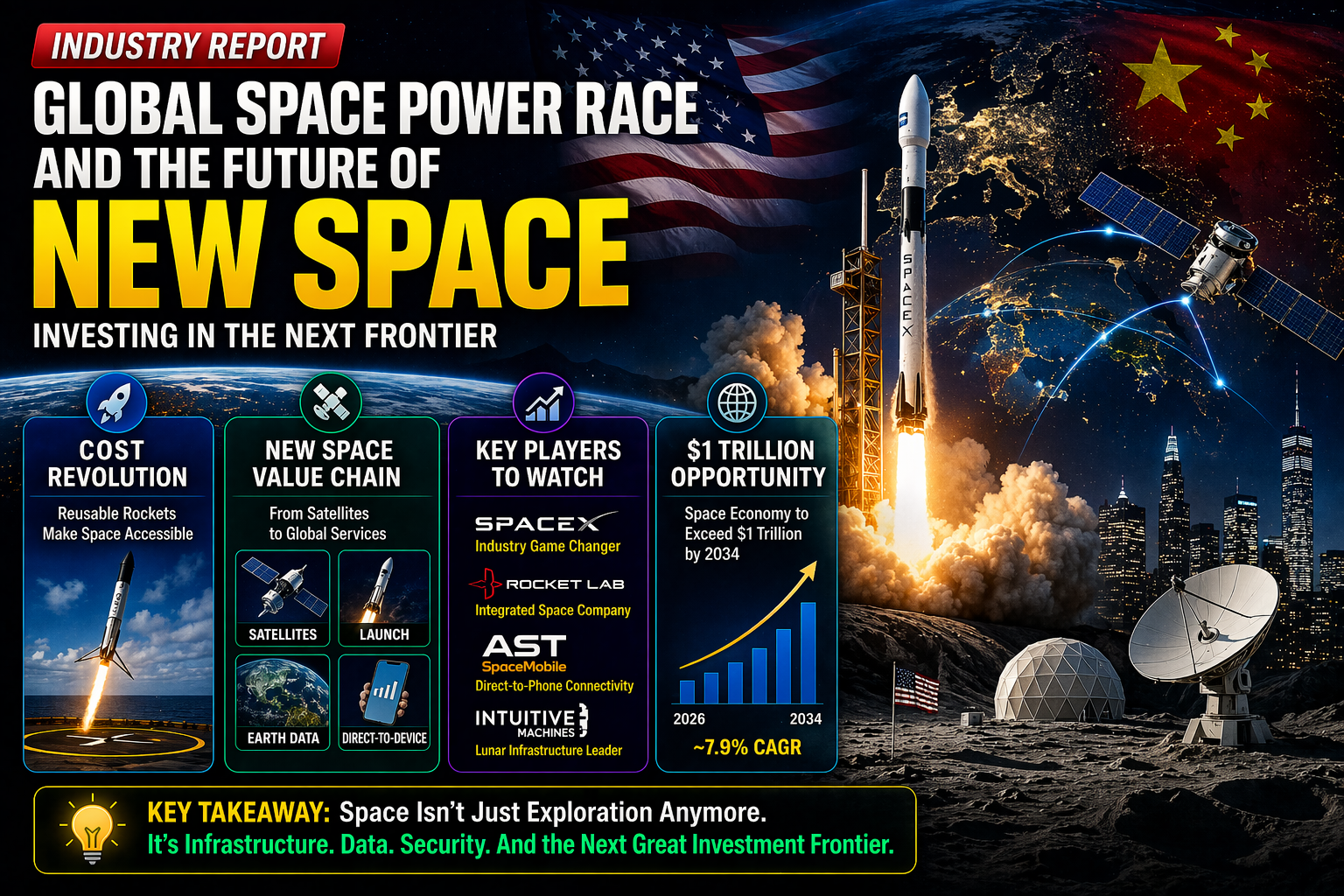
SpaceX, Rocket Lab, AST SpaceMobile, Intuitive Machines — where the money actually goes when launch gets cheap. Full New Space sector breakdown April 2026.
🔥 BRUTAL EDGE™ VERDICT
"New Space is no longer a niche bet on rockets. It is an infrastructure transition — and the winners will not be the companies that 'go to space,' but the ones that control the recurring revenue created because space got cheap. Launch is the headline. Data, connectivity, and defense contracts are the balance sheet."
The Thesis
The global space industry is undergoing a structural transition. The old model — government-led, cost-plus, low-cadence, hardware-centric — has not disappeared, but it is no longer the only game in town. A commercial model has taken hold in which launch costs are falling, private capital is scaling, and the value pool is moving beyond rockets into data, communications, security, and infrastructure services.
For investors, the most important fact is this: cost compression at the launch layer has unlocked monetization across the entire value chain. Reusability, higher launch cadence, miniaturized satellites, and cloud-like access to space have made downstream businesses far more investable than they were a decade ago. Earth observation, broadband, direct-to-device communications, defense networking, lunar logistics, and geospatial analytics — none of these were serious investment categories in 2016. All of them are now.
The industry's growth outlook is large but not single-number precise. Recent estimates place the global space economy at roughly $462 billion in 2026, growing to about $852 billion by 2035 in one forecast, while another sees the market exceeding $1 trillion by 2034. The direction is clear. The exact endpoint still depends on launch economics, defense demand, satellite monetization, and regulatory execution.
The Value Chain
The space industry splits into two layers, and understanding which one you are investing in changes everything.
Upstream includes launch vehicles, satellites, payloads, spacecraft components, ground infrastructure, and emerging lunar/orbital logistics. It is technology-intensive, capital-heavy, and strategically sensitive. It also tends to be more exposed to execution risk, manufacturing bottlenecks, and government procurement cycles.
Downstream is where space-derived data or connectivity turns into end-user value: satellite broadband, Earth observation, defense ISR, direct-to-device communications, climate monitoring, maritime tracking, and geospatial analytics. This layer often carries higher long-term margin potential because it can look more like software, networks, or data services than hardware manufacturing.
Upstream creates the infrastructure. Downstream captures the multiple. Investors who focus only on launch are watching the most visible part of the industry while the most valuable part compounds quietly underneath.
Why the U.S. Is Winning
The United States accounted for an estimated 55.67% of the global space technology market in 2025. While market-share figures vary by definition, the directional conclusion is hard to dispute: the U.S. is the dominant commercial, financial, and defense hub for space.
That dominance rests on four structural advantages. The deepest pool of venture capital and public equity supporting dual-use space businesses. The leading cloud and software ecosystem, which matters because modern space businesses increasingly look like infrastructure-plus-software companies. The strongest commercial launch and satellite operators. And a national-security framework that makes space spending politically durable — the White House's 2025 executive order on a homeland missile shield shows how tightly space, missile defense, and national infrastructure are now linked in U.S. policy.
New Space is not just a consumer or telecom story. It is a strategic infrastructure story, and in that domain the U.S. retains the strongest policy tailwind.
The Sector Map
SpaceX — The Private-Market Benchmark
SpaceX remains the most important company in New Space. It is a launch operator, a broadband constellation owner, a defense-adjacent space infrastructure company, and the central reason capital now believes commercial space can produce technology-scale outcomes. Media reports in April 2026 suggest a confidential IPO filing at a valuation approaching $1.75 trillion to $2 trillion, though this remains unconfirmed by a public SEC filing.
The investment case is obvious: launch economics, Starlink, defense relevance, and founder-driven execution velocity. The risk is equally clear: a valuation at that level requires investors to underwrite not merely current profits, but long-duration dominance across multiple verticals.
Rocket Lab (RKLB) — The Most Balanced Listed Play
Rocket Lab is the strongest listed pure-play because it is no longer just a small-launch company. It operates an integrated model spanning launch, satellite manufacture, spacecraft components, and on-orbit services. Launch alone can be cyclical and capital-heavy. Systems and components diversify revenue and improve quality of earnings.
The 2025 numbers: record annual revenue of $602 million, 21 launches across Electron and HASTE with 100% mission success, and a backlog that grew to $1.85 billion. That is not a one-product launch startup anymore. The bull case is that Rocket Lab becomes a vertically integrated defense-and-space systems prime for the New Space era. The risk is execution on Neutron (its medium-lift rocket), acquisition integration, and competing in a market shaped by SpaceX's scale advantage.
AST SpaceMobile (ASTS) — The Highest-Upside Connectivity Bet
AST SpaceMobile targets direct cellular broadband to standard, unmodified smartphones via satellite. No special handset required. The company has demonstrated successful 5G voice calls and data downloads to standard phones, and its next-generation BlueBird satellites are designed for 24/7 continuous service coverage.
The upside is enormous because the addressable market is consumer-scale rather than aerospace-scale. Dead zones and non-covered geographies become revenue pools without requiring consumers to buy satellite hardware. The risk is equally large: constellation deployment, capital needs, regulatory approvals, partner execution, and direct competition from Starlink's own direct-to-cell efforts.
Intuitive Machines (LUNR) — The Lunar Infrastructure Option
Intuitive Machines is not yet a "safe" business, but it is one of the clearer public proxies for the idea that the Moon will become a sustained logistics and infrastructure theater rather than a one-off mission destination. NASA has awarded the company five CLPS contracts for lunar delivery, and its business now spans payload delivery, data relay, orbital services, and surface infrastructure.
The bull case is that the company becomes a trusted contractor for recurring lunar access. The bear case is that the market gets ahead of contract visibility and underestimates technical and execution volatility. Revenue will remain uneven. The strategic role is becoming clearer.
The Investment Themes
Launch is becoming infrastructure, not an event. As launch gets cheaper, more frequent, and more reliable, the industry begins to resemble logistics infrastructure. That favors operators with scale, cadence, and integration — not one-off mission providers.
Satellite communications is moving from niche to mass-market. If AST SpaceMobile's model scales, it turns satellite connectivity from a specialty product into a wholesale platform layer for mobile operators worldwide. That is a fundamentally different business than selling satellite phones.
Lunar infrastructure is becoming investable before it becomes profitable. This is the highest-risk, highest-optionality part of the sector. The question is not whether humans will return to the Moon. It is whether the companies positioning for it can survive the gap between contract awards and recurring revenue.
Space systems and components may be the quietest compounding business in the sector. Investors focus on launches because they are visible. But spacecraft components, solar arrays, separation systems, avionics, and optical payloads can turn a customer relationship into recurring revenue. Rocket Lab's expansion into this layer is a deliberate strategy to build durable economics underneath the launch headline.
The Risk Stack
1. Capital intensity. New Space is more commercial than Old Space, but it is still expensive. Constellations, launch vehicles, lunar systems, and on-orbit infrastructure all require real capex and long development cycles. This is not software. Investors who treat it like software will misprice risk.
2. Policy dependence. U.S. government demand is a tailwind, but it also means exposure to budget politics, procurement timing, and strategic reprioritization. Defense-linked and lunar infrastructure names carry this risk most acutely.
3. Valuation inflation. A transformational sector can still produce terrible entry points. SpaceX at $1.75 trillion, RKLB at its current multiple, ASTS with no recurring revenue yet — the market is pricing in outcomes that are plausible but not guaranteed. The gap between narrative and earnings is where investors get hurt.
4. Execution. In space, delays matter, launch failures matter, spectrum matters, and hardware quality matters. This is not a theme where narrative alone carries companies indefinitely. Rocket Lab's 100% mission success in 2025 is impressive precisely because it is rare.
Bottom Line
New Space is not a niche speculation anymore. It is an emerging strategic industry with real commercial gravity. The value proposition has shifted from "can private companies operate in space?" to "which private companies will control the services, data, and infrastructure that make space economically indispensable?"
The framework is simple. SpaceX is the sector's center of gravity but not yet directly accessible for most public-market investors. Rocket Lab is the most investable listed infrastructure play. AST SpaceMobile is asymmetric connectivity optionality. Intuitive Machines is a lunar infrastructure option on long-duration government demand.
The companies that win will not necessarily be the ones with the most dramatic missions. They will be the ones with the best claim on repeatable revenue attached to orbiting assets, communications layers, and defense-linked infrastructure. Launch is the headline. Everything else is the business.
About RKLB
Share your analysis
Keep it data-driven. No investment advice.
- Keep it data-driven and respectful
- No investment advice (buy / sell / hold)
- No spam, promotion, or solicitation
- No profanity or offensive content
- Violations are automatically removed
Data: Financial Modeling Prep, Alpha Vantage, CoinGecko
NOT investment advice. Always do your own research.