The Mental Game #001: Why Bull Markets Make You Worse at Investing
The psychology of bubbles, the Odean research on why individual investors lose in rising markets, and why being right about AI is different from being right about AI stock prices in 2026.
The Uncomfortable Truth
You made money this quarter. Every stock you bought is up. Every thesis looks right. You feel like maybe you finally figured out the market.
This is the most dangerous moment of your investing career — and you can't see why because the price action keeps confirming your confidence.
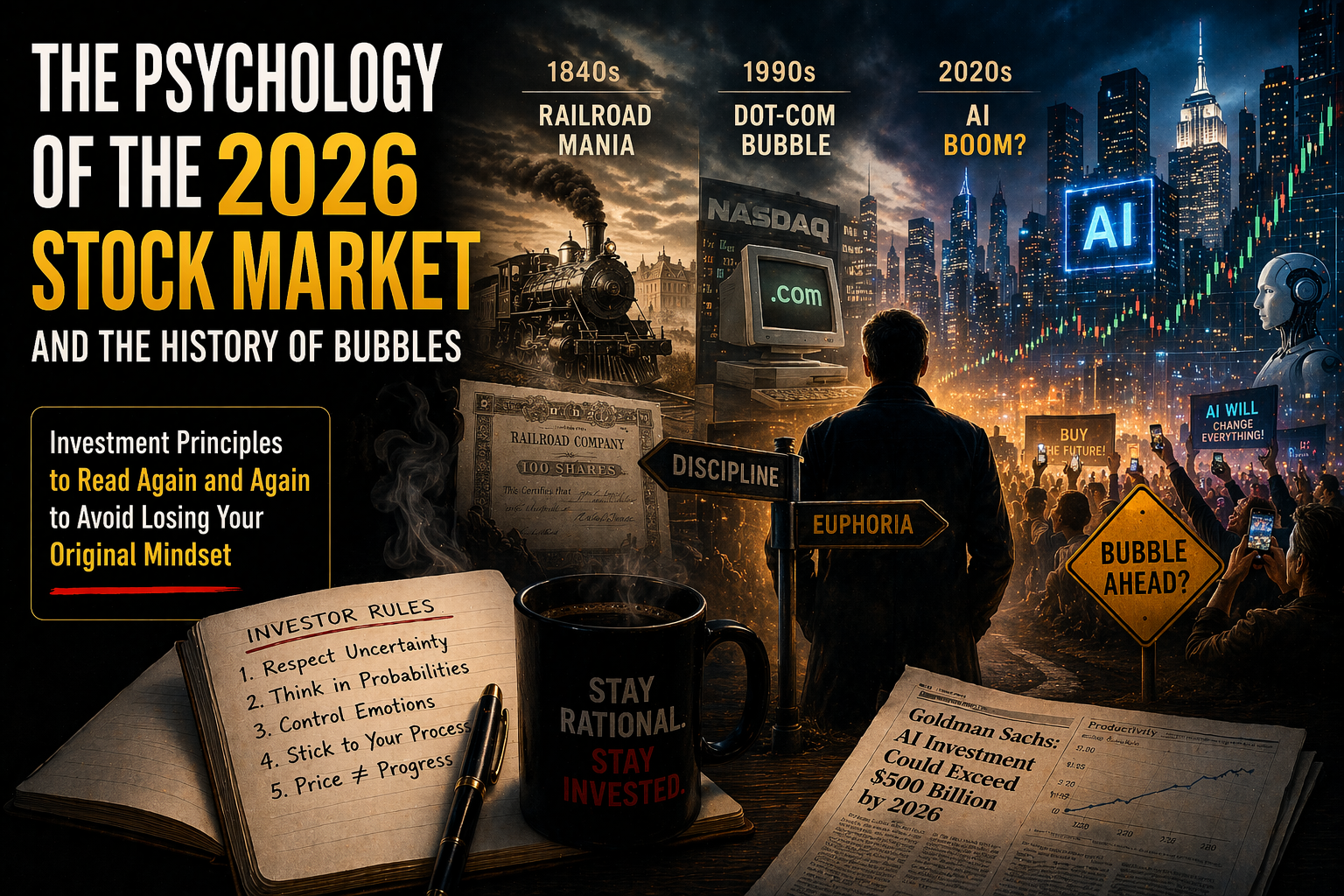
Markets don't move on numbers. They move on human emotion — expectation, fear, impatience, conviction — layered on top of those numbers. Bubbles always arrive wearing the face of "new technology." The internal structure is remarkably consistent.
Railways in the 1840s. Internet in the 1990s. AI in the 2020s.
Every cycle pulls the future forward into the price too fast. Every cycle produces a generation of investors who confuse a rising market with their own skill.
This series exists to document that pattern — and to give you the tools to see it happening to yourself before it becomes irreversible.
The Setup (Why This Series Exists)
This is the first installment of The Mental Game — a series dedicated to the part of investing that nobody talks about until it's too late.
Not what to buy. Not when to sell. Not macro calls or sector rotation.
The psychology underneath every decision you make in markets, and why that psychology is the largest source of underperformance for individual investors according to 30 years of academic research.
Why we're writing this in April 2026:
The S&P 500 is near record highs. AI infrastructure capex is projected at $527 billion for 2026, according to Goldman Sachs. Seven mega-cap stocks account for 33.7% of the S&P 500. Every retail investor has a winning story.
History says this is exactly when the next generation of investors builds the habits that will destroy their portfolios in the correction that eventually comes.
The goal isn't to scare you. It's to give you a framework you can return to when markets get euphoric again — because they will.
1. The Core Misunderstanding — Technology Wins, Prices Often Don't
Stocks have always been "price tags on dreams." A company needs capital to realize the future faster. An investor buys a piece of that future today. The capital market isn't really a trading venue. It's a marketplace for time.
The AI race of the 2020s is the same pattern. The surface question is "who builds the best model?" The deeper question is "who can raise capital longer, deploy infrastructure faster, and absorb losses longer than their competitors?"
Individual investors miss something here: the market does not reward good technology. The market rewards structures where capital concentrates.
In the 1840s railway bubble, railways eventually transformed Britain. Enormous speculation and bankruptcies happened along the way.
In the 1990s dot-com bubble, the internet was real. Most dot-com stock prices in 2000 were wrong. The NASDAQ peaked in March 2000 and fell sharply through October 2002.
AI sits on the same spectrum. The technology will probably matter. That doesn't mean today's prices for AI-exposed stocks are correct.
This distinction changes the investor's entire question.
"Will AI change the world?" is already a late question. The better questions are:
> Who is actually converting the change into cash flow?
> How much of that expectation is already priced in?
Those two questions are the difference between being right about AI and being right about an AI-exposed position.
2. Why Individual Investors Lose — Even in Rising Markets
Bull markets are the most dangerous environment for investing skill because they make everyone look talented. When markets rise, any decision appears to "work" for a while.
Behavioral finance has documented the underlying errors for decades. Two findings from Terrance Odean's research are particularly relevant.
Finding 1: Overtrading destroys returns.
Odean's classic study Do Investors Trade Too Much? showed that individual investors trade excessively, and the result is degraded performance. The more trades you make, the stronger the illusion of competence — and typically, the worse the actual account performance.
Finding 2: The disposition effect.
Odean's other landmark paper, Are Investors Reluctant to Realize Their Losses?, documented that investors hold losing positions too long and sell winning positions too quickly. Losses trigger hope. Gains trigger fear.
This isn't a bad habit. It's close to human nature. Realizing a loss is painful. Locking in a gain is a relief. Both instincts destroy accounts over time.
When these two patterns combine:
The investor trades frequently (racking up fees and slippage), holds losing trades indefinitely (turning small losses into large ones), and sells winning trades quickly (missing the compounding that actually builds wealth).
The portfolio fills with small gains and large losses.
The honest answer to "why is my account underperforming?" is often brutal:
> The market isn't bad at you. You are bad at the market because you are behaving exactly the way humans behave.
This is not a personal failing. It's a species-level pattern documented in decades of research. The first step to fixing it is recognizing it has a name.
3. Why Bubbles Always Arrive Wearing New Technology
Bubbles aren't simply products of greed. That's the explanation most retail investors reach for because it makes them feel safe — as long as they're "not being greedy," they assume they're safe from the bubble.
The historical reality is more disturbing. Bubbles almost always form around real, world-changing technology.
This is what makes bubbles dangerous. If the underlying story were completely fraudulent, the bubble would end quickly. But railways, electricity, internet, and AI are all genuinely transformative. The truth of the technology gives people permission to believe "this time is different" for longer than they should.
The dot-com precedent:
The narrative that the internet would change the world was correct. The problem: the market tried to price in the cash flows that change would eventually produce far too early, at prices far too high. Britannica's account of the dot-com collapse notes that rising interest rates and excessive optimism combined to trigger the unwinding.
The specific trigger matters less than the structure. Bubbles consistently form from the same three ingredients:
```
Real innovation
+
Excessive expectation
+
Slow actual monetization
```
Each cycle repeats the formula.
The AI version in 2026:
Goldman Sachs projects hyperscaler capex of $527 billion in 2026, the largest annual step-up in corporate history. Goldman also warns that monetization pressure and valuation concerns are growing. These two statements can be simultaneously true:
> AI is real.
> Current AI stock prices can still be wrong.
Miss this, and the investor falls into one of two traps.
Trap 1: Reflexive cynicism. "AI is all bubble." This misses real structural transformation and keeps you out of the companies that will compound for a decade.
Trap 2: Narrative conviction. "AI is guaranteed to be right." This leads you to accept any valuation because you've confused being right about the trend with being right about the entry price.
The honest answer is less comfortable than either:
> The technology can be right.
> The price can still be wrong.
4. How to Hold Two Thoughts at Once
The investor's job in a bubble regime is to maintain two seemingly contradictory positions simultaneously.
Position 1: Separate technology direction from stock price.
Agreeing with AI's long-term trajectory doesn't mean a specific company at today's price is a good investment. That company may already be pricing in ten years of its own future. Great companies are not always great stocks at every price.
Position 2: Imagine life after the bubble.
The biggest fortunes in history were often made not at the peak of a bubble, but by investors who could buy quality companies cheaply after the bubble had ended. Amazon after the dot-com collapse is the canonical example. The internet didn't die in 2000. The infrastructure was rationalized, and the actual winners emerged over the following decade.
The same principle will apply to AI. You don't need to get everything right today. Ask instead:
> Will this technology still matter in ten years?
> Who will survive long enough to benefit?
> Is today's price correct, or should I wait for a better one?
These questions do something simple and important. They take you out of "urgency mode" — the psychological state in which bubbles make money — and put you in "patience mode" — the state in which long-term wealth compounds.
The urgency mode is designed to extract your capital during the bubble phase.
The patience mode is designed to preserve your capital through the bubble and deploy it at the reset.
Both modes feel correct to the investor experiencing them. Only one builds lasting wealth.
5. Leverage — Why It Is an Amateur's Enemy
When markets rise rapidly, normal returns start to feel unacceptable. Ten percent per year feels slow. Twenty percent feels unexceptional. This is the emotional condition in which leverage appears attractive.
Leverage doesn't create skill. It amplifies errors.
This matters especially in high-volatility tech stocks, thematic names, and bubble regimes. A leveraged mistake in any of those categories can damage an account beyond recovery. That's not theoretical. It happens every cycle.
The test for any leveraged position is one question:
> If I am wrong, can I recover?
If you cannot instantly answer "yes" to that question, your position is already too large.
The psychology beneath the math:
People use leverage when they are afraid of missing out, not when they have higher-quality ideas. Fear-of-missing-out-driven leverage is not a signal of strength. It is a signal that your emotional regulation has deteriorated faster than your risk management.
Leverage isn't a weapon. It's a multiplier. It multiplies whatever you bring to it — including your panic when the market moves against you.
In a bubble regime, the cost of using leverage to "keep up" is almost always catastrophic. The cost of not using leverage is merely that you compound more slowly during the final phase of the bubble, and survive the reset with capital intact.
The second option is how fortunes are actually built. The first is how portfolios are destroyed.
6. What Successful Investors Actually Do Differently
The myth is that good investors predict the future accurately. The reality is that good investors have written rules down in advance and execute those rules when emotion rises.
Three foundational rules:
Rule 1: Loss rules.
A rule like "sell at 10% drawdown" is not perfect. It will occasionally stop you out of positions that later recover. That's fine. The rule's job is not to optimize returns. The rule's job is to interrupt loss aversion before it turns a controllable loss into an uncontrollable one.
Rules are not prediction tools. They are self-destruction prevention devices.
Rule 2: Position sizing rules.
A good idea with too much capital behind it ultimately introduces emotion. Once emotion is present, discipline collapses. Position sizes should never be determined by "how good does this idea look?" — they should always be determined by "how much am I prepared to lose if I'm wrong?"
This is the most counterintuitive rule for new investors. They want to size based on conviction. Conviction is the least reliable variable in investing.
Rule 3: Trading frequency rules.
Investors who feel anxious if they're not doing something every day rarely survive long-term. Markets don't provide opportunities every day. Most days, doing nothing is the highest-value action available.
This sounds passive. It isn't. Actively choosing to do nothing when nothing compelling is available is harder than actively trading. It requires you to override the urge to feel productive.
The summary:
> Ideas produce gains. Rules produce survival.
Most investors spend 95% of their time on ideas and 5% on rules. Successful investors eventually invert that ratio.
7. Knowing Your Actual Risk Tolerance
People casually describe themselves as "aggressive" or "conservative" investors. Almost nobody knows their actual risk tolerance until they have experienced a real drawdown.
Risk tolerance is not measured by questionnaires. It is revealed by behavior under loss.
Real diagnostic questions:
- Does a 10% drawdown prevent you from sleeping?
- Can you still buy more at a 20% drawdown?
- At 30% drawdown, can you hold your rules?
- When you're at a loss, do you compulsively check news?
- As position size grows, does your judgment deteriorate?
Your honest answers to these questions reveal your actual risk temperament. Your stated preferences are almost always wrong.
Most failures in investing come not from owning the wrong assets, but from owning assets whose volatility is incompatible with the investor's psychological structure. The investor then breaks their own rules under pressure and locks in the loss at exactly the worst possible moment.
This is why self-knowledge matters more than market knowledge for most individual investors.
You can borrow market research. You cannot borrow emotional stability.
8. Why Real Learning Starts After the Bubble Ends
Bubble regimes feel like learning environments. Every decision seems to produce feedback. Investors accumulate confidence that they are building skill.
They aren't. Rising markets hide almost every error.
Overvaluation, excessive concentration, inappropriate leverage, terrible entry prices, chasing without a thesis — all of these errors are temporarily justified by a market that keeps going up.
When the bubble deflates, the questions change:
- Who actually survives?
- Who is generating cash flow?
- Who captured real demand?
- Who was only riding a narrative?
This is when the real learning starts.
Markets during corrections sell everything together — winners and losers, quality and speculation. But over the following 12-36 months, survivors separate from casualties. Wealth is built when that separation becomes visible and investors with preserved capital buy the survivors at dislocated prices.
A bubble is not an ending. A bubble is the beginning of a sorting process.
The investors who win the sort are the ones who:
1. Didn't blow up during the bubble
2. Still have capital available during the reset
3. Have done enough prior research to recognize survivors quickly
The investors who lose the sort are the ones who:
1. Maxed out leverage in the bubble phase
2. Ran out of capital before quality got cheap
3. Refused to believe the correction was structural rather than temporary
You cannot determine during the bubble which investor you will become. You can only set the rules that force you to be the first type.
9. Ten Questions to Reread When Markets Get Euphoric
Print this. Save this. Return to it when your account is making daily highs and you feel invincible.
1. What am I actually buying — a company, or a narrative?
2. Are this company's 3-year earnings connected to its current price?
3. If I feel anxious, is it from insufficient analysis or oversized position?
4. Am I holding losing trades on hope?
5. Am I selling winning trades on relief too quickly?
6. Is this trade a planned action, or an impulse reaction?
7. Is my leverage a multiplier of skill, or an expression of anxiety?
8. Is the market good, or am I just lucky?
9. Can I identify which companies will survive the next correction?
10. What protects my account — conviction, or rules?
These questions are simple. They typically hit the most painful spots first.
That's why they work.
10. The Investor's Posture for 2026 and Beyond
The 2026 market has a strong narrative. AI is real. The productivity revolution may be real. Capital markets are funding the competition at an unprecedented scale.
History always repeats the same sentences back to investors who think the current cycle is unique.
> Technology innovation does not guarantee investment success.
> Prices sometimes reflect the future too early.
> Excessive trading and leverage destroy investors.
> Real opportunities appear after, not during, the bubble.
The right posture is not cynicism. It is structured optimism.
Believe in the future of the technology. Keep vigilance on the price. Love the market. Don't lose yourself trying to match its speed.
The biggest fortunes are typically built when investors are patient, not when they are excited.
Closing
This piece is not designed to be read once. It is designed to be returned to — every time markets get euphoric, every time a new technology narrative dominates, every time you feel the urge to trade faster than your rules allow.
Six principles. Reread them regularly:
1. Don't trade too often.
2. Don't hold losses too long.
3. Don't close gains too quickly.
4. Don't use leverage to solve anxiety.
5. Separate technology from price.
6. Always prepare for life after the bubble.
Consistent adherence to these six principles is enough to keep most investors in the market meaningfully longer than they otherwise would. Surviving longer is how compounding actually gets to work.
The market will always have new narratives.
Human errors remain the same.
The good principles also remain the same.
The next installment of The Mental Game will examine loss aversion in depth — why losing $100 hurts approximately 2.5x as much as gaining $100 feels good, and what that asymmetry does to every portfolio decision you will ever make.
Related Reading
- The Masters: Druckenmiller — How one investor used rules to compound 30% annually for 30 years without a losing year
- The Masters: Livermore — What happened when the greatest trader of his generation stopped following his own rules
For informational and educational purposes only. Not investment advice. The author has no position in any security mentioned. Always conduct your own research.
For the edge that cuts through the noise — Brutal Edge.
Share your analysis
Keep it data-driven. No investment advice.
- Keep it data-driven and respectful
- No investment advice (buy / sell / hold)
- No spam, promotion, or solicitation
- No profanity or offensive content
- Violations are automatically removed