IonQ Special Report Vol.2: The Vertical Integration Bet
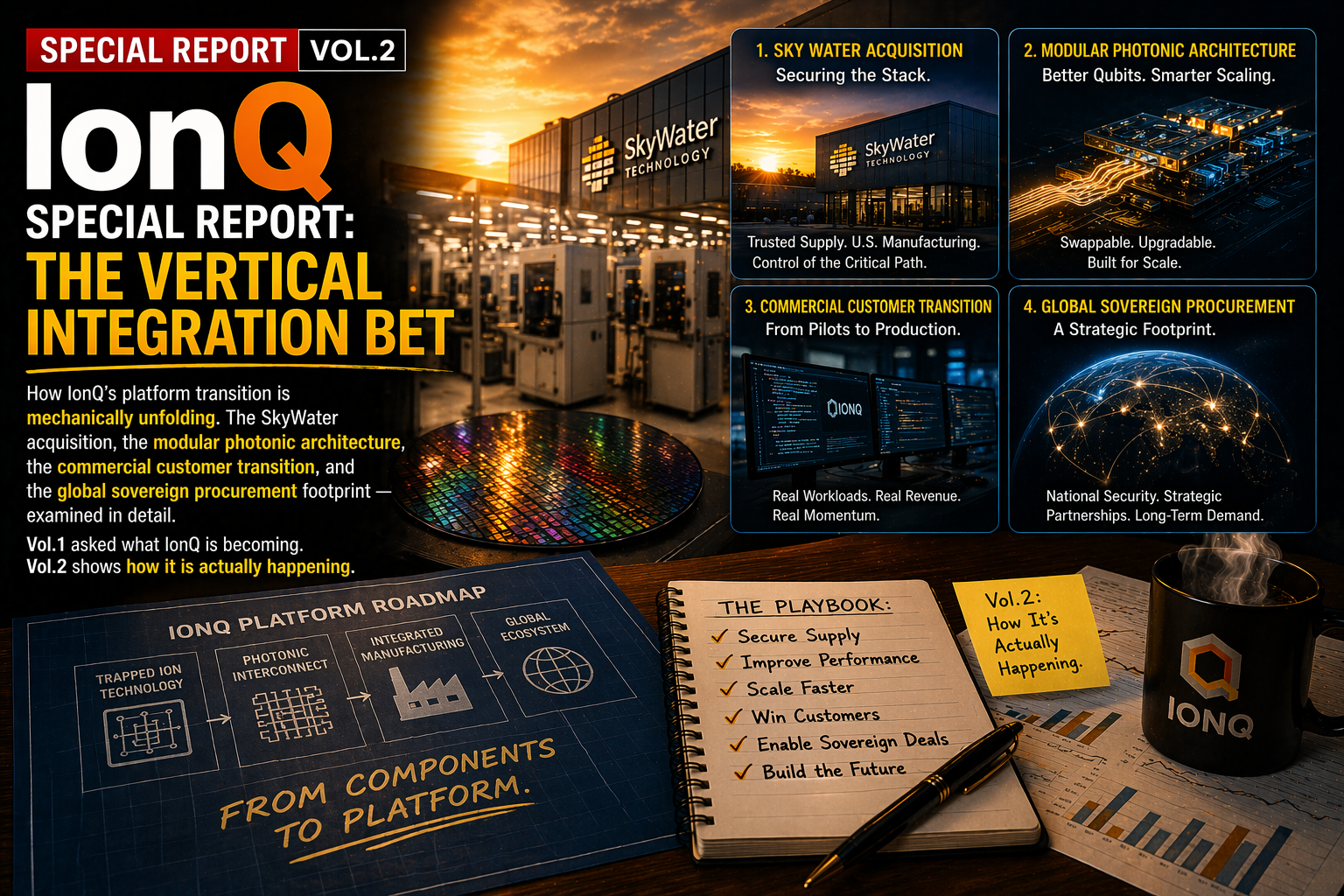
How IonQ's platform transition is mechanically unfolding. The SkyWater acquisition, the modular photonic architecture, the commercial customer transition, and the global sovereign procurement footprint — examined in detail. Vol.1 asked what IonQ is becoming. Vol.2 shows how it is actually happening.
The Setup
Vol.1 established that IonQ is no longer a hardware company. It is executing a platform transition across four layers — computing, networking, security, sensing — unified under U.S. manufacturing capability.
Vol.2's question: How is that transition actually happening, mechanically?
A platform thesis without mechanical evidence is just aspiration. What separates IonQ from every other "quantum platform company" pitch is that the platform assembly is visibly underway in real corporate actions, not just investor decks.
This volume examines four concrete mechanisms:
1. Vertical integration via SkyWater — the manufacturing sovereignty play
2. Modular photonic architecture — the scaling paradigm that makes platform economics possible
3. Commercial customer transition — the shift from grants to enterprise revenue
4. Global sovereign procurement — the footprint that creates standards lock-in
Each mechanism is independent. Each could fail individually. But they are reinforcing each other, and that combined motion is what creates platform economics.
If even three of the four mechanisms execute successfully, IonQ's platform transition completes. If only two execute, the thesis remains half-built. If only one or zero succeed, IonQ reverts to being a capable hardware vendor with an ambitious valuation.
The bull case requires three of four. The bear case requires two of four to fail. This is the actual math of the thesis.
Part 1: The SkyWater Acquisition — More Than a Chip Deal
Announced January 26, 2026, the IonQ-SkyWater transaction is the single most strategically significant corporate action in public quantum computing to date. At $1.8 billion total equity value, it is also the largest.
What SkyWater Actually Is
SkyWater is the largest exclusively U.S.-based, pure-play semiconductor foundry. Facilities in Minnesota (headquarters), Florida, and Texas. It has become a go-to foundry for quantum computing companies, defense contractors, and customers requiring trusted domestic manufacturing.
That last phrase — "trusted domestic manufacturing" — is not a marketing slogan. It is a specific procurement category recognized by U.S. federal agencies, defense programs, and increasingly by allied nations. Technologies classified as strategic require domestic fabrication for security reasons. Many foreign foundries are excluded from these programs regardless of technical capability.
SkyWater is one of the few U.S. foundries that can fabricate at scale for trusted-manufacturing customers. Buying it is not buying capacity. It is buying category access.
Strategic Implication 1: Supply Chain Sovereignty
U.S. federal, defense, and intelligence customers increasingly require trusted domestic manufacturing for technologies they consider nationally sensitive. Quantum computing, quantum sensing, and post-quantum cryptography all sit inside that category.
A quantum company that depends on foreign fabrication cannot fully compete for the most lucrative federal contracts. No matter how good the technology, certain procurement channels are closed without domestic sourcing.
IonQ + SkyWater solves that constraint structurally, not contractually. Post-close, IonQ will own the fabrication capability rather than negotiating access to it. That converts a procurement constraint into a competitive moat.
The companies that cannot manufacture domestically cannot win sovereign contracts at the highest classification levels. IonQ has eliminated this constraint ahead of competitors who remain dependent on external foundries.
Strategic Implication 2: Design Cycle Compression
Quantum hardware iteration has historically been bottlenecked by fabrication cycle times. External foundries typically require 9+ months per design iteration due to queue priority, process node availability, and contract negotiation overhead.
Vertical integration with SkyWater creates the potential for dramatically faster cycle times on quantum-specific process nodes.
In a field where competitors are all racing for architectural breakthroughs, faster iteration is compounding advantage. If IonQ can iterate 3–4x faster than competitors who depend on external foundries, the gap widens over time even if initial positions are similar.
Consider the mathematical implication. A company that iterates every 9 months runs approximately 1.3 design cycles per year. A company that iterates every 2–3 months runs 4–6 cycles per year. Over a 3-year period, the faster iterator has roughly 15–18 design cycles while the slower competitor has 4.
That gap is not linear. It is exponential in architectural learning.
Strategic Implication 3: Roadmap Acceleration
The announced roadmap impact is specific and dated:
- 200,000-qubit QPUs entering functional testing in 2028
- Approximately 8,000 ultra-high-fidelity logical qubits enabled by those systems
- 2,000,000-qubit system accelerated by up to a year
Whether those specific targets hit on schedule is an execution question. Quantum computing roadmaps are notoriously difficult to hold. But the direction is structurally plausible. Mature-node semiconductor manufacturing at domestic scale drives cost curves down by orders of magnitude relative to superconducting competitors, who face fundamentally different cost structures due to cryogenic infrastructure.
If IonQ achieves even 60% of its announced roadmap, the cost position versus competitors inverts.
Strategic Implication 4: Merchant Foundry Optionality
SkyWater will continue serving non-IonQ customers post-acquisition. This is a subtle but important detail most coverage has missed.
The merchant business means:
- Revenue diversification. SkyWater's existing revenue streams continue, providing non-quantum cash flow
- Competitive intelligence. IonQ will have visibility into what other quantum companies are fabricating
- Strategic leverage. Competitors who depend on SkyWater for their own quantum chips will now be customers of a company that is simultaneously their competitor
- Ecosystem position. IonQ becomes not just a quantum vendor but a quantum industry infrastructure provider
Every quantum company that uses SkyWater becomes, in a sense, part of IonQ's extended supply chain. That is how platform positions get built — not by single vertical wins, but by becoming the layer that others depend on.
The Regulatory Risk
The deal is pending regulatory approval. Until close, "vertical integration" is an intention, not a reality.
Antitrust scrutiny for a deal that combines the only pure-play U.S. quantum computing company with the only pure-play U.S. trusted domestic foundry is non-trivial. The deal is more likely than not to close, given that both sides are U.S. entities and the strategic logic aligns with U.S. government priorities for domestic quantum leadership. But regulatory delays are possible. A blocked deal would be a significant negative catalyst.
Investors should track the regulatory timeline carefully. Close is the event that converts thesis into reality.
Part 2: Modular Photonic Architecture — The Scaling Paradigm That Matters
In April 2026, IonQ demonstrated entanglement between two independent trapped-ion systems via photonic interconnect. Its strategic implications are larger than most analysts recognize.
Two Scaling Philosophies
Quantum computing has two divergent paths for scaling beyond current system sizes:
Monolithic scaling. Build a single, ever-larger quantum chip. Add more qubits to one physical system. This is the path IBM has pursued with superconducting, and the conceptually simpler approach.
Modular scaling. Build many smaller systems, network them via photonic links into a distributed computational fabric. Add computational power by adding modules, not by making each module larger.
The winner of the quantum era may not be the company that builds the largest single quantum computer. It may be the company that builds the most scalable networked quantum architecture.
The Classical Computing Parallel
In the 1990s and 2000s, the question was not "who builds the fastest CPU?" Intel's dominance of that question did not translate into infrastructure-era dominance. The winners of classical infrastructure were the companies that built systems to connect many processors — networking companies, cloud infrastructure providers, distributed systems specialists.
The single-processor race had a ceiling set by physics. The distributed systems race did not.
Quantum computing faces a similar structural choice. A single quantum chip has fundamental physical limits — qubit density, error rates, decoherence, fabrication yield at scale. Those limits are real. You cannot engineer past them through better chip design alone.
A network of quantum modules has no equivalent ceiling. You scale by adding modules, not by making each module physically larger.
What the April 2026 Demonstration Proved
Two independent trapped-ion systems were entangled via photonic links. That is not a small result.
Entanglement is the fundamental quantum resource. Without it, distributed quantum computing is impossible. The demonstration proved that IonQ's chosen scaling path — modular entanglement via photonic interconnect — is physically viable at small scale.
Moving from two-system demonstration to production-grade distributed quantum networks is a massive engineering challenge that will take years. The demo is not proof that IonQ has solved distributed quantum computing. It is proof that the architectural direction is not impossible.
That distinction matters because the architectural direction was the bet. Every engineering decision IonQ has made for years has assumed modular scaling would eventually work. If the April 2026 demonstration had failed — if photonic interconnect between trapped-ion systems had proven physically impractical — the entire platform thesis would collapse.
It didn't fail. The bet is still alive.
The Economic Implication of Distributed Architecture
Monolithic systems sell expensive one-off machines. Revenue is lumpy, customer count is small, scaling requires building ever-more-ambitious systems.
Distributed systems sell networks that expand indefinitely. A customer buys a base system, then adds modules as their computational needs grow. Revenue becomes recurring and expandable. Customer retention compounds because each additional module reinforces commitment to the platform.
That is the difference between a hardware business and a platform business.
The Connection to Vertical Integration
Modular architecture only works if the modules are manufactured consistently. Each module must meet strict specifications for the photonic interconnect to function reliably.
This is where vertical integration becomes critical. A company building modular quantum systems through external foundries faces supply chain fragility. Module-to-module variation from different fabrication runs can compromise the photonic interconnect.
A company that owns its fabrication — like IonQ will post-SkyWater — can enforce module consistency directly.
SkyWater and photonic interconnect are not two separate strategic moves. They are one integrated bet on modular scaling as the winning quantum paradigm.
Part 3: The Commercial Customer Transition
The most important single data point in IonQ's 2025 results is not the revenue growth rate. It is the revenue composition.
Over 60% of 2025 revenue came from commercial customers.
A customer paying from a research budget is validating that the technology is interesting.
A customer paying from an operational budget is validating that the technology creates value.
The economics of those two customers are fundamentally different. Research budgets are fixed pools allocated to exploration. Operational budgets are ROI-accountable. A technology that graduates from research budgets to operational budgets is validating commercial viability — not just scientific credibility.
The Land-and-Expand Dynamic
IonQ management has described the commercial sales motion as "land-and-expand." This framing implies a specific revenue trajectory:
- Initial hardware sale establishes the customer relationship
- Over multiple years, the customer expands deployment (more systems, more users, more capabilities)
- Hardware upgrades occur as new generations launch
- Software, networking, security, and services layer on top of the hardware base
This is platform economics, not hardware economics.
A one-time $10M hardware sale is worth $10M. A $10M initial sale followed by multi-year expansion to $50M in additional revenue is worth $60M — but the capture economics and margin profile are very different across those two categories.
Hardware companies typically trade at 3–8x revenue multiples. Platform companies with recurring and expanding revenue bases can trade at 15–40x multiples depending on growth rates and retention. The same $60M of total customer value produces dramatically different market caps depending on which category the market applies.
The RPO Signal
Remaining Performance Obligations (RPO) — the disclosed value of contracted future revenue — grew from $77 million at end-2024 to $370 million at end-2025.
That is a 4.8x increase in one year.
RPO growth at this magnitude is inconsistent with a one-shot hardware sales motion. It is consistent with multi-year customer commitments that lock in revenue trajectory beyond the current reporting period.
When RPO grows faster than revenue, the business is shifting toward longer-duration customer relationships. That is exactly what platform transitions look like mechanically.
Investors who track only revenue miss this signal. Investors who track RPO see the leading indicator of the transition before it shows up in reported revenue.
International Mix as a Commercial Signal
The 30%+ international revenue mix in 2025 signals something specific about commercial customer quality.
International adoption of U.S. deep tech typically lags domestic adoption by 2–3 years in normal conditions. When international adoption happens early, it indicates that: the technology is validated enough that international customers override the normal lag, the customer sourcing is not dependent on U.S. federal procurement relationships, and the use cases are sufficiently universal that they translate across national contexts.
This signals that IonQ's customer base is structurally more diversified than its peer group, and that commercial validation is occurring across multiple national contexts simultaneously.
Part 4: Global Sovereign Procurement — The Platform Standard Play
IonQ is not just selling internationally. It is embedding into sovereign procurement across multiple regions.
Asia: The Anchor Customer Strategy
South Korea — KISTI and the National Flagship Supercomputer Integration.
The KISTI Tempo 100-qubit system contract finalized. The Tempo 100 will connect to HANGANG, South Korea's 6th-generation national flagship supercomputer, through NVIDIA's NVQLink framework. This creates a hybrid quantum-classical computing environment at national infrastructure scale.
That is not a customer relationship. It is a sovereign infrastructure integration that embeds IonQ into Korea's long-term computational strategy. Once a national supercomputer architecture incorporates a specific quantum vendor, switching costs become enormous.
Additional Korean relationships — Hyundai (battery chemistry and automotive applications), Sungkyunkwan University, Seoul National University, Intellian — extend the Korean presence beyond a single anchor contract into an ecosystem of industrial, academic, and national infrastructure relationships.
Japan — Toyota Tsusho and Strategic Distribution.
The Toyota Tsusho partnership positions Toyota Tsusho as IonQ's distribution and business development partner for Japan. This is a market-penetration strategy, not a sales relationship. Rather than building Japanese sales capacity from scratch, IonQ leveraged existing national networks.
Singapore — Horizon Quantum and the 256-Qubit Pre-Commitment.
Horizon Quantum pre-committed to receiving one of IonQ's first 256-qubit systems. This is validation that IonQ's next-generation product roadmap has buyers lined up before commercial availability.
Europe: The Cambridge-Basel Axis
United Kingdom — Cambridge Quantum Innovation Centre and 256-Qubit Deployment.
The University of Cambridge partnership established a Quantum Innovation Centre with plans for a 256-qubit IonQ system deployment. Cambridge has stated that this will become the most powerful quantum computer in the UK when installed.
Cambridge is not just a customer. It is a scientific institution whose endorsement carries weight across European research ecosystems. When Cambridge commits to a specific vendor, downstream institutional buyers across Europe face reduced decision risk.
This is how platform standards emerge in institutional markets. Not through direct sales effort, but through anchor endorsements that reduce decision risk for subsequent buyers.
Switzerland — QuantumBasel Partnership Expansion.
The QuantumBasel partnership was expanded through 2029 with total contract value exceeding $60 million. The deal includes ownership transfer of Forte Enterprise systems and commitment to next-generation Tempo hardware.
Ownership transfer is the key phrase. When a customer transitions from "accessing quantum through cloud" to "owning quantum systems on-premises," the commitment deepens dramatically.
North America: Defense and Manufacturing Anchoring
Defense and Intelligence Positioning.
IonQ's relationships with the Air Force Research Laboratory (AFRL) produced the photonic interconnect milestone as a joint project. DARPA HARQ program participation positions IonQ in the next-generation hybrid quantum architecture research. MDA SHIELD IDIQ is a ceiling contract that qualifies IonQ to compete for defense-related quantum work.
These are qualifications and research relationships that position IonQ inside the U.S. national security quantum stack. Being inside the procurement ecosystem is often less about immediate financial value and more about strategic positioning for the largest long-term contracts.
Why Global Footprint = Platform Standard
Institutional buyers — sovereign nations, defense agencies, major research institutions, large enterprises — do not make procurement decisions in isolation. They watch what their peers do.
The first major institutional customer in a category creates asymmetric influence over subsequent decisions.
When Cambridge commits to IonQ, German, French, and Italian research institutions face reduced risk in evaluating the same vendor. When KISTI integrates IonQ into national infrastructure, Japanese and Taiwanese institutions face reduced risk in parallel evaluations.
This is "institutional trust compounding." It is slow, cumulative, and almost invisible in quarterly financials. But it is one of the most durable economic moats that exists in technology markets.
The Integrated Picture
The four mechanisms are not separate initiatives. They are reinforcing.
Vertical integration (SkyWater) enables the manufacturing consistency required for modular architecture (photonic interconnect) at scale. Modular architecture enables expandable customer relationships (land-and-expand) because customers can add modules over time. Expandable relationships create the multi-year commitments that appear as RPO growth and sovereign procurement depth.
And sovereign procurement depth in turn validates the platform thesis, which justifies continued investment in vertical integration and modular architecture.
It is a flywheel. Each component strengthens the others. If the flywheel is working, the trajectory compounds. If individual components fail, the flywheel slows but does not necessarily break.
The Core Takeaway of Vol.2
The platform transition is not aspirational. It is mechanically underway across four reinforcing mechanisms.
Each mechanism can be tracked independently:
- SkyWater close and integration — the manufacturing sovereignty component
- Photonic interconnect scaling — the modular architecture component
- Commercial mix and RPO trajectory — the customer transition component
- Sovereign procurement pattern — the standards-lock-in component
An investor who wants to evaluate IonQ's progress should watch these four mechanisms, not the stock price.
Stock price will be volatile. The underlying mechanisms either progress or they don't. If they all progress, the price eventually follows. If two or more stall, the thesis weakens structurally regardless of what the stock does in the interim.
The mechanisms are the signal. Price is noise layered over that signal.
The Vol.2 One-Line Principle
> "Platform transitions are not decided by product launches. They are decided by whether the reinforcing mechanisms build the flywheel. Most investors watch the launches. The patient ones watch the flywheel."
Related Reading
- IonQ Special Report Vol.1: The Re-Categorization
- IonQ Special Report Vol.3: The Price of Admission
- The Structural View Vol.1: Palantir vs Anthropic
For informational and educational purposes only. Not investment advice. The author has no position in any security mentioned. Always conduct your own research. Quantum computing investments carry exceptional execution, technical, and timeline risk.
For the edge that cuts through the noise — Brutal Edge.
Share your analysis
Keep it data-driven. No investment advice.
- Keep it data-driven and respectful
- No investment advice (buy / sell / hold)
- No spam, promotion, or solicitation
- No profanity or offensive content
- Violations are automatically removed
Data: Financial Modeling Prep, Alpha Vantage, CoinGecko
NOT investment advice. Always do your own research.