IonQ Special Report Vol.1: The Re-Categorization
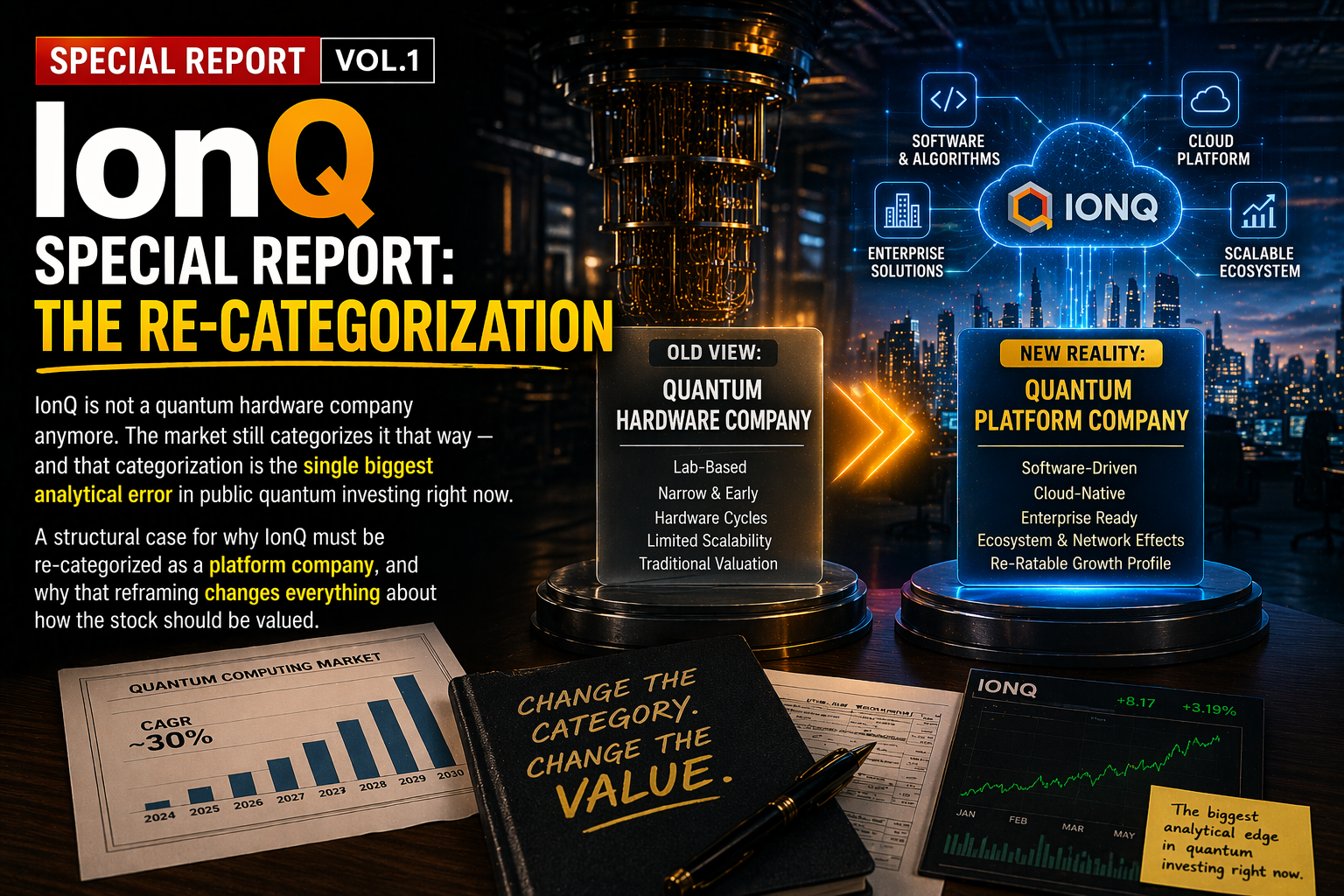
IonQ is not a quantum hardware company anymore. The market still categorizes it that way — and that categorization is the single biggest analytical error in public quantum investing right now. A structural case for why IonQ must be re-categorized as a platform company, and why that reframing changes everything about how the stock should be valued.
The Opening Thesis
> The single most important analytical error in public quantum investing today is categorizing IonQ as a hardware company.
That framing made sense in 2021–2023, when IonQ was defined primarily by its trapped-ion chips and its cloud-delivered quantum computing service. It no longer fits what the company is actually building in 2026.
The gap between what IonQ has become and how the market still categorizes it is not a detail. It is the entire investment setup.
If you get the categorization right, everything else — valuation framework, peer comparison, time horizon, position sizing — falls into place. If you get it wrong, you are applying a hardware multiple to a platform transition, or a platform multiple to a hardware company. Both errors destroy capital.
This is Volume 1 of a three-part IonQ Special Report series.
Vol.1 answers the question: "What is IonQ actually becoming?"
Vol.2 examines how that transition is mechanically unfolding through vertical integration, modular architecture, and global commercial expansion.
Vol.3 examines what the transition costs — the execution risks, the valuation mathematics, and the honest framework for deciding whether to own this stock.
Part 1: Why Categorization Matters More Than Valuation
Most investors jump straight to valuation when evaluating a stock. What's the P/E? What's the P/S? Is it cheap or expensive?
That is analytical malpractice for a company in transition.
Because valuation only works when applied to the correct category. A hardware company trading at 120x sales looks insane. A platform company trading at 120x sales during an inflection year might be reasonable. The absolute number is meaningless without the categorical frame.
Consider the historical pattern:
- Amazon in 2000 was categorized as "online bookseller." That framing justified fundamental bear cases for years. Investors who held anyway made generational returns because the correct category was "infrastructure platform for commerce and cloud."
- Nvidia in 2016 was categorized as "gaming GPU company." That framing made the stock look expensive whenever gaming cycles slowed. The correct category — "AI infrastructure provider" — emerged years later, and the market eventually repriced accordingly.
- Tesla in 2018 was categorized as "luxury car maker with execution problems." That framing produced persistent short interest. The correct category — "vertically integrated energy and mobility platform" — took years to become consensus.
The pattern is consistent: major valuation re-ratings happen when the market finally accepts a new category, not when fundamentals change.
The fundamentals were always there. What changed was the label.
IonQ is currently in the middle of this kind of re-categorization cycle. The company has been telling investors for over a year that it is a "full-stack quantum platform company." The market is still partially pricing it as "a trapped-ion hardware vendor with commercial traction."
The investor who correctly identifies the transition early captures the re-rating. The investor who waits for consensus captures only what remains after consensus has arrived.
Part 2: The Evidence That IonQ Is No Longer a Hardware Company
If IonQ were still a hardware company, its strategic moves would focus on improving hardware: more qubits, better fidelity, faster iteration cycles, better cloud access.
It does all those things. But the strategic moves of 2024–2026 reveal a fundamentally different ambition.
Acquisition Pattern Analysis
Look at what IonQ has acquired or announced to acquire in the last 18 months:
Oxford Ionics (2025) — Semiconductor-based trapped-ion integration. This is not just better hardware. It is the ability to use standard semiconductor manufacturing processes for quantum chips. The strategic value is lower cost, faster iteration, and access to established fab infrastructure.
Capella Space, Vector Atomic, Skyloom Global (2025) — Quantum sensing, atomic clocks, space-adjacent capabilities. These acquisitions have nothing to do with quantum computing in the narrow sense. They are expansion into quantum sensing and positioning — adjacent markets that share underlying physics but serve entirely different customer bases.
SkyWater Technology ($1.8B, pending 2026) — Full U.S.-based semiconductor foundry. This is the largest, most strategically ambitious move. Not just another supplier. A vertically integrated manufacturing layer.
Lightsynq, ID Quantique — Quantum networking and quantum-safe cryptography. These are the communications and security layers of quantum infrastructure.
These acquisitions do not describe a hardware company trying to build a better machine.
They describe a company systematically assembling four separate quantum stacks:
1. Computing — trapped-ion QPUs, modular photonic interconnects
2. Networking — photonic links, quantum internet primitives
3. Security — post-quantum cryptography, quantum key distribution
4. Sensing — atomic clocks, quantum detection, precision timing
All four layers unified under a single U.S.-based manufacturing capability via SkyWater.
This is not a product strategy. This is a platform strategy dressed in deep tech clothing.
What IonQ Says About Itself
In Q4 2025 earnings commentary, management explicitly described IonQ as "the world's only full-stack quantum platform company." This is not marketing. It is a deliberate repositioning.
The phrase "full-stack platform" signals: multiple integrated layers of capability, control across the value chain, lock-in potential across layers, and revenue that compounds through integration, not just unit sales.
The Customer Mix Signal
IonQ's 2025 revenue disclosure revealed two numbers that matter enormously:
- Over 60% of 2025 revenue came from commercial customers (up from predominantly government/research sources in prior years)
- Over 30% of 2025 revenue came from international markets (the first time international exceeded 30%)
These are not growth rate numbers. They are composition numbers. And composition signals category.
A government-dominated revenue mix looks like a research instrument company. A commercial-dominated, internationally diversified revenue mix looks like a strategic infrastructure company. The category shift is visible in the financial statements, not just the press releases.
Part 3: The Trapped-Ion Architecture Is a Strategic Choice
The variables that actually matter in commercial quantum deployment:
- Fidelity — how accurately each qubit holds and transmits information
- Connectivity — can every qubit interact with every other qubit, or only with neighbors?
- Coherence time — how long each qubit maintains its quantum state before decoherence
- Error correction efficiency — how many physical qubits are needed to produce one logical qubit
- Operating conditions — temperature, vacuum, cooling, shielding requirements
- Scaling path — whether the architecture scales by adding qubits to one chip, or by networking multiple systems
What Trapped-Ion Actually Means
Room-temperature operation. No external cryogenic systems, no dilution refrigerators, no sub-absolute-zero cooling infrastructure. This dramatically simplifies deployment environments.
All-to-all connectivity. Any qubit in the system can interact directly with any other qubit. This is architecturally uncommon. All-to-all connectivity reduces algorithmic overhead and simplifies circuit design.
Long coherence times. Trapped ions can maintain quantum states for significantly longer periods than many competing architectures.
Fidelity advantage. IonQ announced 99.99% two-qubit gate fidelity in 2025. Higher fidelity means fewer errors per operation, which means fewer physical qubits needed for error correction, which means better scaling economics.
19-inch rack form factor potential. This enables deployment in environments superconducting architectures cannot reach — military aircraft, submarines, forward-operating installations, standard enterprise data centers without specialized cooling infrastructure.
The customer categories that benefit most from that wider deployment envelope — defense, intelligence, classified environments, forward-operating installations, sovereign national infrastructure — are exactly the customer categories with the highest willingness to pay in all of enterprise computing.
IonQ did not stumble into trapped-ion. The architecture was chosen with this commercial envelope in mind.
Algorithmic Qubits (AQ) — A Positioning Strategy Disguised as a Benchmark
IonQ has introduced the concept of "Algorithmic Qubits" (#AQ) as an alternative performance metric. The logic: raw qubit counts are misleading, because a system with many low-fidelity qubits cannot solve real problems, while a system with fewer high-fidelity qubits can.
IonQ is deliberately trying to shift the industry conversation from "physical qubit count" to "usable computational capability." That shift favors architectures with high fidelity and good connectivity — exactly IonQ's strengths.
It is a positioning strategy disguised as a benchmark. If customers and analysts increasingly evaluate quantum systems by usable capability rather than raw qubit count, IonQ benefits structurally.
Part 4: Why "Full-Stack Quantum Platform" Is Not Marketing
The phrase gets used so often it risks becoming meaningless. But in IonQ's case, the assembly is visible and specific.
Layer 1: Computing
Trapped-ion QPUs across multiple generations. The Tempo system (5th generation, 100 qubits) is already commercially deployed. The 6th generation (256 qubits) is targeted for operational demonstration in Q4 2026. The 200,000-qubit QPU is targeted for functional testing in 2028, enabling approximately 8,000 ultra-high-fidelity logical qubits.
This is the core computing layer. Without it, nothing else matters. But it is only one of four layers.
Layer 2: Networking
Quantum networking — the ability to entangle quantum systems across distance — is not a theoretical future capability. It is actively being built. The April 2026 photonic interconnect demonstration validated that IonQ's modular scaling architecture is physically viable.
Quantum networking enables: distributed quantum computing (multiple modules networked as a single logical system), quantum internet primitives (entanglement distribution for secure communication), and multi-site quantum systems for redundancy and scaling.
IonQ's networking capability is a separate economic layer from computing. Having both layers is not redundant. It is multiplicative.
Layer 3: Security
Quantum computing threatens classical cryptography. Shor's algorithm, run on a sufficiently powerful quantum computer, can break the RSA encryption that underpins the internet. Through acquisitions including ID Quantique's related technologies, IonQ has positioned itself across the security layer.
The defensive market (QKD, PQC) may be larger and earlier-revenue than the offensive market (quantum computing itself). For any enterprise or government seriously planning for a quantum future, security planning precedes compute deployment.
Layer 4: Sensing
Atomic clocks, quantum gravimeters, quantum-enhanced positioning systems. The Capella Space, Vector Atomic, and Skyloom Global acquisitions position IonQ across the quantum sensing category.
Sensing has advantages computing doesn't: near-term commercialization (some applications already viable), lower technical barriers, and strong defense and intelligence demand (precision timing, navigation without GPS).
Why Four Layers Under One Company Is Strategic
The strategic value of unifying all four under IonQ is not that each layer is individually best-in-class. It is that customers increasingly want integrated stacks from one trusted vendor.
A sovereign nation planning a quantum program does not want to integrate compute from Vendor A, networking from Vendor B, security from Vendor C, and sensing from Vendor D. That multi-vendor integration is expensive, politically complex, and operationally fragile.
That is the platform thesis in one sentence: integrated stacks win sovereign procurement.
Part 5: The de Masi Factor
Niccolo de Masi became CEO of IonQ in February 2025, then Chairman in August 2025. His profile combines two skill sets that rarely appear together in deep tech:
Scientific fluency. Physics training at Cambridge. Technical understanding sufficient to engage credibly with engineering teams and with sophisticated enterprise customers.
Capital markets fluency. Multiple public company leadership roles. Over 50 M&A transactions across his career. Over $5 billion in equity capital raises. He understands how to structure deals, manage dilution, communicate with Wall Street, and execute platform-scale acquisitions.
Most quantum companies have founders strong in physics but weaker in capital markets, M&A, and platform strategy. de Masi is rare because he combines both.
Pattern Analysis: Strategic Moves Under de Masi
Since de Masi's tenure began:
- Oxford Ionics, Capella Space, Vector Atomic, Skyloom Global acquisitions (2025)
- SkyWater Technology acquisition announced ($1.8B, pending close)
- KISTI Tempo 100 contract finalized (South Korea)
- Cambridge Innovation Centre established (UK)
- QuantumBasel partnership expansion through 2029 ($60M+)
- Toyota Tsusho distribution partnership (Japan)
- Horizon Quantum strategic agreement (Singapore)
- Defense and intelligence contract wins (AFRL, DARPA programs, MDA SHIELD IDIQ)
That pace of strategic activity is unusual for a deep tech company at IonQ's stage.
It is also only possible when the CEO can execute M&A, commercial contracts, and government sales simultaneously — without each function depending on separate leadership handoffs.
The Paradox of High-Caliber Leadership
de Masi is one of IonQ's greatest competitive advantages. He is also, paradoxically, one of its greatest execution risks.
When a CEO moves this fast, the margin for error on any individual initiative shrinks. Premium valuation, serial M&A, roadmap acceleration, and global commercial expansion happening simultaneously means less room for any single element to underperform.
Leadership dependency is concentrated. If de Masi leaves, becomes distracted, or miscalibrates on one major deal, the stock's narrative coherence can fracture quickly.
The honest framing: de Masi is the most important single variable in this investment case, after the quantum technology itself. Monitoring his behavior, retention, and strategic coherence is not optional context. It is central to the thesis.
Part 6: What Re-Categorization Implies for Valuation
Hardware companies get valued on: current revenue multiples (typically 4–10x for profitable hardware), gross margin trajectory, unit economics, and capex intensity.
Platform companies get valued on: forward revenue multiples on expected platform scale, network effects and lock-in indicators, customer lifetime value (not just current revenue), and optionality value of adjacent markets.
The same stock can look expensive in one framework and reasonable in the other.
Consider: IonQ at $130M trailing revenue and $16B+ market cap looks extreme as a hardware company. As a platform company entering commercial inflection across four layers, with $3.3B cash, $370M RPO, and accelerating international mix — the framework is different.
This is not a claim that the platform framework is "correct" and the hardware framework is "wrong." Both frameworks are analytically valid. The question is which one fits what IonQ is actually doing in 2026.
Investors who refuse to update their category will consistently view IonQ as overvalued. That may eventually be proven correct. It may also mean missing the re-rating that platform transitions produce when they succeed.
The Core Takeaway of Vol.1
IonQ is not a quantum hardware company anymore.
The acquisitions, the platform language, the four-layer strategic stack, the commercial customer mix shift, the international revenue composition, the architectural choice of trapped-ion for deployment breadth, and the M&A-native leadership under de Masi all point to the same conclusion.
This is a platform transition in progress.
The market is still partially in the old category. That gap — between what IonQ is becoming and what the market still calls it — is the structural setup that makes this stock analytically interesting.
Get the category right first. Everything else follows.
The Vol.1 One-Line Principle
> "In deep tech investing, categorical errors cost more than valuation errors. The market eventually fixes mispricing. It takes years to fix miscategorization — and the re-rating captures years of compounded value in weeks."
Related Reading
- IonQ Special Report Vol.2: The Vertical Integration Bet
- IonQ Special Report Vol.3: The Price of Admission
- The Structural View Vol.1: Palantir vs Anthropic
- The Mental Game #002: How to Survive an AI Bubble
For informational and educational purposes only. Not investment advice. The author has no position in any security mentioned. Always conduct your own research. Quantum computing investments carry exceptional execution, technical, and timeline risk.
For the edge that cuts through the noise — Brutal Edge.
Share your analysis
Keep it data-driven. No investment advice.
- Keep it data-driven and respectful
- No investment advice (buy / sell / hold)
- No spam, promotion, or solicitation
- No profanity or offensive content
- Violations are automatically removed
Data: Financial Modeling Prep, Alpha Vantage, CoinGecko
NOT investment advice. Always do your own research.