IonQ Special Report Vol.3: The Price of Admission
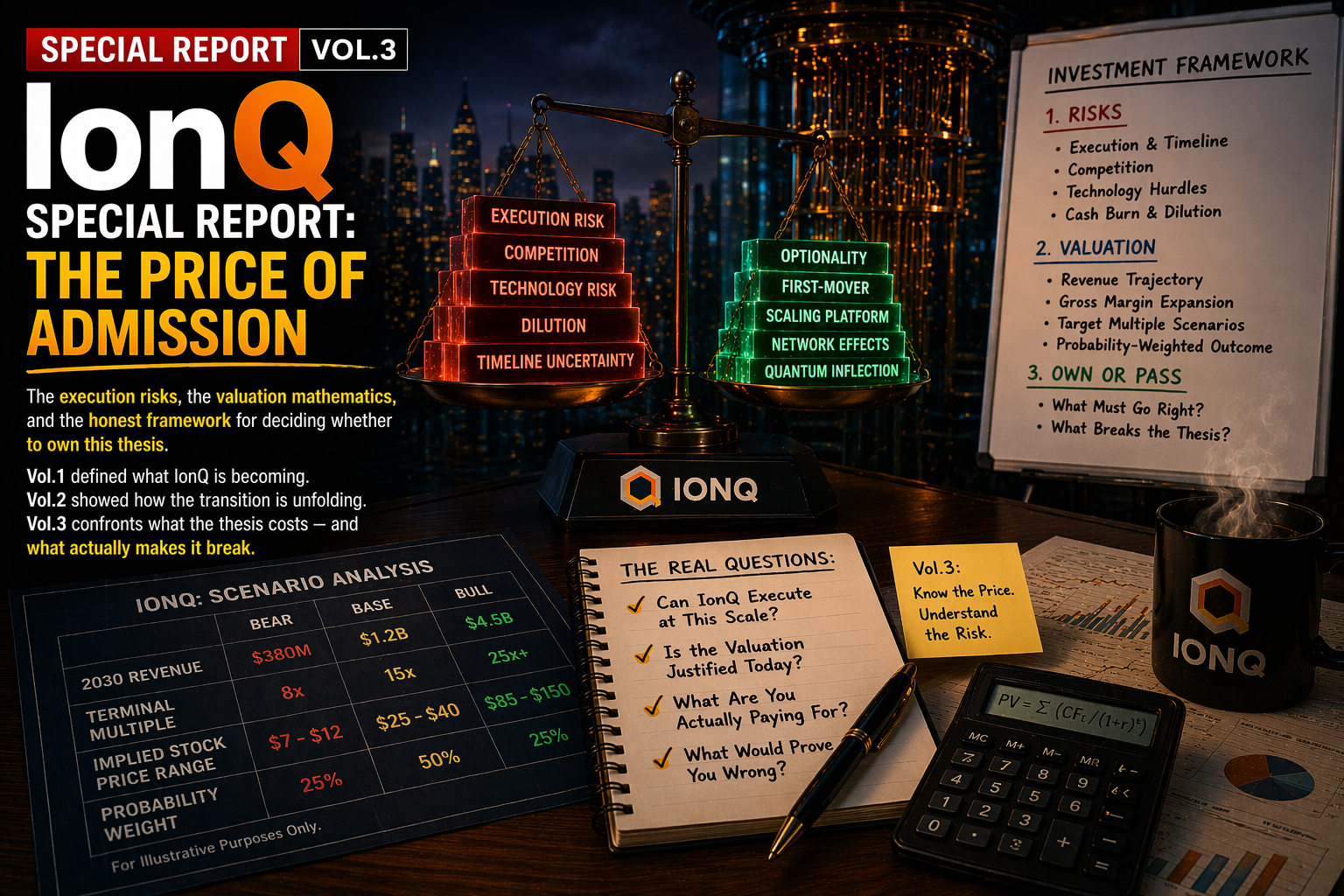
The execution risks, the valuation mathematics, and the honest framework for deciding whether to own this thesis. Vol.1 defined what IonQ is becoming. Vol.2 showed how the transition is unfolding. Vol.3 confronts what the thesis costs — and what actually makes it break.
The Setup
Vol.1 answered: "What is IonQ becoming?"
Answer: a platform company in transition, not a hardware vendor.
Vol.2 answered: "How is the transition mechanically happening?"
Answer: through four reinforcing mechanisms — vertical integration, modular architecture, commercial customer transition, and sovereign procurement.
Vol.3 asks the hardest question:
> "Assume the transition is real. Now what does it cost to own this thesis, and what could break it?"
This is where most bullish coverage fails. It describes the thesis, then stops. It does not take the bear case seriously. It does not confront valuation math honestly. It does not tell investors how to size a position appropriate to the risk.
Good analysis is not about finding reasons to buy. It is about understanding what must be true for the investment to succeed, and what it would mean if those conditions fail.
Vol.3 does that work.
Part 1: The Bear Case, Honestly
The bear case on IonQ is not "quantum computing is fake." That argument was stronger five years ago. The scientific reality of trapped-ion quantum systems at 99.99% two-qubit fidelity, operational 100-qubit commercial deployments, and validated photonic interconnect is too concrete for that dismissal.
The real bear case is more sophisticated. It has five parts.
Bear Case 1: The Valuation Already Prices Much of the Success
Markets do not price reality. They price expectations. When a stock trades at a market capitalization multiple of trailing revenue in the high double-digits to triple-digits, it is not betting on the current business. It is betting on the expected outcome over a multi-year horizon.
IonQ's current market cap relative to 2025 revenue reflects significant forward optimism. That optimism is not unjustified — the growth rate, commercial mix shift, and strategic moves support elevated expectations. But expectations that are already priced create an asymmetric risk profile.
When expectations are elevated, the risk of disappointment increases even if execution remains on track. A company delivering 70% of its announced roadmap may be objectively successful. If the stock had priced in 100% delivery, the stock still falls despite the success.
The honest framing: IonQ is not priced to be mediocre. It is priced to be transformative. Any scenario short of transformative will be punished.
Bear Case 2: Quantum Timelines Remain Fundamentally Long
Even the most optimistic roadmaps envision major commercial quantum breakthroughs years in the future. IonQ's own roadmap targets:
- 256-qubit operational system: Q4 2026
- 200,000-qubit QPU functional testing: 2028
- 2,000,000-qubit system: late 2020s / early 2030s
The biggest commercial inflection points are 2–5+ years out.
That time horizon creates two problems:
First, patient capital is rare. Most investors — retail and institutional — do not psychologically tolerate holding positions through multiple years of operating losses and milestone delays. IonQ's 2026 adjusted EBITDA guidance of -$310M to -$330M means the company will burn through significant cash reaching its roadmap milestones. Even with $3.3B in cash and investments, investors watching quarterly losses pile up will face emotional pressure to sell.
Second, roadmaps slip. Every major quantum player has missed announced timelines at some point — IBM, Google, Rigetti, IonQ itself on earlier milestones. A six-month delay that would be routine in other industries can shake investor conviction significantly in a high-expectation name.
The investors most likely to be disappointed by IonQ are not the ones who are wrong about the thesis. They are the ones who correctly identify the thesis but underestimate the holding period required to realize it.
Bear Case 3: Strategic Acquisition Integration Risk
Vertical integration through M&A is strategically sound and operationally difficult. This is one of the most reliably difficult challenges in corporate strategy.
IonQ is integrating: Oxford Ionics (completed 2025), Capella Space (2025), Vector Atomic (2025), Skyloom Global (2025), SkyWater Technology ($1.8B, pending close), and prior Lightsynq and quantum networking acquisitions.
Each deal adds integration risk. Each requires: aligning technical roadmaps, retaining key personnel from acquired companies, integrating financial and operational systems, managing cultural differences, and avoiding strategic confusion across layered acquisitions.
Most large M&A programs underdeliver their announced synergies. The reason is not that executives lack intelligence. It is that integration is harder than planning it looks.
If even one major integration fails — SkyWater in particular, given its size and strategic importance — the platform thesis weakens materially.
Bear Case 4: Platform Economics Remain Unproven
IonQ is not yet demonstrating platform-style margins, network effects, or lock-in in financial statements.
The platform framing is a thesis about the future, not a current fact. Until investors see: multi-year customer retention data across upgrade cycles, upgrade revenue from existing customers as a distinct line item, customer spending growth over time (net dollar retention > 100%), ecosystem revenue from third-party developers or partners, and margin expansion consistent with platform dynamics —
"Platform company" is a narrative the market is pricing rather than an economic reality operators are reporting.
This does not mean the platform thesis is wrong. It means the thesis is not yet financially visible. Investors are paying a premium for a future outcome, not for proven platform economics.
If the platform economics fail to materialize in financial statements over the next 2–4 years, the multiple compresses — regardless of how well the underlying business performs.
Bear Case 5: Competition Is Not Static
IBM, Google, Microsoft, Amazon, and well-funded private companies (PsiQuantum, Quantinuum, Atom Computing, Infleqtion, Pasqal, QuEra) are all executing their own quantum strategies.
Trapped-ion is not architecturally unique to IonQ. Quantinuum (privately held, Honeywell spinoff) is a direct trapped-ion competitor with arguably stronger technical credentials in some areas.
A trapped-ion bet is not a trapped-ion monopoly bet.
The winner of the quantum era is not necessarily the company with the best architecture. It may be the company that combines adequate architecture with the best ecosystem, the strongest sales motion, or the most entrenched government relationships.
The Honest Composite Bear Case
Each individual risk is manageable. The compound risk is not trivial.
A realistic bear scenario: SkyWater integration takes longer than expected, quantum roadmap milestones slip by 12–24 months, Quantinuum goes public in 2027 at a valuation that compresses IonQ's premium, commercial revenue growth slows from triple-digit to mid-double-digit rates, and the market reprices IonQ against less transformative outcomes.
In that scenario, the stock can decline 50–70% from current levels despite the platform thesis remaining partially intact. That is the actual risk. Not "quantum is fake." Not "IonQ goes to zero." The risk is that the thesis becomes mostly right but the stock still underperforms significantly for multiple years while the market waits for financial validation.
Investors who cannot psychologically survive that scenario should not own the stock at this valuation, regardless of how attractive the long-term thesis appears.
Part 2: The Valuation Framework, Honestly
Hardware Framework vs. Platform Framework
As established in Vol.1, the same stock can look "expensive" or "reasonable" depending on which valuation framework is applied.
Hardware framework:
- Apply 4–10x revenue multiple to trailing or forward sales
- On ~$130M trailing revenue → $520M–$1.3B market cap justified
- Current market cap substantially above either range
Platform framework:
- Apply 15–40x revenue multiple reflecting platform economics and growth
- Compare against high-growth platform companies at similar inflection points
- Factor in TAM expansion from multi-layer strategy
- Factor in RPO trajectory and multi-year customer commitments
- Factor in optionality value of eventual scaling milestones
- Current market cap defensible under aggressive platform assumptions
Neither framework is "correct." The honest answer is: the market is currently pricing IonQ somewhere between hardware and platform frameworks, weighted toward platform. That weighting moves based on execution — stronger milestones shift the weighting toward platform, delays shift it toward hardware.
What "Priced for Transformation" Actually Means
"Priced for transformation" means:
1. The implied TAM in the current market cap is much larger than trailing addressable revenue
2. The implied growth trajectory requires sustained triple-digit growth for multiple years
3. The implied margin structure assumes eventual platform-like gross margins (70%+)
4. The implied competitive position assumes durable market share in a category that doesn't fully exist yet
These are not impossible assumptions. They are aggressive assumptions. For them to hold, every significant piece of the thesis must execute reasonably well.
If execution stays on track, the current valuation can be justified in retrospect. If execution stalls, the current valuation looks like the market overpaying for a narrative.
The Optionality Value Nobody Prices
There is one valuation factor that standard frameworks struggle to capture: the optionality value of adjacent market expansion.
IonQ's four-layer platform strategy creates optionality across: quantum computing (the core market), quantum networking (potentially larger over time), quantum security (already commercial, growing rapidly), and quantum sensing (near-term commercial, adjacent defense applications).
A traditional discounted cash flow model based on the computing business alone misses the option value of the other three layers. The market appears to be pricing some of this optionality already. Whether it is pricing too much or too little is the central valuation debate.
Part 3: The Position Sizing Framework
Position sizing is the most important portfolio decision and the one retail investors think about least.
A great thesis with too-large position sizing produces bankruptcy. A mediocre thesis with correct position sizing produces only proportional losses.
IonQ is a high-conviction, high-variance position. That is not a contradiction. It is a specific risk profile requiring specific portfolio treatment.
The Kelly Criterion Framing
When a position has high variance, size it smaller than your conviction suggests.
Not because you doubt the thesis. Because variance can destroy you before the thesis plays out.
For IonQ specifically: if you have 70% conviction the thesis is correct, and 30% chance it underperforms significantly (50–70% drawdown scenario), the math says size smaller than pure conviction would suggest.
This is not a reason to avoid the stock. It is a reason to size it such that the downside scenario does not compromise the rest of your portfolio.
Three Sizing Tiers
Conservative tier (0.5%–2% of portfolio):
- Appropriate for investors who find the thesis intellectually compelling but uncertain about timing
- Small enough that a 70% drawdown is tolerable
- Large enough to matter if the thesis plays out
- Allows adding on significant pullbacks without exceeding comfortable total exposure
Moderate tier (2%–5% of portfolio):
- Appropriate for investors with high conviction on the platform thesis and multi-year holding period
- Requires emotional discipline to hold through volatility
- Still sized such that portfolio can absorb worst-case drawdown without compromising long-term compounding
Aggressive tier (5%+ of portfolio):
- Appropriate only for investors who deeply understand both the thesis and the risks
- Requires explicit acceptance that the position can halve
- Should be paired with explicit plans for handling major drawdowns without panic selling
- Generally inappropriate for retirement portfolios or capital that cannot tolerate extended volatility
The honest framing: Most investors should not size IonQ above 2–3% of portfolio, regardless of conviction. The risk profile does not justify concentration even when the thesis is correct.
The Compounding Argument for Smaller Sizing
If a position has the potential to 5x or 10x over 5–7 years, you do not need large initial sizing to make the outcome meaningful. A 2% position that 5x becomes 10% of portfolio — a significant contributor without requiring the initial concentration.
Smaller initial sizing with higher potential returns often produces better risk-adjusted outcomes than larger sizing with the same potential. The math favors patience and position sizing discipline, even for investors with high conviction.
Part 4: The Signals That Actually Matter
Investors who own IonQ should not be watching daily price action. They should be watching the underlying variables that determine whether the thesis is executing.
Tier 1: Deal-Defining Signals (Binary Events)
SkyWater acquisition closes. Binary event. If it closes, vertical integration thesis advances. If it fails regulatory or shareholder approval, the platform thesis weakens substantially. Target close: 2026.
Major roadmap milestones hit or miss. 256-qubit operational system in Q4 2026 is the nearest major milestone. Hitting it validates the execution trajectory. Missing it by more than one quarter signals pace problems.
Key personnel retention, especially de Masi. The CEO is integral to the current execution pace. Departure would be a major negative catalyst.
Tier 2: Trajectory Signals (Quarterly Data)
Revenue composition. Commercial mix should stay above 60%. International mix should stay above 30%. If either ratio reverses meaningfully, the commercial transition is stalling.
RPO trajectory. RPO should continue growing faster than revenue. If RPO growth slows relative to revenue, customer commitments are weakening.
Gross margin direction. Hardware companies have limited margin expansion. Platform companies typically show gradual margin improvement. Margin trajectory is an early signal of whether platform economics are emerging.
Adjusted EBITDA trajectory. 2026 guidance is significant loss expansion. By 2028–2030, losses should be narrowing. If they are not, cash burn becomes a concern.
Tier 3: Ecosystem Signals (Slower-Moving Indicators)
New sovereign or major institutional contracts. Each new national-scale commitment (beyond Korea, UK, Switzerland, Japan, Singapore) strengthens the platform standard thesis.
Third-party development on IonQ systems. Platform economics require ecosystem — software, applications, integrations built by parties other than IonQ itself.
Competitive dynamics. Quantinuum going public would compress IonQ's premium. Major IBM quantum commercial wins would validate the ecosystem counter-argument.
What NOT to Watch
Daily or weekly price action. Noise in a multi-year thesis.
Analyst upgrades and downgrades. Backward-looking in most cases.
Quantum hype cycles. IonQ's value is not determined by whether quantum is in or out of favor in retail sentiment.
Part 5: The Framework for Deciding
Step 1: Verify Your Category
Before anything else, confirm your own analytical framework:
- Are you evaluating IonQ as a hardware company? → The stock looks expensive. Most of Vol.1 explains why this framework may be wrong.
- Are you evaluating IonQ as a platform company in transition? → The stock's valuation becomes debatable rather than obviously expensive. Vol.2 documents the transition mechanics.
- Are you evaluating IonQ as a speculative technology bet without a clear framework? → Stop. Do the categorical work before making the investment decision.
Most analytical errors begin with using the wrong category.
Step 2: Stress-Test the Platform Thesis
If you have decided the platform framework is correct, stress-test it with specific questions:
1. Do I believe vertical integration through SkyWater will succeed post-close?
2. Do I believe modular photonic architecture will scale to production in 3–5 years?
3. Do I believe the commercial customer transition is durable, not cyclical?
4. Do I believe global sovereign procurement will continue expanding?
5. Do I believe de Masi will continue executing at current pace?
If you believe 4+ of these, the platform thesis is intact for you.
If you believe 3 or fewer, the thesis is partial for you.
If you believe 2 or fewer, the thesis is broken for you.
Your count determines whether you should own the stock at all, and at what size.
Step 3: Apply the Risk Framework
Match position size to thesis strength:
- Believe 5/5 stress-test questions? → Upper range of your personal sizing comfort (still not more than 5% for most investors)
- Believe 4/5? → Middle range
- Believe 3/5? → Minimum position or pass
- Believe 2 or fewer? → Do not own this stock
Step 4: Define Your Break Conditions
Before buying, decide what would invalidate your thesis. Specifically:
- What specific event would cause you to sell entirely?
- What specific event would cause you to reduce position?
- What specific event would cause you to add to position?
Writing these down before buying reduces emotional selling during volatility.
For IonQ specifically: SkyWater deal failure → significant thesis damage. de Masi departure → re-evaluate immediately. Quantum roadmap slip of 12+ months → thesis pace concern. Commercial mix reversal below 50% → commercial transition concern. Major trapped-ion competitor going public at premium valuation → competitive pressure.
Write your own break conditions. They will be specific to your interpretation of the thesis.
The Final Brutal Edge Framework
IonQ is not a stock for most investors. That is not a criticism. It is a category statement.
The combination of: multi-year holding period required, significant near-term cash burn, high valuation relative to current financials, execution risk across multiple simultaneous initiatives, binary dependencies on specific deal closes and milestones, and competitive pressure from well-funded alternatives — creates a risk profile that requires specific psychological tolerance and portfolio construction.
Investors who should consider IonQ:
- Have multi-year holding periods and can tolerate extended volatility
- Understand the platform thesis, not just "quantum is cool"
- Can size positions correctly relative to risk
- Will not panic-sell during major drawdowns
- Have portfolios sufficiently diversified that this position is non-critical
Investors who should avoid IonQ:
- Have short time horizons (under 3 years)
- Cannot emotionally tolerate 50%+ drawdowns
- Are investing money they may need for other purposes
- Would size aggressively based on conviction alone
- Do not fully understand the platform thesis
Neither category is "correct." They are descriptions of different investors with different needs.
The Brutal Edge honest view: IonQ is one of the most intellectually interesting investment cases in public technology markets right now. That does not automatically mean it belongs in every portfolio. Intellectual interest and appropriate ownership are different standards.
The Complete Series Synthesis
Vol.1: IonQ must be re-categorized. It is no longer a hardware company. The market's persistent hardware framing is the single biggest analytical error, and correcting it is the first step in understanding the investment.
Vol.2: The platform transition is not aspirational. It is mechanically unfolding through four reinforcing mechanisms — vertical integration, modular architecture, commercial customer transition, and global sovereign procurement. The evidence is concrete and trackable.
Vol.3: The transition is real. The thesis is priced aggressively. The execution risks are non-trivial. Position sizing matters more than conviction. The investor's job is not to decide whether IonQ succeeds — it is to decide whether the probability of success, discounted by execution risk and time horizon, justifies the current price at an appropriate position size.
That is the complete framework.
The Series One-Line Synthesis
> "IonQ is not a bet on whether quantum computing wins. It is a bet on whether a specific company can complete a specific platform transition at a specific pace — before the execution risk, the competition, or the market's patience catches up with its valuation. That bet has real upside. It also has real downside. The correct position size is smaller than pure conviction would suggest. Everything else is ego dressed as analysis."
What to Watch Going Forward
Immediate term (next 3–6 months):
- SkyWater regulatory approval progress
- Q1 and Q2 2026 earnings — commercial mix, RPO, operational metrics
- Additional sovereign procurement announcements
Medium term (6–18 months):
- SkyWater close and initial integration signals
- 256-qubit operational demonstration
- Third-party ecosystem development around IonQ platform
- Competitive dynamics (Quantinuum IPO speculation, IBM roadmap execution)
Long term (18–36 months):
- Financial validation of platform economics (margin expansion, retention data, upgrade revenue)
- Multiple sovereign-scale contracts converting from single-system deals to multi-generation commitments
- Progress toward 200,000-qubit functional testing milestone
These are the signals that matter. Everything else is noise.
Related Reading
- IonQ Special Report Vol.1: The Re-Categorization
- IonQ Special Report Vol.2: The Vertical Integration Bet
- The Structural View Vol.1: Palantir vs Anthropic
- The Mental Game #001: Why Bull Markets Make You Worse at Investing
- The Mental Game #002: How to Survive an AI Bubble
For informational and educational purposes only. Not investment advice. The author has no position in any security mentioned. Always conduct your own research. Quantum computing investments carry exceptional execution, technical, and timeline risk. Position sizing should reflect that risk. Readers should consult qualified financial advisors before making investment decisions.
For the edge that cuts through the noise — Brutal Edge.
Share your analysis
Keep it data-driven. No investment advice.
- Keep it data-driven and respectful
- No investment advice (buy / sell / hold)
- No spam, promotion, or solicitation
- No profanity or offensive content
- Violations are automatically removed
Data: Financial Modeling Prep, Alpha Vantage, CoinGecko
NOT investment advice. Always do your own research.