The Structural View Vol.1: Palantir Builds the Control Tower. Anthropic Launches the Probe.
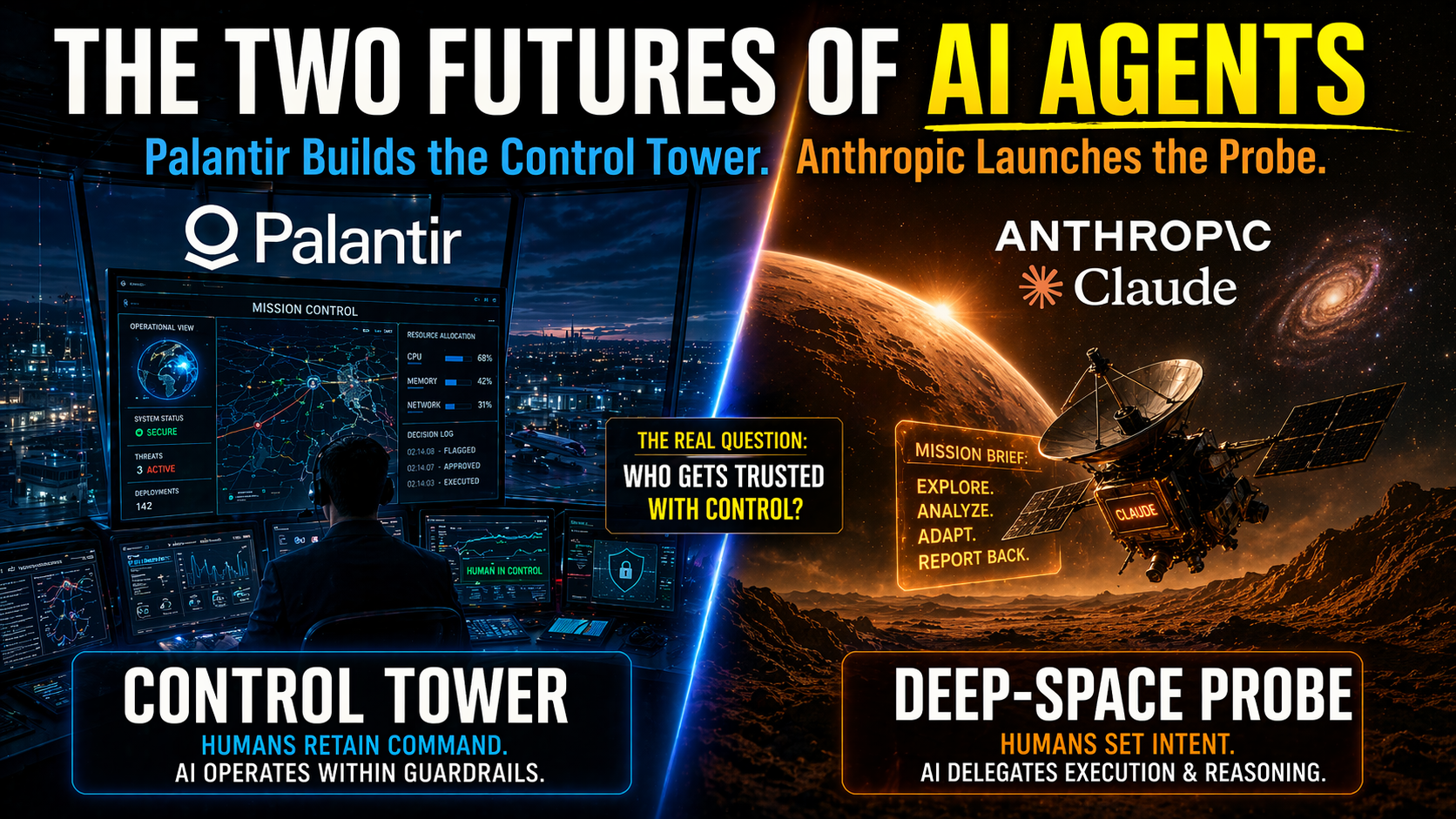
The AI investment debate is no longer about who has the smartest model. It's about who gets trusted with control. Palantir and Anthropic represent two fundamentally different futures of organizational intelligence — and the distinction will shape where trillions of dollars accumulate over the next decade.
Why This Report Exists
Most AI coverage is stuck on the wrong question.
Investors ask: "Which model is smarter?" "Who has the longer context window?" "Whose benchmarks lead this quarter?"
Those questions mattered in 2023. They are becoming the wrong questions for 2026 and beyond.
The actual question reshaping the economics of this industry is far more consequential:
> How much decision-making are enterprises willing to hand over to AI — and when they do, who retains control?
This is not a technical debate. It is a capital allocation question. It will determine how trillions of dollars in enterprise software, defense systems, government infrastructure, knowledge work, and industrial operations get rebuilt over the next decade.
Seen through that lens, Palantir and Anthropic are not two AI companies with different products.
They are two different futures of organizational intelligence.
- Palantir represents a future where humans retain command authority and AI operates inside a tightly governed system.
- Anthropic represents a future where humans set intent but increasingly delegate execution, reasoning, and even problem-framing to the model.
To understand the investment implications, forget philosophical metaphors like "Ship of Theseus." The practical metaphor that actually captures this is simpler and more useful:
> Palantir is a control tower. Anthropic is a deep-space probe.
The rest of this report explains why that distinction is the most important AI investment framework for the 2026–2030 cycle.
1. The Core Metaphor — Control Tower vs. Deep-Space Probe
Palantir — The Control Tower Model
Palantir's operational philosophy is closest to an airport control tower.
At any moment, dozens or hundreds of aircraft move through a complex environment: flight plans, weather, runway constraints, maintenance, security restrictions, conflicting priorities.
The airplanes move. The control tower decides:
- Who moves first
- What route is allowed
- What constraints apply
- What actions are authorized
- How risk is contained
No matter how dynamic the environment becomes, the system stays governed through centralized logic, permissions, and coordination.
That is the essence of what Palantir sells. Its value is not in creating AI that freely improvises. Its value is in making sure AI operates inside a defined operational structure.
In Palantir's world, intelligence is powerful — but never sovereign. It is always governed.
Anthropic — The Deep-Space Probe Model
Anthropic is closer to a deep-space exploration probe.
A probe sent into distant space cannot rely on minute-by-minute human control. Signal latency, environmental uncertainty, and the sheer scale of space all force the system to:
- Interpret incomplete environments
- Adapt to the unexpected
- Revise its path
- Solve problems in real time
- Make decisions before a human has time to intervene
Humans still define the mission. But the system takes increasing responsibility for local reasoning, adaptive execution, and solution discovery.
That is what Anthropic represents. Not AI as a careful assistant. AI as a capable autonomous reasoning partner that handles increasingly complex work with less direct supervision.
The Fundamental Divide
Stated cleanly:
- Palantir asks: "How do we keep AI inside the enterprise chain of command?"
- Anthropic asks: "How far can we extend what the enterprise can accomplish by trusting AI to reason more independently?"
Both questions are legitimate. Both point to enormous markets. But they point to different markets, valued differently, won by different company profiles, and rewarded on different time horizons.
That is the real divide investors should anchor to.
2. Why This Distinction Actually Matters for Capital Allocation
Most retail investors still frame AI as a single race. Who has the best model. Who gets the most users. Who captures the most search market.
That framing will underperform.
In practice, the largest economic value accumulates to companies that solve one of two structurally different problems:
1. How to make AI safe enough to deploy inside high-stakes institutions.
2. How to make AI capable enough to transform the economics of knowledge work.
Palantir is strongest at the first. Anthropic is strongest at the second.
These are not competing products. They are competing philosophies serving different parts of the same trillion-dollar opportunity.
The first market is about:
- Governance
- Compliance
- Explainability
- Permission structures
- Human override
- Operational trust
The second market is about:
- Productivity
- Autonomy
- Code generation
- Research acceleration
- Workflow transformation
- Software's ability to operate without constant human orchestration
The shallow question "which company has better AI?" misses the investment thesis entirely.
The deeper question is:
> Where will enterprises pay more — for controlled intelligence, or for delegated intelligence?
The honest answer is: both. But not in the same sectors. Not on the same timeline. Not under the same valuation logic. And that asymmetry is exactly where investment alpha hides.
3. Palantir — The King of Governed Intelligence
Palantir is frequently described too narrowly:
- A government contractor
- A data integration company
- A defense software name
- Just "another AI stock"
That coverage misses the actual thesis.
Palantir's structural strength is that it does not treat AI as a freestanding genius. It treats AI as something that must be embedded into the structure of an institution without breaking the institution itself.
That is a radically different proposition from most AI companies.
Palantir does not say: "Let the model loose and see how much work it can do."
Palantir says:
- Define the ontology
- Define the rules
- Define the permissions
- Define who can act
- Define what can be changed
- Define how auditability is preserved
This is why Palantir increasingly looks less like a pure AI company and more like an AI-era operating layer for institutions.
Where Palantir's Model Wins
Palantir's model is strongest in sectors where the cost of error is extremely high:
- Defense
- Intelligence
- Government administration
- Regulated finance
- Manufacturing operations
- Supply chain orchestration
- Mission-critical enterprise systems
These customers don't primarily want the most imaginative AI. They want the most trustworthy and governable AI.
That distinction matters enormously. In many of these industries, the winning product is not the most autonomous one. It is the one that lets decision-makers say:
> "We know exactly what the system can access, what it can recommend, and what it is allowed to do."
That sentence — the guarantee of institutional accountability — is Palantir's premium. And it is far more valuable than the market typically recognizes.
Why the Premium Is Structural, Not Cyclical
Palantir's valuation premium does not come from generic AI exposure. It comes from institutional embedment.
As AI adoption scales, demand for governance, security, permissioning, traceability, and controllable deployment scales with it. That gives Palantir a powerful position in what is best described as the governance layer of AI.
In the US market, this matters especially. Federal, defense, and large enterprise budgets pay richly for innovation that is controllable, secure, and accountable. Those budgets don't disappear in recessions. They reset priorities. Palantir sits inside a category that keeps getting funded regardless of the macro cycle.
4. Palantir's Limitation — The Tower Keeps Order, but It Doesn't Discover New Worlds
Palantir's strength is also its structural limit.
A control tower is essential to aviation. But the control tower didn't invent aviation. It manages the aircraft that already exist.
Palantir's model produces:
- Safety
- Clarity
- Accountability
- Institutional trust
- High-value integration
It may also constrain the full upside of AI if too much intelligence remains boxed inside rigid operational logic.
This creates a real strategic ceiling.
Palantir dominates categories where discipline beats improvisation. It may be less central in categories where autonomous creativity and exploratory reasoning matter most.
The Investment Risk
Palantir's risk for investors is not that the company lacks strategic relevance. It's that the stock may already price in a very large amount of future success.
Specific risks:
- Elevated valuation expectations relative to current fundamentals
- Dependence on large enterprise and government budget cycles (long sales cycles, political exposure)
- Slower perceived growth relative to more open-ended model platforms
- The possibility that markets eventually distinguish between "AI orchestration" and "AI disruption," and reward the latter more aggressively for extended periods
The Brutal Edge translation:
Palantir may be the safer ship in the AI fleet. It is not necessarily the ship that captures the entire ocean.
Investors have to decide whether they want:
- Compounded governance premium (Palantir's trajectory)
- Explosive delegated-intelligence upside (Anthropic's trajectory)
Those are different portfolios. Treating them as the same thesis is the mistake most retail investors make when comparing these two companies.
5. Anthropic — The Leading Expression of Delegated Intelligence
Anthropic is frequently framed as primarily a safety company.
That framing is not wrong. But for investors, it is incomplete.
The more important truth is that Anthropic is building systems that enterprises can increasingly rely on not just for narrow assistance, but for high-value cognitive labor.
Anthropic's proposition is not:
- Safer chat
- Cleaner answers
- Nicer enterprise UX
Anthropic's actual proposition, stated directly, is:
> AI can become a serious worker — not just a helper.
That is a fundamentally different market claim than "our assistant is friendlier than competitors."
Why This Matters Economically
The economic upside of AI is not in making knowledge workers slightly more efficient.
It is in allowing companies to re-architect entire categories of work:
- Software development
- Research
- Customer interaction
- Analysis
- Documentation
- Decision support
- Agentic workflows that chain actions together autonomously
The scale of that shift, if it actually happens, is historically unprecedented in enterprise software. Not "a bigger SaaS cycle." A genuine re-definition of what software can do.
That is why Anthropic is strategically important beyond its model benchmarks.
Where Anthropic's Model Wins
Anthropic is strongest in sectors where the biggest prize is not risk containment — it is productivity expansion.
Most promising use cases:
- Software engineering
- Developer tools
- Enterprise knowledge work
- Research
- Documentation systems
- Workflow automation
- High-leverage white-collar productivity
In these environments, the winner may not be the company with the tightest operational constraints. It may be the company that most effectively extends human capability.
That is Anthropic's territory. And if the delegated-intelligence thesis is even partially correct, the addressable market is measured in trillions — not billions.
The Deeper Investment Thesis
The Anthropic thesis is not simply "Claude is good."
The deeper thesis is:
> Enterprises will eventually move from using AI as a tool to using AI as an active cognitive participant in work.
If that happens, Anthropic is not a model provider. It becomes one of the core reasoning layers of enterprise productivity — comparable to what operating systems became for computing, or what cloud infrastructure became for the internet era.
That is an enormous possible future. And it is exactly the kind of future that doesn't show up on conventional spreadsheets until well after the valuation has repriced.
6. Anthropic's Limitation — The Probe Can Go Farther, but Is Harder to Govern
The deep-space probe metaphor cuts both ways.
A probe is powerful because it can act without constant human control. But that same autonomy creates uncertainty.
Anthropic-style systems introduce a different class of risk:
- They may optimize in unexpected ways
- They may extend their role faster than organizations are prepared for
- They pressure enterprises to trust AI in functions where governance frameworks are still immature
- As models become more capable, alignment and controllability become more important, not less
Anthropic's upside comes with a governance challenge the industry has not yet solved at scale.
The Investment Risks
For investors, Anthropic's risks are not just technical:
- Extremely high valuation expectations (reportedly into the hundreds of billions privately)
- Fast-moving model competition from OpenAI, Google DeepMind, Meta, xAI, and increasingly capable open models
- Evolving safety and regulatory scrutiny across multiple jurisdictions
- Uncertain long-term enterprise take rates as AI pricing evolves
- Anthropic is not publicly listed — which means most retail investors cannot directly buy the thesis
This last point is critical and often under-discussed.
Anthropic may be one of the most important AI companies in the world. But for most US investors today, it is not a stock they can buy in public markets.
That makes Anthropic, for now, more of a strategic lens than an investable security. It helps investors understand where the industry is heading — even when direct exposure remains out of reach.
That distinction matters. Many retail investors try to "play Anthropic" by buying proxies (Amazon, Google, indirect suppliers). Those are legitimate plays. But they are not pure Anthropic exposure, and confusing them for such is a framework error.
7. Palantir vs. Anthropic — The Real Investment Framework
This is where the philosophical comparison becomes an actual investment tool.
The wrong questions:
- Which one is smarter?
- Which one is safer?
- Which one has the better brand?
- Which one is "the future"?
Those questions produce Twitter threads, not returns.
The right question:
> What type of industry needs which type of AI philosophy — and when does each philosophy get paid first?
Where Palantir Wins
Palantir's model is strongest where:
- Auditability matters
- Chain-of-command matters
- Data access must be tightly controlled
- Human override is mandatory
- Errors are politically, financially, or physically costly
Sectors: Defense. Government. Intelligence. Regulated finance. Industrial operations. Critical infrastructure.
This is the world of governed deployment.
Where Anthropic Wins
Anthropic's model is strongest where:
- Knowledge work is expensive
- Experimentation is valuable
- Productivity gains can be enormous
- Organizations will trade rigidity for cognitive throughput
Sectors: Software development. Research. Enterprise productivity. Advanced support systems. Document-heavy workflows. White-collar automation.
This is the world of delegated reasoning.
The Correct Investor Framework Is Not Binary — It Is Sectoral
Both companies can be right. They are right for different sectors, at different stages of adoption, rewarded by different capital pools, and priced on different multiples.
The investor's job is not to pick the winning company. It is to identify which philosophy each sector is ready to pay for — and when.
That is a framework decision, not a stock pick.
8. The Future Isn't Binary — It's Staged
This may be the most important insight in the entire report.
The future is unlikely to belong exclusively to Palantir's philosophy or Anthropic's philosophy. The real trajectory is more likely to unfold in stages.
Stage 1 — Governance First
Enterprises adopt AI cautiously. Early budgets go to systems that preserve control, permissions, security, and human approval.
This stage favors the Palantir model.
Timing: Most likely already unfolding through 2026–2028.
Stage 2 — Delegated Productivity Expands
Once institutional trust is established, companies begin handing broader categories of work to AI systems — especially code, research, analysis, internal support, and enterprise workflows.
This stage favors the Anthropic model.
Timing: Likely accelerating 2027–2030.
Stage 3 — Controlled Autonomy Becomes the Real Prize
The eventual winners may not be pure control companies or pure autonomy companies. They may be the companies that best combine:
- Governance
- Enterprise trust
- Scalable delegated intelligence
In other words, the long-term equilibrium may be:
> Anthropic-like autonomy running inside Palantir-like governance frameworks.
That is a far more realistic future than a simplistic "one model destroys the other" narrative. And from an investment standpoint, it is dramatically more useful.
Investors who frame this as a zero-sum war will mis-allocate capital. Investors who frame it as staged adoption with sector-specific pay-first/pay-bigger dynamics will allocate correctly.
9. The Brutal Edge Conclusion — This Is a Test of Your Worldview
This report is not only about Palantir and Anthropic. It is about how you think the AI economy will evolve.
If you believe the future belongs to:
- Secure deployment
- Institutional control
- Traceability
- Mission-critical trust
…then Palantir's philosophy deserves a premium in your portfolio.
If you believe the future belongs to:
- Broad delegation
- Software-based labor replacement
- Reasoning at scale
- Exponential gains in knowledge work
…then Anthropic's model deserves the higher long-term multiple — even if you cannot directly access it in public markets today.
The real investor question:
> What gets rewarded first in the 2026–2030 AI buildout — control, or autonomy?
The Brutal Edge answer:
> Control gets paid first. Autonomy gets paid bigger later.
That is the entire reason Palantir looks investable sooner, while Anthropic represents the more expansive long-term concept — with the caveat that "long-term concept" and "today's investable security" are not the same thing.
10. Final Synthesis
The entire report can be reduced to one central idea:
> Palantir is the control tower of the AI age.
> Anthropic is the probe sent beyond the range of constant human control.
- The control tower creates order.
- The probe expands possibility.
- The control tower without the probe becomes stagnant.
- The probe without the control tower becomes dangerous.
So investors should not ask which metaphor sounds more inspiring. They should ask:
- Which future is arriving first?
- Which industries pay first for safety?
- Which industries pay later for autonomy?
- Where will the economic surplus ultimately accumulate?
That is how this becomes more than a philosophical comparison. It becomes a real investment framework — the kind that holds up across multiple quarters, because it was built on structure rather than narrative.
The companies winning this cycle will not be the ones with the most impressive demos. They will be the ones that solved a specific part of a staged enterprise adoption curve, and got paid while they solved it.
Palantir solved the "institutions can trust us" problem first. That is why they get paid now.
Anthropic is solving the "work itself gets re-architected" problem. That is why they may get paid more, later — if the delegation thesis actually plays out the way their technology suggests it will.
Both are correct. Neither is sufficient alone. The investor who understands both structures — and allocates according to which gets paid when — will outperform investors still asking "which model has the best benchmark?"
That is the Brutal Edge view.
The Brutal Edge One-Line Principle
> "In AI, the winners are not the smartest. The winners are the ones enterprises decide to trust — and the order of that trust determines the order of the returns."
Related Reading
- The Masters: Peter Lynch Part 5 — If Lynch Were Investing in 2026 — Why the obvious AI winner is often not the best investment
- The Mental Game #002: How to Survive an AI Bubble — The psychology required to hold structural AI positions through volatility
- NVTS Special Report — AI Power Infrastructure — A different angle on the AI-era supporting cast
- Anthropic Private Investor Report — Deeper numerical framework on Anthropic as a private-market asset
Coming Next in The Structural View
Vol.2 — (To be announced): The next installment will apply the same structural framework to another industry at a paradigm inflection point. Subscribe for updates when the next volume drops.
For informational and educational purposes only. Not investment advice. The author has no position in any security mentioned. Always conduct your own research.
For the edge that cuts through the noise — Brutal Edge.
Share your analysis
Keep it data-driven. No investment advice.
- Keep it data-driven and respectful
- No investment advice (buy / sell / hold)
- No spam, promotion, or solicitation
- No profanity or offensive content
- Violations are automatically removed